This copy is for your personal, non-commercial use only. Distribution and use of this material are governed by our Subscriber Agreement and by copyright law. For non-personal use or to order multiple copies, please contact The Epoch Times Reprints.
(Left) President Donald Trump looks on aboard Air Force One during travel to Palm Beach, Fla., from Joint Base Andrews, Md., on Nov. 25, 2025. (Right) Venezuelan President Nicolas Maduro speaks at the Eurobuilding Hotel in Caracas on Nov. 14, 2025. Anna Rose Layden/Reuters; Federico Parra/AFP via Getty Images
Venezuelan authorities on Dec. 2 approved a migrant repatriation flight from the United States, resuming a practice that was paused after U.S. President Donald Trump said last week that the country’s airspace should be considered closed.
“The Aeronautic Authority of Venezuela has received a request from the government of the United States to restart migrant repatriation flights from that country to Venezuela,” the country’s transportation ministry said in a statement.
An Eastern Airlines flight flying from Phoenix was authorized to land at Maiquetia, near Caracas, the ministry added.
Previously, migrant flights conducted by U.S. Immigration and Customs Enforcement (ICE) had been conducted by the United States twice every week, bringing back Venezuelans who had either entered the U.S. illegally or received humanitarian parole or Temporary Protected Status (TPS) that was later revoked.
On Nov. 29, Trump said that Venezuela’s airspace should be considered closed.
In a post on Truth Social, Trump addressed “all Airlines, Pilots, Drug Dealers, and Human Traffickers,” telling them to “consider THE AIRSPACE ABOVE AND SURROUNDING VENEZUELA TO BE CLOSED IN ITS ENTIRETY.”
The warning follows a series of U.S. military actions and escalating tensions with Caracas over narcotics trafficking and security operations in the Caribbean.
Venezuela’s government condemned Trump’s comments on Nov. 29, describing them as a “colonialist threat” against the South American country’s sovereignty and incompatible with international law.
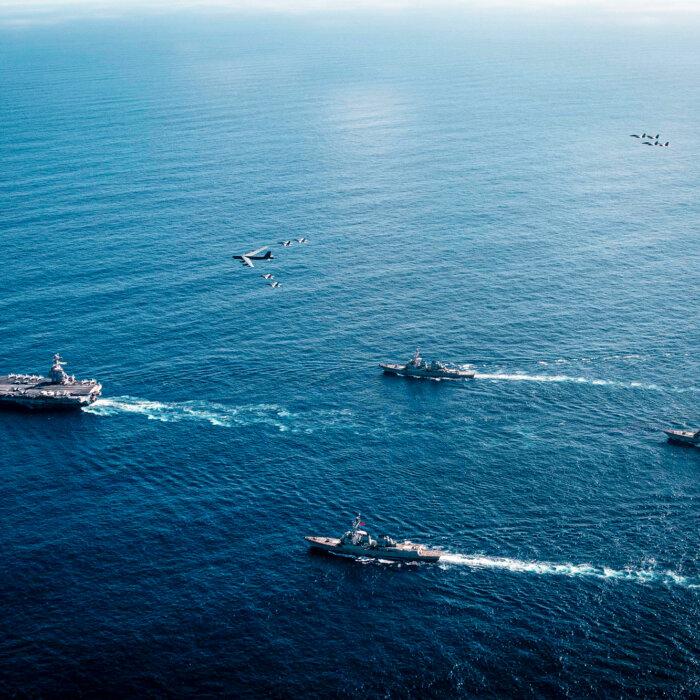
The United States has carried out at least 21 lethal strikes on suspected drug-smuggling vessels since September, killing more than 80 alleged traffickers aboard boats that U.S. officials say were ferrying narcotics northward. The USS Gerald R. Ford—the world’s largest aircraft carrier—arrived in the Caribbean on Nov. 16 to bolster the Pentagon’s counter-narcotics mission.
U.S. officials have also accused Venezuelan President Nicolas Maduro and other Venezuelan officials of backing drug cartels and their trafficking operations. The Venezuelan leaders have denied the allegations.
Venezuelan President Nicolas Maduro holds Simon Bolivar's sword as he addresses members of the armed forces, Bolivarian Militia, police, and civilians during a rally against a possible escalation of U.S. actions toward the country, at Fort Tiuna military base in Caracas, Venezuela, on Nov. 25, 2025. Leonardo Fernandez Viloria/Reuters
Last week, Trump signaled the possibility of expanded operations, telling U.S. troops on Nov. 27 that U.S. forces may soon conduct ground actions targeting drug-trafficking routes inside Venezuela. He praised the work of the Air Force’s 7th Bomb Wing in deterring maritime smuggling, saying traffickers have increasingly shifted away from sea routes.
“You probably noticed that people aren’t wanting to be delivering by sea, and we'll be starting to stop them by land also,” the president said. “The land is easier, but that’s going to start very soon. We’d warn them. Stop sending poison to our country.”
Shortly after Trump’s second inauguration, U.S. Special Presidential Envoy Richard Grenell traveled to Venezuela to meet Maduro and discuss bilateral relations between both countries. Maduro, a socialist and authoritarian leader, has long been regarded as hostile to the United States on questions of migration, crime, and its relations with Russia and China.
During Trump’s first term, in 2019, he recognized the president of the National Assembly of Venezuela, Juan Guaidó, as the interim president of the country instead of Maduro, alleging that the presidential election of 2018 was illegitimate.
Guaidó was subsequently recognized by many countries and even attended Trump’s State of the Union Address in 2020, but he never gained effective control over Venezuela.
Trump has said that he remains open to talks with Maduro.
“If we can save lives, we can do things the easy way, that’s fine,” Trump told reporters on Nov. 25. “And if we have to do it the hard way, that’s fine, too.”
Tom Ozimek and Reuters contributed to this report.
Arjun Singh was a reporter for The Epoch Times. He covered national politics, legal controversies, immigration, the U.S. Congress, and the Supreme Court of the United States.