U.S. and South Korean officials have clarified that workers can come to the United States under existing temporary visas, South Korea’s Ministry of Foreign Affairs said on Oct. 1.
Seoul said in a statement that the two countries would also establish new channels of cooperation for Korean investors, as well as for immigration enforcement.
The announcement followed the inaugural meeting of the bilateral U.S.–Republic of Korea Business Travel and Visa Working Group in Washington on Sept. 30.
On Sept. 4, federal officials entered a construction site in Bryan County, Georgia—where South Korean manufacturing companies Hyundai Motor Group and LG Energy Solution are building a $4.3 billion battery cell manufacturing plant—in the course of investigating unlawful employment practices, and detained hundreds of Korean nationals.
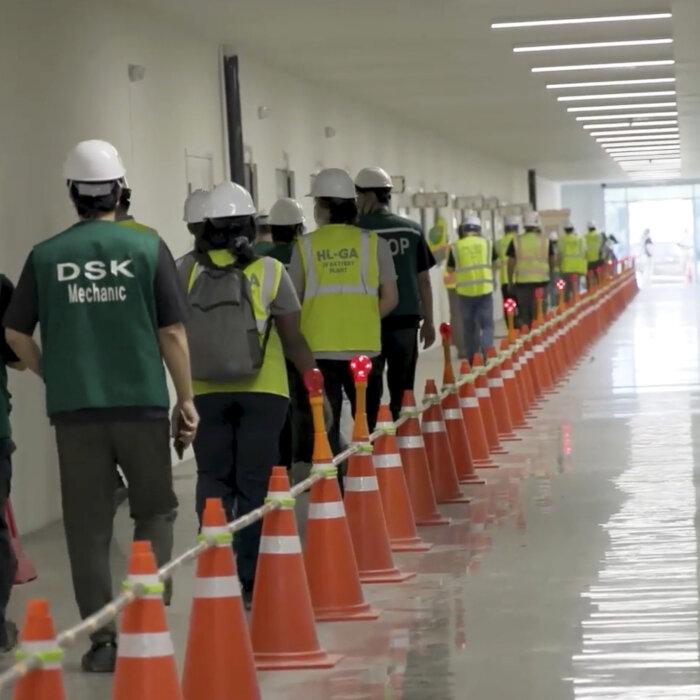
The Hyundai campus is one of Georgia’s largest economic development projects.
After the working group meeting, South Korea’s Ministry of Foreign Affairs said: “The two sides clarified the scope of activities permitted under the B-1 (temporary business) visa, in accordance with the needs of Korean companies.
“The U.S. side reaffirmed that B-1 visas may be used for activities such as installation, servicing, and repair of equipment purchased overseas as part of the investment process, and also confirmed that the same activities are permissible under ESTA as they are for B-1 visa holders.”
The ministry also said that the two partners agreed to establish the provisionally named “Korean Investor Desk” at the U.S. Embassy in Seoul, which is scheduled to open in October. The desk will act as a communication channel for South Korean companies that are investing in the United States and need advice on visas.
“Following the Korean side’s proposal to establish a cooperative framework between Korean diplomatic missions in the United States and U.S. immigration enforcement agencies, the two sides agreed to set up direct lines of contact and strengthen cooperation between Korean missions and branches of U.S. Immigration and Customs Enforcement (ICE) and Customs and Border Protection (CBP),” the ministry said.
Seoul added that it would be holding another working group meeting with Washington “as soon as possible” to discuss any other issues facing Korean companies looking to invest in the United States.
Investing in the US
Separately, the State Department said in a Sept. 30 statement that the United States government “is working closely with its Korean allies to advance the U.S.–ROK [Republic of Korea] trade and investment partnership, including by processing appropriate visas for qualified ROK visitors to continue investing in America, in compliance with U.S. laws.”The statement said that U.S. Deputy Secretary of State Christopher Landau, who delivered opening remarks at the meeting, highlighted South Korea as “one of the leading investors in the United States” and reaffirmed the country’s commitment to encouraging foreign investment, particularly from South Korea.
LG Energy Solution, which suspended work on its joint Georgia factory with Hyundai after the ICE operation, said on Oct. 1, “We are grateful for the government’s prompt support, and we will thoroughly prepare and work hard to normalise the construction and operation of our plants in the United States.”