Three dual Canadian-U.S. citizens are facing federal drug charges in the United States in connection with an international drug and gun smuggling operation along the Ontario-Quebec-New York border.
The U.S. Attorney’s Office announced this week that three people from the Akwesasne Mohawk Territory were arrested on July 30 as part of an investigation into a drug-trafficking operation that allegedly involved trading methamphetamine for firearms.
The First Nation is located along the St. Lawrence River, spanning southeastern Ontario, southwestern Quebec, and northern New York State, and functions as a single unified community despite being divided by these borders.
The arrests were the result of a joint investigation by American, Canadian, and tribal law enforcement into suspected cross-border drug trafficking activity operating through Akwesasne, according to an Aug. 3 press release from the U.S. Attorney’s Office.
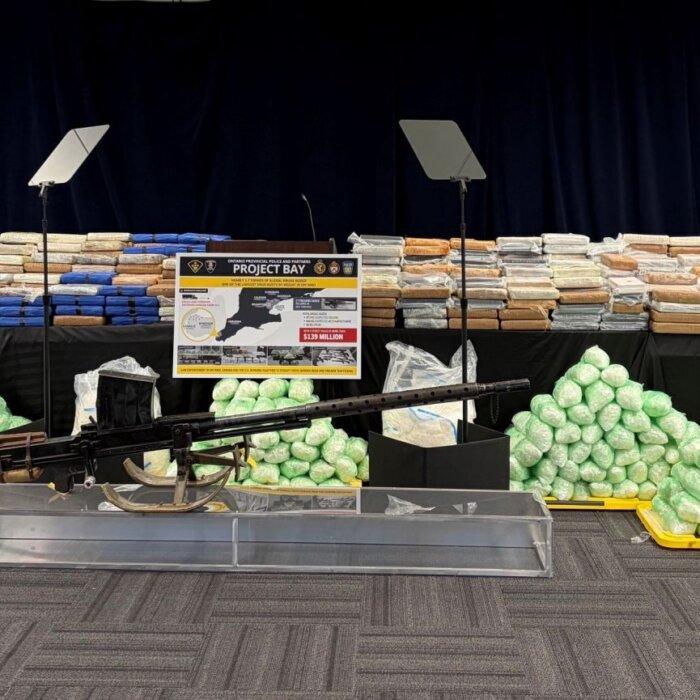
“As the investigation progressed, authorities identified an alleged smuggling network responsible for moving illicit drugs from Canada into the United States,” officials said. “Investigators further determined that the defendants allegedly planned to exchange methamphetamine for multiple firearms.”
Basil Lazore, 47, and Michael Arquette, 38, are charged with conspiracy to possess and distribute controlled substances. Both men are looking at a minimum of 10 years in prison, with the possibility of life imprisonment, along with a fine of up to $10 million if convicted.
Patricia Ransom, 81, is charged with conspiracy to distribute and possess with intent to distribute a controlled substance. She could face a minimum of five years in prison and a maximum of 40 years if convicted.
Lazore was arrested in Canada and Arquette and Ransom were taken into custody in the United States.
Ottawa Provincial Police Chief Superintendent Mike Stoddart said the investigation was an example of Canadian and U.S. law enforcement partners working together to “disrupt the trafficking of illegal drugs and firearms and the criminal networks that profit from it.”
“Criminal networks do not recognize borders, and neither does our commitment to public safety,” he said in the press release.
Akwesasne Mohawk Police Service Chief Ranatiiostha Swamp also said the investigation and subsequent arrests highlight the importance of police collaboration.
The force is headquartered in Quebec, but polices the entire “unique border community” spread across the three regions, Swamp said.
“We have long recognized the need for coordinated and intelligence-driven enforcement strategies,” he added. “This investigation reinforces the importance of law enforcement partnerships by combining resources to combat organized crime.”
The RCMP, Sûreté du Québec, and St. Regis Tribal Police were also part of the investigation led by the Bureau of Alcohol, Tobacco, Firearms and Explosives and Homeland Security Investigations.