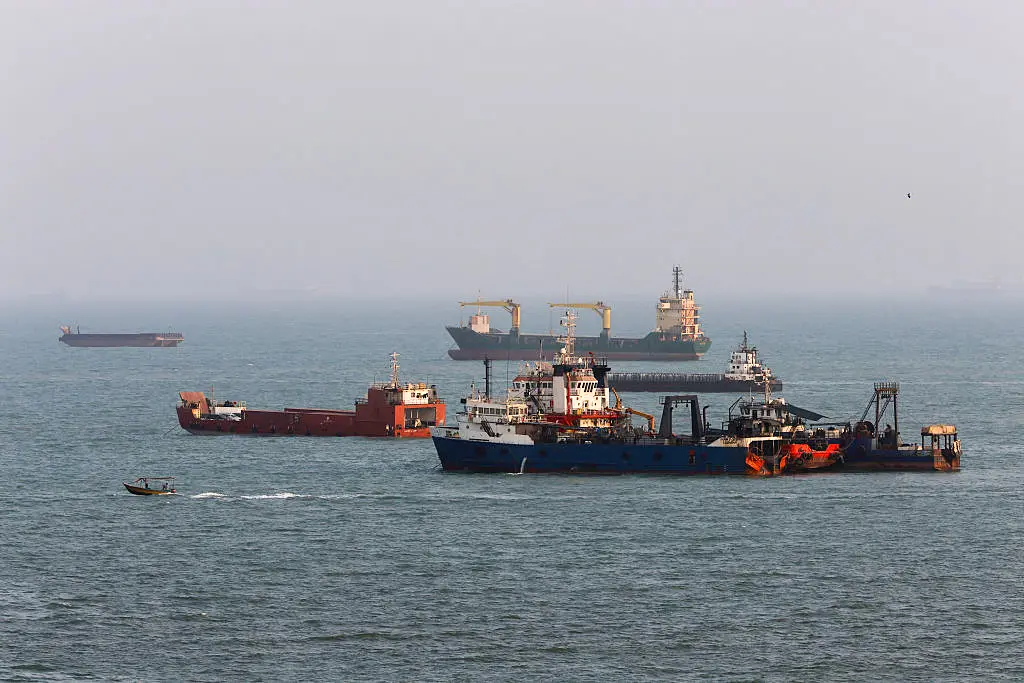
The United States and Iran have agreed to cease attacks over control of the Strait of Hormuz and will continue technical talks on their memorandum of understanding, a U.S. official said on June 28.
“Technical talks are slated to continue on all areas of the MOU. Both sides will stand down for now and vessels can move freely,” the official said.
The official was referring to the memorandum of understanding signed between the two sides on June 17, which includes the full reopening of the Strait of Hormuz, a critical waterway through which a significant share of global oil and gas shipments passes.
Both countries launched fresh strikes on June 27 and June 28 after the U.S. military accused Iran of attacking ships in the Strait of Hormuz. The U.S. Central Command (CENTCOM) said on June 26 its forces targeted Iranian drone and missile storage facilities after Iran struck M/V Ever Lovely, a Singapore-flagged cargo ship, as it was exiting the waterway on June 25.
The command later said on June 27 that it struck 10 Iranian military targets near the Strait of Hormuz in response to Iran’s strike against the M/T Kiku, a Panama-flagged crude oil tanker.
Among the targets were Iranian military surveillance infrastructure, communication systems, air defense sites, drone storage facilities, and minelayer capabilities, CENTCOM said.
In turn, Tehran launched attacks against Bahrain and Kuwait, two small Middle Eastern oil-rich countries located near Iran.
Kuwait’s Army said on X that its air defense systems responded to drone and missile attacks on June 28, but no casualties were reported from the attacks.
The Bahraini Interior Ministry posted on social media that sirens had been activated and urged residents to remain calm and seek shelter at the nearest safe place.
In a Truth Social post on June 27, President Donald Trump accused Iran of violating the preliminary agreement and warned that the U.S. military could take action if the violations continued.
“There may come a point when we are no longer able to be reasonable, and will be forced to militarily complete the job that we very successfully started,” he wrote. “If that happens, the Islamic Republic of Iran will no longer exist!”
Iranian Foreign Minister Abbas Araghchi said on June 28 that responsibility for reopening the Strait of Hormuz rests solely with Iran and that no other country can interfere in the management of the waterway, according to state-run media.
“Based on the memorandum of understanding, the Strait of Hormuz, under the management that Iran will adopt, will return to its pre-war capacity within 30 days, after the obstacles are removed by the Islamic Republic of Iran,” Araghchi was quoted as saying by the semiofficial Islamic Republic News Agency.
The Trump administration has said that Iran cannot impose controls on the strait, including fees or fines on vessels transiting the waterway.
Jack Phillips contributed to this report.