The UK economy contracted for a second consecutive month in October, underscoring a loss of momentum ahead of a major tax-raising budget and intensifying expectations that the Bank of England will cut interest rates next week.
Reeves raised taxes by 26 billion pounds ($34.7 billion) and announced measures, including a freeze on income tax thresholds, which will leave 1.7 million people paying more. The budget widened Reeves’s headroom to 21.7 billion pounds ($28 billion) in 2029–30, almost 12 billion pounds ($16 billion) more than in March.
Barret Kupelian, chief economist at PwC, said on Dec. 12 that speculation around the autumn budget kept households and businesses in a wait-and-see mode. He added that the November data were unlikely to show improvement.
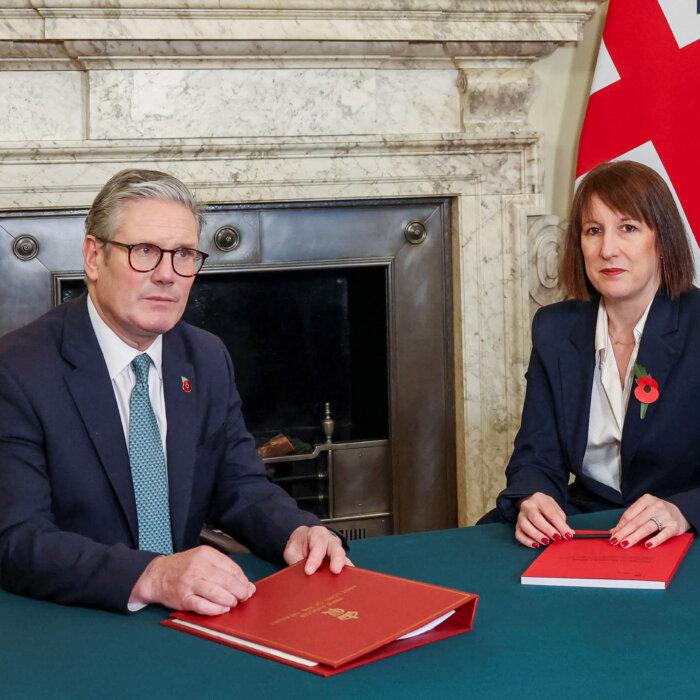

“Given the timing of the Budget, November’s GDP print is likely to look similarly subdued before any post-Budget effects start to show up,” Kupelian said.
The ONS breakdown showed that the weakness was broad-based.
Services output showed no growth over the three months to October, compared with growth of 0.2 percent in the three months to September.
Production output fell by 0.5 percent, driven largely by a slump in the manufacture of motor vehicles and related equipment, matching the decline seen in the previous three-month period.
Rate Cut Expectations Build
Weak GDP data have strengthened the case for looser monetary policy, economists said, with the Bank of England’s (BoE) Monetary Policy Committee due to meet next week.The BoE is currently holding its benchmark interest rate at 4 percent and will announce its next decision on Dec. 18.
Rob Wood, chief UK economist at Pantheon Macroeconomics, said on Dec. 12 that what he described as “Budget chaos” through November was likely to hit growth in that month as well.
He said the disruption could even result in a contraction of 0.1 percent in the final quarter of 2026.
“Weak GDP adds to the reasons for the Monetary Policy Committee to cut interest rates next week,” Wood said, adding that policymakers would need “a huge surprise in inflation and the labour market data published next week to stop a hike.”
Around two-thirds of those polled also expected a further cut to 3.5 percent by the end of March.
James Rossiter, head of global macro strategy at TD Securities, said a December cut appeared inevitable, though the longer-term path remained uncertain.
“There’s a fair debate about the final cut to 3.5 percent, when and whether that happens. For us, it’s a base case,” Rossiter said, adding that a sharper slowdown in the economy and labor market could ultimately push rates closer to 3 percent.