President Donald Trump on Monday said that the U.S. military will reinstate a blockade of Iranian ports and the United States will be reimbursed for effectively guarding the Strait of Hormuz.
In a post on Truth Social, Trump said that the strait will stay open “with or without Iran” after fresh U.S. strikes targeted Iranian military sites overnight.
“We are reinstating THE IRANIAN BLOCKADE, so named because it is only stopping Iran’s ships or customers from entering or leaving. All other countries will have fair and open use of the Strait,” Trump said on Truth Social.
The United States, he wrote, “from this point forward, known as ‘THE GUARDIAN OF THE HORMUZ STRAIT,’ but as such, and as a matter of FAIRNESS, will be reimbursed, at the rate of 20 percent on all cargo shipped, for any and all costs necessary to do the job of providing safety and security to this very volatile section of the World. The process and formation will begin immediately.”
The latest round of strikes marks an escalation in a conflict following the U.S.–Iran signing of a memorandum of understanding to end hostilities, open the strait, and allow for negotiations on Iran’s nuclear program as well as its stockpile of enriched uranium.
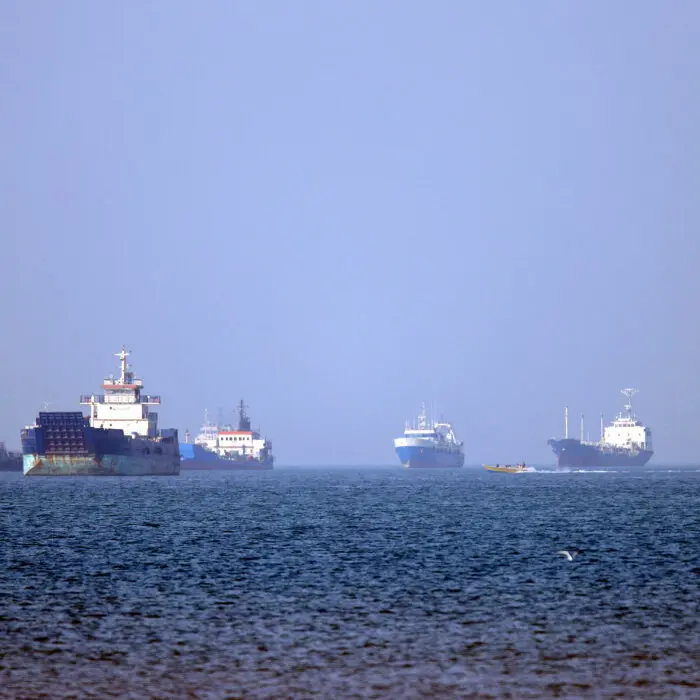
Iran has said on multiple occasions through state-run media that Tehran should control the strait, through which roughly one-fifth of the world’s traded oil passes, and that commercial vessels transiting the waterway must follow its pre-approved routes.
Over the weekend, a newly created Iranian agency, the Persian Gulf Strait Authority, said that the waterway is shut. It reiterated that claim in a post on X on Monday, saying that transit through the strait is “currently unfeasible” and blaming the U.S. strikes.
U.S. Central Command (CENTCOM) has disputed Tehran’s assertions. On Sunday, CENTCOM said Iran does not have any control over the Strait of Hormuz and that American forces are now “positioned and prepared to keep” the strait open to international transit.
Iran’s Islamic Revolutionary Guards Corps (IRGC) said in a statement on Monday that the only way to restore shipping traffic through the strait was to stop U.S. military strikes in the waterway, and it further warned that “continued interference could lead to greater incidents in the global oil and gas sector,” according to state-run PressTV.
The paramilitary organization also claimed that the strait is Tehran’s “territory” and said that it will not allow the United States to “continue its illegal interference there.”
Mohammed Mokhber, an adviser to Iranian leader Mojtaba Khamenei, responded to Trump’s recent comment by saying on Monday that Tehran will fight for the Strait of Hormuz, according to the semi-official Tasnim News agency.
Days after an initial ceasefire was announced in April, Trump said the United States would impose a blockade on Iranian ports. More than 100 ships were redirected or disabled by CENTCOM forces before the memorandum was signed in June.
Speaking with Fox News on Monday morning, Trump explained his rationale for the United States being reimbursed for its actions in the strait.
Trump added that “we’re going to be reimbursed, because the other nations are very wealthy. They’re on our side, and we can’t be expected to do that for nothing.” He added that the United States had “guarded it for nothing” and put “our people in danger.”