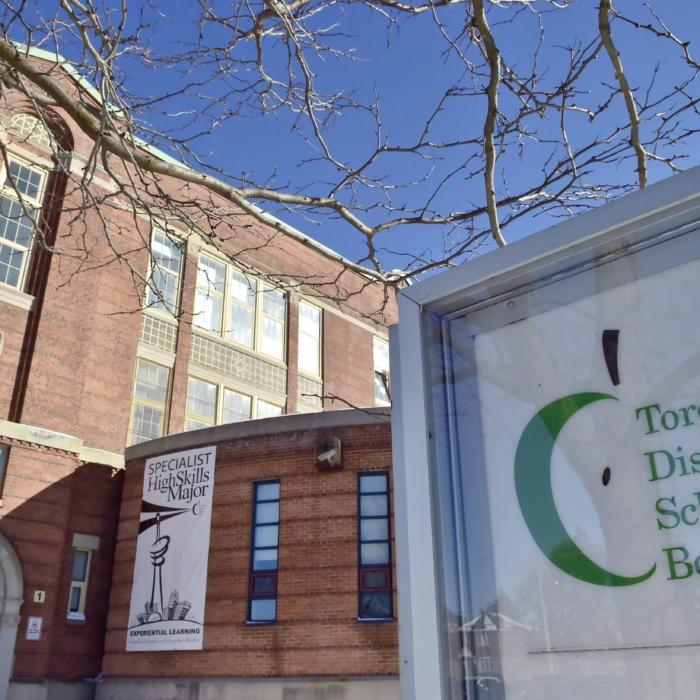
The Toronto District School Board (TDSB) says it will be charging students to take part in its International Baccalaureate (IB) high school program, in which students complete a pre-university curriculum spanning two years.
While not all Ontario school boards charge for students who want to complete the IB program, the TDSB says the program costs $3,300 per student to run, and it will be charging students that amount starting this fall.
“A fee of $3,300 will begin for attendance in the International Baccalaureate program beginning for students entering Grade 9 in September 2025,” the website said.
Students in Grade 10, 11, and 12 who are currently enrolled in the program will need to pay a “portion” of these fees, TDSB said on its website.

Fees are nonrefundable for students that leave the program before completing it, and those who decide not to continue in the program will be expected to return to their “home school,” TDSB said.
The Epoch Times attempted to contact the TDSB and was told to redirect questions to the Ministry of Education.
The website indicated that subsidies will be available for students who have a gross household income under $50,000. Parents and guardians requesting a subsidy will be required to show their recent notice of assessment, TDSB said.
Subsidy requests must be made new each year.
“These costs are related to teacher training, annual dues, program coordination, and participation in IB examinations,” TDSB said.
What Is IB?
The International Baccalaureate program is an intensive academic program taught in high school where students are required to study three subjects “at the Higher Level.”“Students in the IB Diploma Program complete rigorous academic courses that, in many cases, go well beyond the regular secondary school curriculum,” TDSB said.
Program Benefits
A 2022 study by University of Toronto professor Scott Davies and University of B.C. professor Neil Guppy compared university outcomes for high school students in Toronto and Vancouver who earn an IB diploma, with those from French Immersion and regular high school programs.The study found that students who complete the IB program have better performance in university, including higher grades, fewer dropouts, and a higher graduation rate.
The study authors also found that those who earn an IB diploma in high school are more likely to go into science, technology, engineering, or math programs in university.
Fifty percent of Toronto-area IB diploma earners entered a science program, compared to 29.8 percent who chose arts, according to the study. In Vancouver, those numbers were 45.1 percent and 25.5 percent.
”The results from this study indicate that [Diploma Program] graduates tend to perform better than their peers from traditional high school programmes across several university outcomes,” Davies and Guppy wrote.