The unanimous Court of Appeal decision from the three-judge panel grants a victory to the province of Ontario, which had appealed the Ontario Superior Court decision by Justice Paul Schabas in July 2025 that had blocked the removal of the bike lanes.
“There is no Charter right to bicycle lanes – neither specifically nor as inference from any of the rights specifically enumerated in the Charter,” Justice Grant Huscroft wrote in the Aug. 14 appeal court decision, adding that it is “illegitimate for courts to involve themselves in matters of legislative policy” and that “policy is for politics.”
Bike Lane Feud
In October 2024, the province said that it intended to pass legislation that would allow it to remove bike lanes from areas of Yonge Street, Bloor Street, and University Avenue because it said they had lessened available lanes for traffic and worsened congestion.
The proposed legislation, introduced as Bill 212, passed in November 2024. However, the next month, the cycling group Cycle Toronto and several individuals launched a Charter challenge against the legislation.
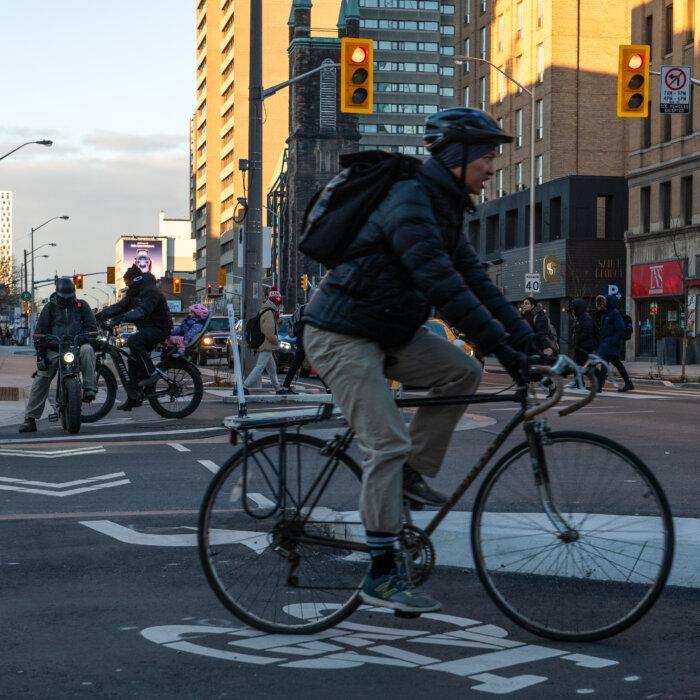

Justice Schabas granted an injunction to stop the bike lane removal in April 2025, and later ruled in July that removing the bike lanes would put cyclists at risk and was therefore unconstitutional.
Schabas’s ruling said that removing the lanes would violate parts of Section 7 of the Canadian Charter of Rights and Freedoms protecting life, liberty, and security of the person.
Ontario’ Appeal
In the appeal court’s decision, the panel found Schabas’s reasoning flawed in part because it could mean that a future government would be legally prevented from changing infrastructure authorized by a previous government simply because that infrastructure provided a purported safety benefit.
The appeal court also found that the government’s argument that removing the bike lane would lessen traffic congestion should not have been part of Schabas’s decision-making process. Schabas had found the government’s argument unpersuasive and cited that as part of the reason for his decision. The court of appeal said that matters of a government’s wisdom in making a decision do not apply to its legal right to make a decision.
“The temptation to do so may be great; judges may suppose that they have much to offer to public policy debate. But the temptation must be resisted,” The appeal court said.
The higher court did not make any ruling on the merits of removing the bike lanes or the government’s argument that doing so will reduce traffic congestion, but instead ruled that such matters should be left to elected representatives and voters instead of the courts.
“The Ontario legislature is as free to establish bicycle lanes as it is to remove them or authorize their removal. The Charter has nothing to say about whether bicycle lanes are a good or a bad idea – wise or unwise policy,” Huscroft wrote.
“These judgments are no business of the courts.”
Ruling
As a result of the appeal court’s ruling, Ontario is legally free to move forward with the planned removal of the bike lanes barring a successful appeal to the Supreme Court of Canada.
The ruling also sets a precedent in Ontario that may make it more difficult to cite Section 7 of the Charter in attempts to prevent governments from changing policies that were previously adopted with the stated goal of improving safety, as the bike lanes in question were originally built in part to improve cyclist safety under Toronto’s municipal government while John Tory was mayor.
“Our government received a mandate from the people to tackle the traffic and gridlock costing Ontario’s economy more than $56 billion every year,” Sarkaria said in a statement.
“We’ve always been clear: bike lanes should go where they make sense, on secondary roads, not at the expense of vehicle lanes on our busiest streets.”
Cycle Toronto’s Executive Director Michael Longfield said it’s too early to decide what the group’s next action would be, and whether it would attempt to appeal the decision to the Supreme Court of Canada.
“It is a complex decision, but certainly from our perspective this fight to defend our bike lanes isn’t over, and we intend to keep pursuing that to the full extent of the law,” Longfield told The Epoch Times.
Longfield added that the appeal court’s ruling doesn’t contradict the matters raised in the challenge brought by his group against the province, arguing that removing the bike lanes will endanger people’s lives. He said that he’s choosing to be optimistic in the short-term given that Toronto Mayor Olivia Chow has said she will try to find a solution with the province.