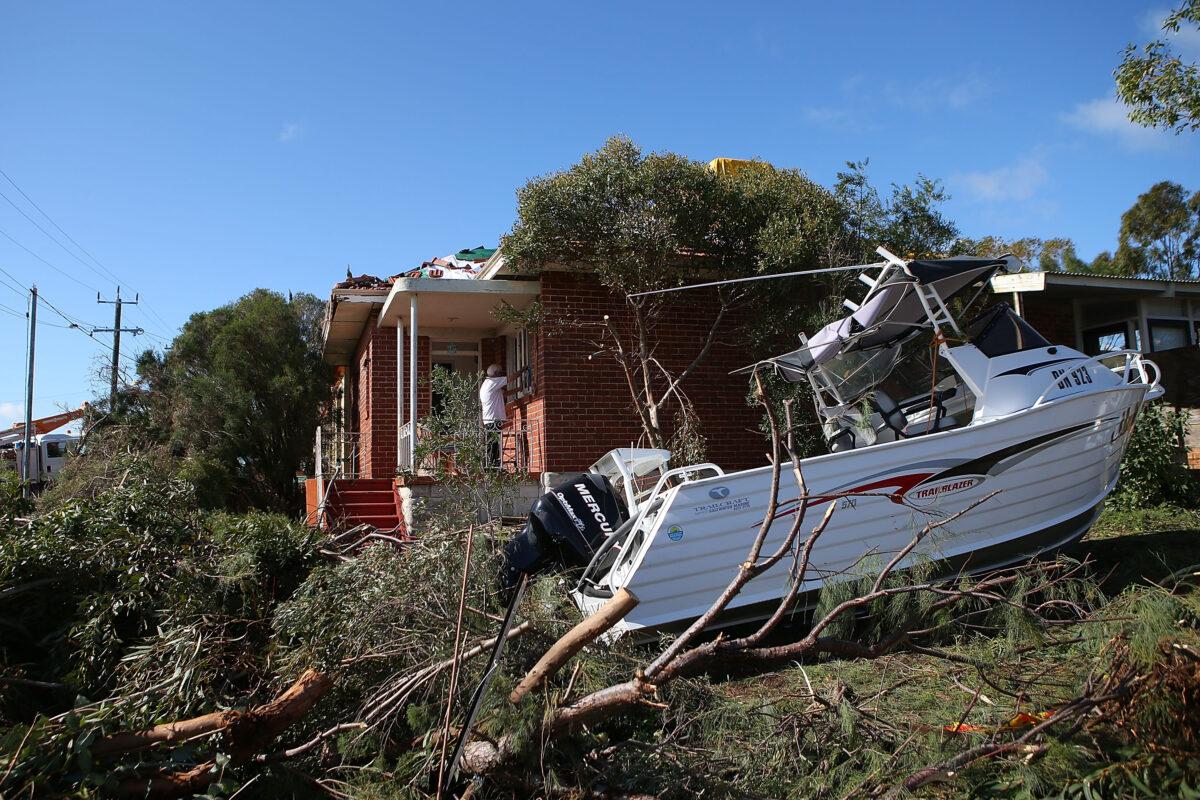
South Western Australia (WA) has copped a beating from the weather gods as a “cold” tornado ripped through the Frankland River region on June 3, flipping a vehicle and damaging a tractor.
In recent days, south-west WA has been lashed by storms and massive hail.
According to the Severe Storms Research group, the tornado that passed through WA was a cold tornado, rather than a warm, tropical event.
“One of the cells embedded within the leading edge of the system spawned a cold-core tornado which overturned a vehicle and damaged a tractor after touching down in farmland near Frankland River, approximately 100km north-west of Albany.
“Wagin residents were treated to golf ball sized hail and the Bureau of Meteorology were kept busy in issuing numerous thunderstorm warnings as the system progressed across the south-west of the state.”

Cold tornadoes differ from their warmer, more tropical counterparts.
These types of tornadoes will often have quite a short lifespan, usually of just a few minutes, and generally happen in conjunction with thunderstorms.
The Bureau is predicting more potential rain and storms for south-west WA, with additional hail possible.
Coastal areas could see rainfall totals of up to 100mm.
Tornados in Australia
A tornado is a violently rotating column of air that extends from the clouds to the ground—the weather event must fulfil these two conditions to be counted as a tornado.They can last less than a minute or more than an hour, and can be very small or massive in scale.
The common term “mini tornado” is actually not a real event, as all tornadoes are considered genuine events in their own right.
There are, however, supercell and non-supercell tornadoes, with the former being more common in the warmer months, while the latter tend to form from cold air.
According to the Bureau, tornadoes are much more common in Australia than many people realise.
Based on historical records, between 30 and 80 tornadoes are observed annually across the nation.
They most commonly come on their own, but “tornado outbreaks” can occur where multiple tornadoes occur within a single weather system.
An example of this was on Sept. 28, 2016, when at least seven tornadoes formed at once in South Australia, leading to a state-wide loss of power.
The weather events generally form when weakly rotating air is sucked up towards a cloud, with the upwards motion causing the air to spin and hasten.
Winds inside a tornado can exceed 300 km/h, making them one of the most destructive phenomena in nature.