This copy is for your personal, non-commercial use only. Distribution and use of this material are governed by our Subscriber Agreement and by copyright law. For non-personal use or to order multiple copies, please contact The Epoch Times Reprints.
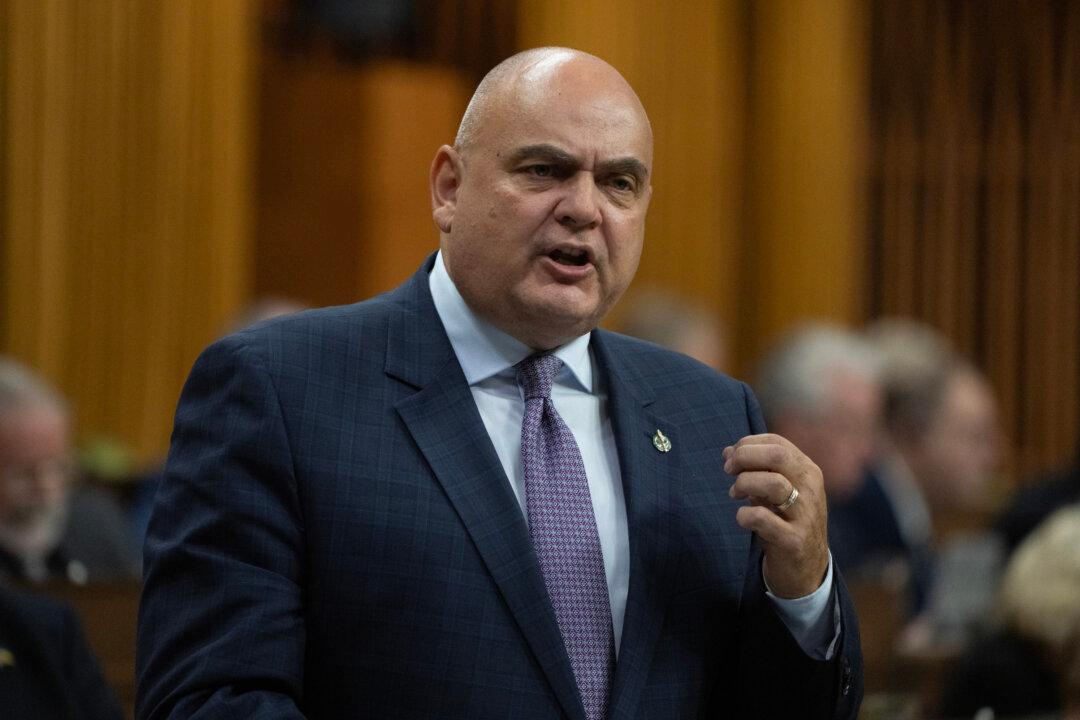
Conservative MP Dan Albas rises during question period in the House of Commons on Parliament Hill in Ottawa on June 2, 2023. THE CANADIAN PRESS/Justin Tang
The Conservative Party is raising further questions about the Liberal government’s decision to provide a $1 billion loan to BC Ferries to purchase four new vessels from a state-owned Chinese shipyard, as newly released documents show senior government advisers debated how to manage the messaging around the decision.
According to internal emails obtained by The Globe and Mail, senior aides deliberated on how to manage an upcoming announcement regarding a connection between Ottawa and BC Ferries’ decision. At the time of the internal debate, it had not yet been announced that the Canada Infrastructure Bank (CIB), a federal agency, had supplied the loan to BC Ferries for the purchase.
“Newly uncovered documents show senior Liberals were only concerned about their political interests. They did nothing to cancel the contract and ensure that our shipbuilders could participate,” Conservative MP and transport critic Dan Albas said during question period on Sept. 16.
Housing and Infrastructure Minister Gregor Robertson responded that all parliamentarians were “disappointed” with BC Ferries’ decision, and that it was “unfortunate” that no Canadian companies bid on this contract to build the ships.
“I agree with the member opposite on this side of the House. We are bringing forward a comprehensive ‘buy Canadian’ program to make sure all of our agencies and departments are focused on buying Canadian,” Robertson said.
Email Disclosure
According to internal emails obtained by the Globe and Mail and reported on Sept. 15, while MPs were set to begin question period on June 18, senior Liberal aides received an email from Robertson’s director of communications, Mohammad Hussain, about messaging around the upcoming announcement that CIB had loaned money to BC Ferries for the ships.
“My immediate instinct is that we can move forward with this announcement as a paper release and refuse to wear any of the procurement choices,” wrote Hussain, according to the Globe.
“The BC government not stepping in also gives us cover,” he wrote, referring to B.C. Premier David Eby saying that reopening the contract to other bidders would mean delays and significantly higher costs.
“The main challenge here is that the Conservatives hate CIB and I think they will run with this. The project is likely not viable without our loan,” he wrote.
The email also states that “one of our ADMs asked us to consider the signal it sends to China if we were to cancel a $1-billion contract with them as we try to re-establish economic ties and remove tariffs. I am not sold on this line of thought, but I would appreciate your thoughts on it,” he said, in reference to an unidentified assistant deputy minister in Robertson’s department.
The email was forwarded to the office of Transport Minister Chrystia Freeland later that day, according to the Globe.
Conservatives have been critical of BC Ferries’ decision to hire state-owned China Merchants Industry Weihai Shipyards to build four vessels at the same time as the U.S. imposing 50 percent tariffs on steel and aluminum, and Ottawa encouraging businesses to “buy Canadian.” The Conservatives have called for the CIB to cancel the loan.
The announcement also came amid concerns with Chinese interference in Canada’s democratic process, and an escalating trade dispute between the two countries. In March, China had retaliated against Canada’s October 2024 tariffs on steel, aluminum, and electric vehicles by imposing 100 percent tariffs on Canadian canola oil, oil cakes, and peas, along with 25 percent tariffs on Canadian pork and aquatic products. Beijing announced further tariffs on Aug. 12, saying it would impose 75.8 percent temporary tariffs on Canadian canola, starting on Aug. 14.
During a House of Commons transport committee meeting back in August, Robertson said the federal government had no role in approving the $1 billion CIB loan for purchase of the vessels, and that it would not cancel the loan.
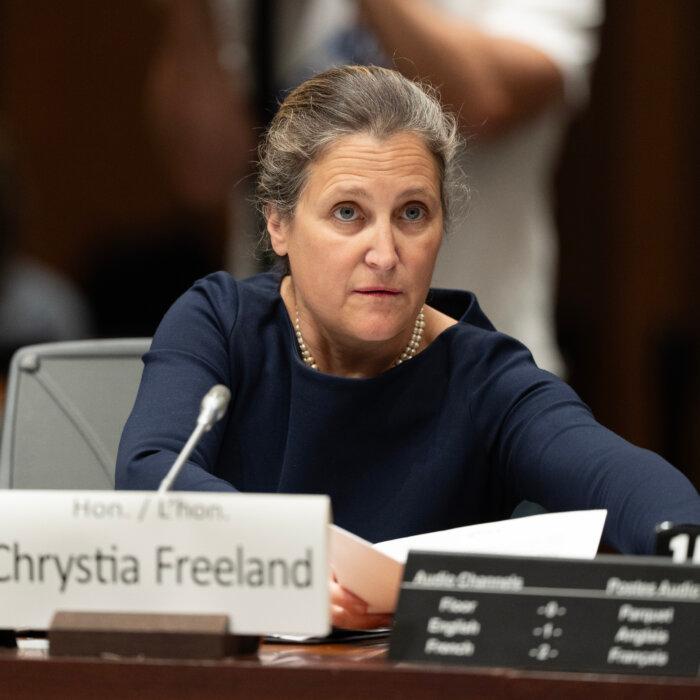
Freeland testified that she was disappointed by the decision, and that she was doing “everything in my power” to ensure Canadian workers, steel, and aluminum are prioritized in future contracts.
BC Ferries CEO Nicolas Jimenez also testified that it had adjusted its procurement process qualifications specifically to allow Canadian shipyards to qualify, and that none chose to formally submit a proposal. While one Quebec shipyard “showed interest,” he said it declined to submit a proposal.
“We chose the proposal that offered the best combination of value, quality, delivery, timelines and protections for our customers throughout the build,” Jimenez said.