TAIPEI, Taiwan—Taiwanese President Lai Ching-te is urging countries to be united against what he called China’s “malicious” law on ethnic unity.
Lai sounded the alarm about China’s ethnic unity law at the opening of the 10th annual Ketagalan Forum on Aug. 4. The event, which focused on security-related issues in the Indo-Pacific, was hosted by Taiwan’s Ministry of Foreign Affairs and the Taiwan Institute of Economic Research.
The Chinese law, which went into effect on July 1, “infringes upon Taiwan’s sovereignty and persecutes religions and minority groups,” Lai said.
“But it goes beyond that,” Lai added. “By using forms of transnational repression, it imposes political censorship in all parts of the world, creating a chilling effect.
“The entire international community should come together and staunchly oppose this malicious law.”
In the face of threats posed by China’s law, Lai said Taiwan “will not accept united front infiltration or red terror.”
“We will build stronger systems to prevent, counter, and protect against these threats,” Lai said.
“We will also deepen our cooperation with friends and allies. Together, we will defend free speech, boost defense and resilience around the world, and uphold the rules-based international order.”
Transnational Repression
Also speaking at the forum was Gen Nakatani, a Japanese lawmaker and former Japanese defense minister. He is also one of the co-chairs of the Inter-Parliamentary Alliance on China (IPAC), a group of more than 300 lawmakers from countries around the world who believe that coordinated responses are needed to confront the Chinese regime’s malign activities.
Nakatani recalled visiting Taipei in 2024 to attend the IPAC summit, during which China’s transnational repression was elevated from a human rights issue to the core of national security.
“And yet the threat [of transnational repression] has not receded. Instead, the Chinese government has now given it the force of law,” Nakatani said, according to a translation.
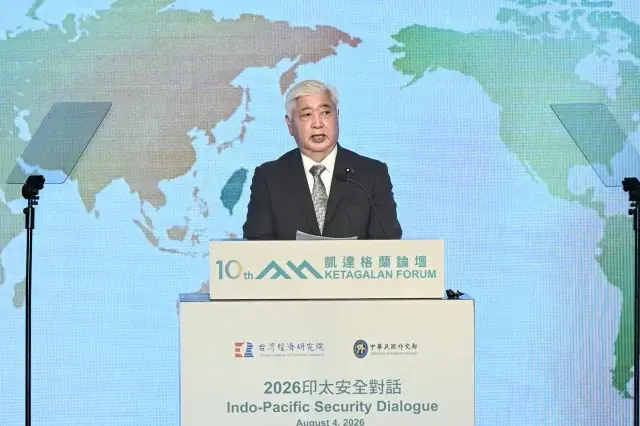
While Nakatani stressed that he would draw no definitive conclusions as the Taiwanese investigation into the assault remains ongoing, he noted that the assault served as a reminder of Article 63 of the Chinese law.
That provision, he warned, effectively asserts Beijing’s “criminal jurisdiction over what is spoken in Tokyo, what is spoken in Taiwan,” and what is spoken at the Ketagalan Forum on Tuesday.
Nakatani said countries must adopt a comprehensive strategy to address the issue, including information sharing, diplomatic exposure, economic countermeasures, and cross-border protection networks.
Moreover, Nakatani said, it was important to have the right way of thinking.
“We must no longer regard these actions as isolated cases of excessive law enforcement. Rather, we must recognize that transnational repression is an integral part of a broader strategy of external influence and coercion,” Nakatani said, according to a translation.
In a statement on July 1, the IPAC urged all democratic governments to oppose the Chinese law “with every tool available” since it threatens Chinese activists, researchers, journalists, civil society actors, and politicians who “dare to tell the truth.”
US Arms Sale
U.S. Rep. Michael McCaul (R-Texas), chairman emeritus of the House Committee on Foreign Affairs, also participated in Tuesday’s forum. In a speech, he reaffirmed the strong U.S.–Taiwan partnership and the enduring U.S. commitment to Taiwan’s defense.
“The Chinese Communist Party would love nothing more than to undermine our partnership and alter U.S. policy toward Taiwan,” McCaul said. “But on behalf of the United States Congress, I can report to you here today that the policy we mandated in the Taiwan Relations Act remains alive and well, alive and well to promote a free and democratic Taiwan.”
Taiwan and the United States have not maintained formal diplomatic relations since Washington switched diplomatic recognition to Beijing in 1979. Nonetheless, under the Taiwan Relations Act, the United States remains Taiwan’s most important security partner and primary arms supplier.
McCaul said he is “confident” Trump will submit the delayed $14 billion arms package to Congress “soon.”
“While the U.S. pursues strategies to stabilize its relationship with China, we are still clear-eyed about the CCP’s threats and their end game,” McCaul said.
Quoting U.S. Gen. Douglas MacArthur’s description of Taiwan as an “unsinkable aircraft carrier,” he added that the phrase remains “true today,” describing Taiwan as an “enduring pillar of freedom to check and to stop the spread of the Chinese Communist Party’s malign influence across Asia.”
The CCP considers Taiwan a Chinese province and is advancing its military capabilities in preparation for a potential invasion to seize the self-governing island.
Calling out Beijing’s aggression, McCaul said that attempts at forced unification “will never succeed” since China “has never controlled Taiwan.”
“We must not allow the Chinese Communist Party to upend the global balance of power,” he said.