The Swedish Board of Agriculture will set up emergency stocks of grains and agricultural inputs to ensure that citizens have “access to sufficient safe food in the event of a serious crisis and, in the extreme, war,” the agency said in an Oct. 14 statement.
“The government has allocated funds for the Swedish Board of Agriculture to establish emergency stocks of grain for food consumption throughout the country during 2026–2028, as well as critical input goods that are important for Sweden to be able to maintain its domestic food production,” the agency stated.
The procurement will first focus on the country’s northern region, especially the four counties of Norrbotten, Vasterbotten, Jamtland, and Vasternorrland, which depend on transportation from southern regions for their food supplies.
“At the same time, the area is strategically important for Sweden’s and NATO’s defense. The Swedish Board of Agriculture will therefore begin building up emergency grain stocks in these counties,” the board stated.
The tender for the stockpiling became available on Oct. 15.
The aim of the procurement is to ensure that the government is able to secure 3,000 calories per person per day—a limit decided by the Swedish National Food Agency as necessary during a state of heightened alert.
Emergency stocks will be stored throughout the country, ensuring that food stocks can be pulled from any region if key infrastructure were to be knocked down in some parts amid war and other crises, according to the board.
Sweden’s stockpiling comes amid increasing concerns over Russian agitations in the broader region.
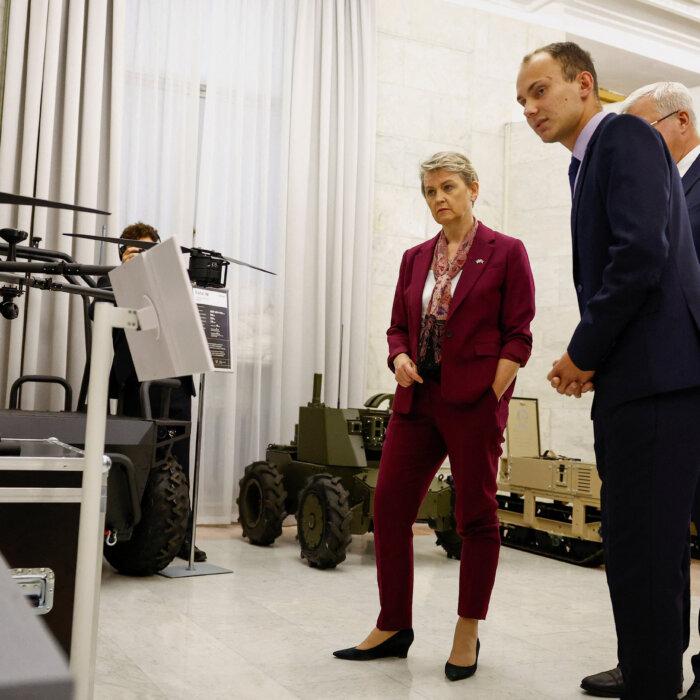
The European Union chief said there has been a “worrisome pattern of growing threats” to European security that falls outside the bounds of a conventional war. This includes drone incursions into Europe, sabotage of undersea cables, and cyberattacks.
“It’s time to call it by its name: This is hybrid warfare, and we have to take it very [seriously],” she said.
“Tackling Russia’s hybrid war is not only about traditional defense, it is about software for drones. It is about spare parts for pipelines. It is about rapid cyber response teams.”
Von der Leyen proposed a drone wall system to detect, track, and intercept unmanned aerial vehicles that intrude into European airspace.
“However, any aggression against my country will be met with a decisive response. There should be no doubt about this among those in NATO and the EU,” Lavrov said.
However, at this time, Russia is unlikely to carry out an involuntary reserve mobilization at a large scale to “dramatically” expand the size of the nation’s military, the think tank stated in its post.
In its Oct. 14 statement, the Swedish Board of Agriculture also discussed the potential economic impacts of its decision to stockpile food.
“The knowledge that there are stocks means that market players take into account the prices at which purchases are made. Even on occasions when withdrawals from emergency stocks are carried out, this can have a negative impact if this is not done in a market-based manner,” the board stated.
However, regarding the actual market impact, the agency stated that it does not expect much in northern Sweden.
“Our contingency storage model is based on minimal market impact, also at a regional level. The grain market in northern Sweden is small, and we will have extra oversight of the competitive situation in the market,” the agency stated.