This copy is for your personal, non-commercial use only. Distribution and use of this material are governed by our Subscriber Agreement and by copyright law. For non-personal use or to order multiple copies, please contact The Epoch Times Reprints.

The Epoch Times
The Epoch Times
AD
The Epoch Times
Australia News

Support Services Overwhelmed as More Australians Go Homeless: Report

‘Homelessness services are so stretched they are having to turn away one in two people who knock on their doors,’ said Homelessness NSW CEO.
Google LogoMark Us Preferred on Google
Support Services Overwhelmed as More Australians Go Homeless: Report
A homeless girl sleeps on the ground by a sign asking for food and clothing in Sydney, Australia, on Jan. 18, 2021. Jenny Evans/Getty Images
Alfred Bui
Alfred Bui
12/12/2023|Updated: 12/12/2023
0:00

A new analysis has shown an increase in the number of Australians already experiencing homelessness and rough sleeping when they seek help from homeless services.

This comes as the Australian rental market has seen a surge in prices and record-low vacancy rates.

Homelessness Australia, a peak industry body for the homelessness sector, has released its analysis of the latest data on homelessness services by the Australian Institute of Health and Welfare (AIHW).

The peak body found that there was a 5.5 percent rise in the number of people who were already homeless when they sought help in the 2022-2023 financial year.

The percentage of Australians experiencing rough sleeping when they first approached homeless services also soared by 17 percent.

At the same time, there was a 16 percent jump in individuals turning to rough sleeping after they exited homelessness support and another 12 percent increase in exits to places like prisons or acute mental health facilities.


Related Stories
The Epoch Times
Australia’s Housing Crisis: $300,000 Income Required to Afford Mortgages
The Epoch Times
Nearly 80 Percent of Australian Households Grapple With ‘Extreme’ Financial Stress: Report

Homelessness Australia CEO Kate Colvin said the data revealed the impacts of the housing crisis on Australians.

“These figures are a stark and alarming indicator of how the deepening housing crisis is pushing more Australians to sleep in their car, pitch a tent or couch surf,” she said.
“It’s very hard to work or learn when you have no roof over your head or a real prospect of getting a home.”

Homelessness Sector Overwhelmed by Rising Demand

Despite the significant rise in demand for homeless services, the capacity of service providers barely increased in the previous financial year.
Specifically, the total number of clients who received support from service providers only rose by around 900 to 273,600 in 2022-2023, according to AIHW data.

Homelessness NSW CEO Dom Rowe acknowledged that the sector was unable to keep up with the rising service demand despite trying their best.

“Homelessness services are so stretched they are having to turn away one in two people who knock on their doors, and there are many more people who don’t ask for help at all,” she said in comments obtained by AAP.

“Frontline services do the best they can to keep people housed, but there are not enough homes and inadequate funding to keep up with demand.”

To tackle the issue of rising homelessness in Australia, Ms. Colvin urged the federal government to invest more in social housing, focus on solving the causes of homelessness, and provide more funding for homelessness support services.
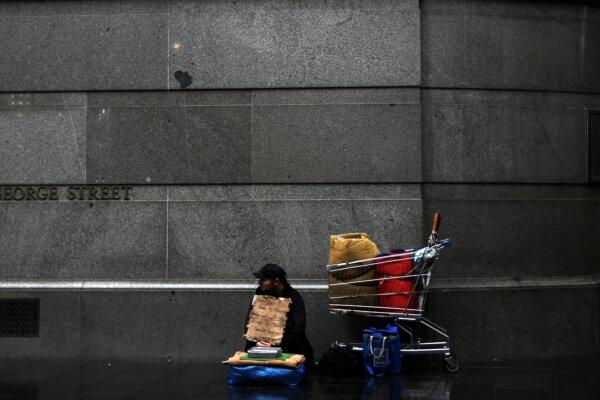
A homeless man waits for charity in the rain in central Sydney, Australia, on May 29, 2020. (Saeed Khan/AFP via Getty Images)
A homeless man waits for charity in the rain in central Sydney, Australia, on May 29, 2020. Saeed Khan/AFP via Getty Images

Why People Fall into Homelessness

The AIHW report indicated that among those received support from homeless services in 2022-2023, over 100,000 were first-time clients.

Around 55 percent of those people had already experienced homelessness when they approached services for help, while 45 percent were at risk of having no place to live.

For new clients experiencing homelessness, the housing crisis was the top reason for needing assistance (24 percent), followed by family and domestic violence (20 percent), and inadequate or inappropriate dwelling conditions (16 percent).

Meanwhile, the top three reasons for assistance by new clients who were at risk of homelessness were family and domestic violence (33 percent), housing crisis (18 percent), and financial difficulties (13 percent).

Homelessness Australia’s analysis comes as the rental vacancy rate hit a new record low of 1.02 percent in October, down from 1.10 percent in September, well below a healthy vacancy rate of 3 percent.

In addition, the national median rental prices rose to $550 (US$360) a week in the September quarter, up 14.6 percent compared to a year ago.

Real estate data firm PropTrack attributed the price surge to low rental supply and strong demand.


Google LogoMark Us Preferred on Google
Alfred Bui
Alfred Bui
Author
Alfred Bui is an Australian reporter based in Melbourne and focuses on local and business news. He is a former small business owner and has two master’s degrees in business and business law. Contact him at [email protected].
Author’s Selected Articles
Chinese-Linked Firms Defy Australian Order to Sell Off Stakes in Rare Earth Miner
Jul 08, 2026
Chinese-Linked Firms Defy Australian Order to Sell Off Stakes in Rare Earth Miner
Population Growth Masking Australia’s Real Economic Problems: Report
Jul 08, 2026
Population Growth Masking Australia’s Real Economic Problems: Report
900,000 Australians Could Be on the NDIS by 2030 If Costs Are Not Controlled: Report
Jul 03, 2026
900,000 Australians Could Be on the NDIS by 2030 If Costs Are Not Controlled: Report
Australia Will Struggle to Develop All 31 of Its Critical Mineral Reserves, Inquiry Told
Jun 29, 2026
Australia Will Struggle to Develop All 31 of Its Critical Mineral Reserves, Inquiry Told
Related Topics
homelessness
Australian Housing Crisis
Homelessness Australia
AD
Add to My List
Save
The Epoch Times
Copyright © 2000 - 2026 The Epoch Times Association Inc. All Rights Reserved.