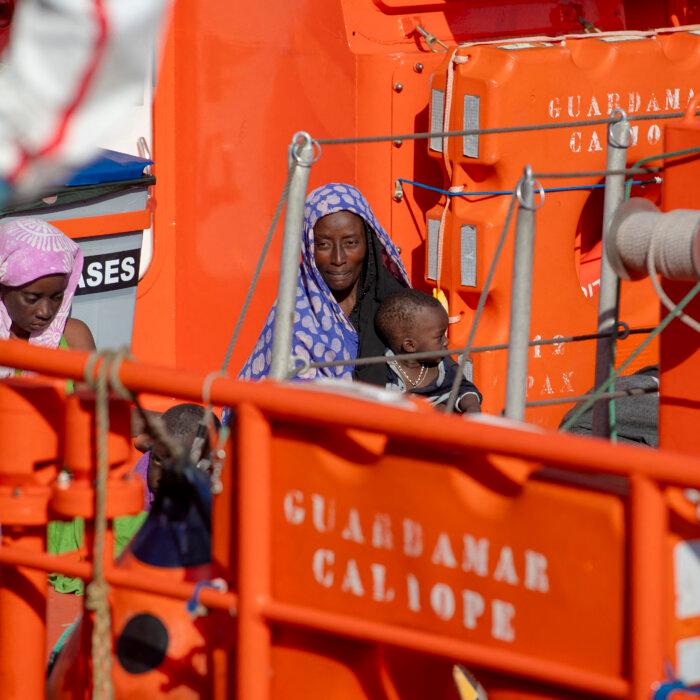
Spain deployed military units to its North African enclave of Ceuta to reinforce security after thousands of illegal immigrants breached its border with Morocco.
At least nine people died during the breach at the border on July 30, according to Spain’s government delegation in Ceuta. It did not offer details on the fatalities.
The deployment came after the government of Ceuta declared the city was facing an “absolute humanitarian and social emergency” following the surge in illegal border crossings. The city asked the Spanish government to declare a national emergency, deploy the army to the enclave, and fully close the borders.
While the Spanish government declined to declare a national emergency, stating that current legislation does not classify migration flows as a risk to national security, it did send 60 soldiers, police reinforcement, as well as a military vessel and diving unit.
Ceuta is a Spanish autonomous city located in North Africa, like Melilla, which together represent the European Union’s only land borders with Africa, and often face surges by illegal migrants seeking to reach Europe.
Juan Jesús Vivas, head of the Ceuta regional government, asked for more police and for the army to be deployed on the border in a July 30 post on the official account of the Government of Ceuta X account.

“We are facing a situation of absolute humanitarian and social emergency,” Vivas told the Spanish Radio station Cadena SER.
He said that some immigration facilities were operating at 2,400 percent of capacity.
Vivas said Ceuta could face a situation comparable to the May 2021 migration crisis, when 10,000 people entered the enclave in mere days.
A Guardia Civil spokesperson said that the immigrants were “massively entering from the sea” through the Tarajal breakwater, but could not provide any estimates for their numbers. State television TVE on July 30 reported that 2,000 to 3,000 people had crossed.
Spanish Prime Minister Pedro Sánchez said that the government is “fully committed to providing an immediate response to the situation in Ceuta.”
“We are mobilizing all necessary resources, working with Moroccan and international authorities, and preparing the necessary measures to restore normalcy as soon as possible,” he said in a July 30 post on X.
The surge follows two major policy shifts by Spain this year, including a mass granting of legal status to hundreds of thousands of illegal immigrants and a recent court ruling barring summary expulsions of immigrants who swim ashore.
The Spanish Supreme Court ruled on June 29 that “hot returns,” or summary expulsions without formal proceedings, cannot be applied to migrants intercepted at sea who swim into Ceuta or Melilla.
Irene Montero, a former equality minister and current member of the European Parliament from the hard-left Podemos party, said in an April 14 post on X that the process could ultimately extend further, saying that up to 800,000 illegal immigrants should be granted papers.
The situation in Ceuta has drawn major criticism from the opposition.
Right-wing party Vox stated that “thousands of Moroccans are crossing the Ceuta border because of the policies” of Sánchez.
“They are not exiles, nor refugees, nor women, nor children; they are all men of military age,” it stated in a July 30 post on X.
Santiago Abascal, leader of Vox, said in a July 30 post on X: “They’re not coming fleeing from any war or poverty. It’s an invasion.”
European leaders have criticized the mass legal status plans, as those with Spanish residence permits and regularized immigrants would be entitled to travel within the Schengen area of the EU for up to 90 days in any 180-day period.
Alice Weidel, co-chair of Germany’s populist Alternative for Germany (AfD) party, said that “already more than 1,500 migrants, predominantly from Morocco and Algeria, have entered the EU in a very short time.”
“Their presumed destination is likely Germany. Borders must now be closed and rejections rigorously enforced,” she said in a July 30 post on X.