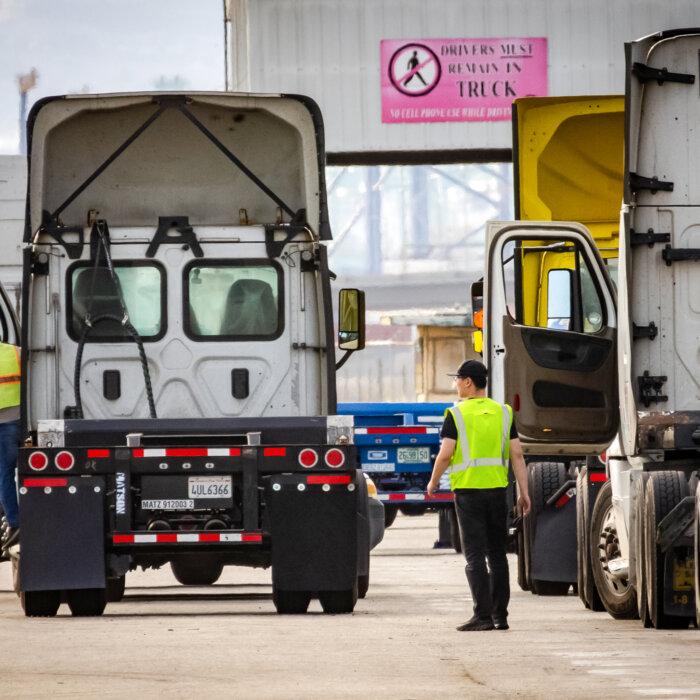
A new report from Ontario’s auditor general identifies “serious” gaps in testing, training, and oversight in Ontario’s commercial truck driver training and licensing system, saying that this creates a “safety risk for all drivers on Ontario’s roads.”
The report from Ontario Auditor General Shelley Spence found multiple cases of private truck-driving schools failing to offer the full mandatory Entry Level Training (ELT) to would-be drivers, telling students to sign off on training hours they hadn’t done, along with “falsified” student records.
The report also points to provincial DriveTest centres giving inconsistent road tests and various lapses in oversight of the province’s commercial trucking industry.
“Without an effective process in place to enforce compliance with all mandatory training, these drivers continue to operate even though their training may fall below the provincial ELT standard. This poses a safety risk for all drivers on Ontario’s roads,” the report reads.
The audit notes that while large commercial trucks only make up roughly 3 percent of vehicles on Ontario roads, they were involved in 12 percent of deadly collisions between 2019 to 2023. It goes on to cite Ontario government data on collisions showing truckers were at fault in approximately 46 percent of the roughly 128,000 collisions involving large commercial trucks between 2015 to 2025.
The report comes amid heightened scrutiny into trucking safety in Canada and the United States after a series of deadly accidents.
Quebec’s chief coroner announced a public inquiry into the issue last year following an increase in fatal truck collisions, saying evidence shows that inexperienced and illegally hired drivers are contributing to the rising death toll.
The Truck Training Schools Association of Ontario last year submitted a brief to a parliamentary committee saying that a rise in poorly trained truck drivers and the exploitation of foreign workers operating improperly maintained vehicles are making Canadian roads more dangerous.
Missing Training, Improper Testing
Ontario requires would-be commercial truckers seeking their Class A licence to complete 103.5 hours of training including on-road driving, classes, and manoeuvre practice done at the truckyard.“Two of the five private career colleges offered only 59.5 and 81 hours, or 57 percent and 78 percent, of the minimum 103.5 training hours required by the ELT standard,” the report reads, adding that “in both private career colleges, they instructed our students to sign off on training hours they did not complete.”
Testimony was included in the report of a student who reported being asked to sign off on hours of training that had not been completed and being told this was necessary “for their [the school’s] records or in case of an audit.”
This student also reported only getting roughly 20 hours of one-on-one driving lessons, far short of the required 50 hours, as well as only being taught one way to reverse park as it was the only way used at the DriveTest Centre in Peterborough.
The report also found that students weren’t instructed on “all the required elements of truck driving,” including how to do left turns at large intersections, reverse park, or perform emergency braking.
The audit also found various problems with road testing in the province, specifically noting that 29 DriveTest centres in Ontario let drivers take their road tests on lower-speed highways, creating an inconsistency with test requirements.
It also found that 24 of the province’s DriveTest centres only tested students for one type of reverse manoeuvre, rather than the required provincial test, which tells instructors to choose a reversing manoeuvre randomly from two ways of reversing, both of which methods are required to have been mastered by a student who obtains their Class A commercial trucker licence.
Oversight Gaps
In addition to the deficiencies found in commercial trucker training and testing, the audit identifies significant oversight gaps of private truck-driving schools in the province.The audit also identified a number of unregistered truck-driving schools that it said were partnering with legitimate, registered schools in order to still be able to issue students their certification via the provincial system.
These issues come amid rapid growth of the truck-driving training sector in the province in the past few years, according to the audit, which noted that registered private career colleges offering ELT for would-be commercial truckers went from 93 in 2019 to 205 in 2024, along with a rise in students enrolled from 13,683 to 22,699 in the same time period.
Response
The audit makes 13 recommendations that it says will address some of the problems identified in Ontario’s commercial truck driver training and licensing system and ineffective processes in place from MCURES and the Ministry of Transport.
These recommendations include a call for more instructor oversight, standardized and consistent road testing, more monitoring of drivers, updating and analyzing the quality and content of driving licensing requirements, stricter vehicle inspections, a tougher crackdown on fraudulent or rule-breaking training schools ,and better information sharing between government ministries.
MCURES and the Ministry of Transport both agreed to the recommendations.
For his part, Ontario’s Transportation Minister Prabmeet Sarkaria said the province has already forced the closure of several trucking schools that were not following the rules.“We have a proactive approach we are putting forward,” Sarkaria told reporters May 12 in the wake of the audit being released.
“Last January, we referred some of those to the Ontario Provincial Police, who then acted on it and charged individuals.”
The leader of Ontario’s NDP, Marit Stiles, also weighed in, saying the issues raised in the audit have been well known for a number of years and still haven’t been dealt with effectively.
“There’s so many examples in here,” Stiles said. “But they’ve also sent a message to all the bad actors in here, that they can get away with this.”