The March For Australia rallies across the country have attracted mixed responses from parliamentarians across the political spectrum.
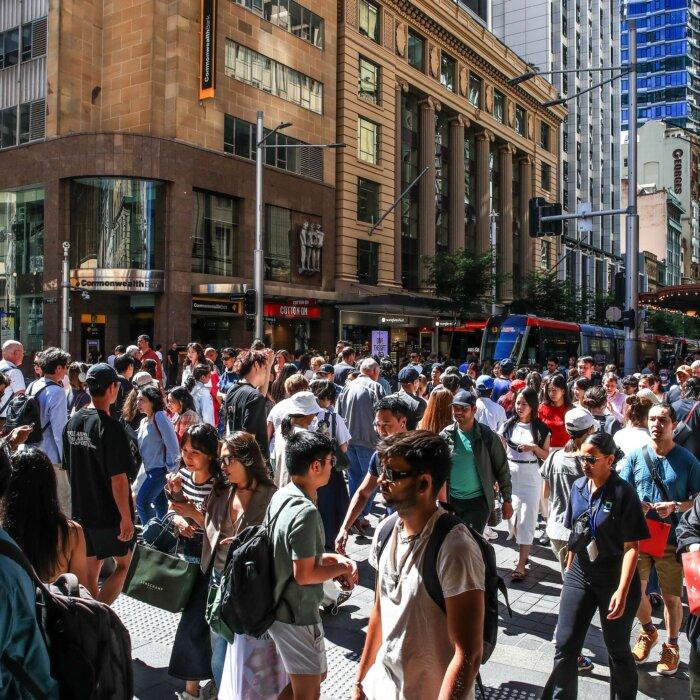
On Aug. 31, tens of thousands took to the streets in major cities, including Sydney, Melbourne, Brisbane, Perth, Canberra, Adelaide, and even smaller cities like Bundaberg, calling on the federal government to pause or slow down immigration.
Concerns About Neo-Nazi Hijacking
Federal Multicultural Affairs Minister Anne Aly said while there were legitimate concerns about housing infrastructure problems caused by an influx of new residents, she said the protests were targeted at migrants from “countries that have brown people,” rather than white Western countries.“It’s very clear from the conduct that was observed at these marches, that these marches were a con by the far right neo-Nazis to prey on some legitimate concerns around housing and around cost of living in order to propagate their anti-immigration, racist agenda,” she told ABC radio on Sept. 1.
“One of the very clear calls to action that was listed there was anti-Indian immigration, against people coming from India.
“Now that, to me, is clearly racist when you target a specific ethnicity, that is clearly racism.”

Similarly, Shadow Immigration Minister Paul Scarr said he saw “neo-Nazis” addressing crowds.
“When we see neo-Nazis address a crowd of people in some of our major cities, that raises material concerns with respect to social cohesion in our country,” he told ABC.

Scarr stated that while some people attended the marches out of housing and cost-of-living concerns, what happened in Melbourne was “particularly disturbing.”
“This is a very complicated issue. And I think those of us in positions of political authority need to be very careful in terms of how we deal with these issues so that we don’t alienate people of goodwill,” he said.
Violence erupted between competing rallies—some between self-proclaimed neo-Nazis and legitimate protestors—in Melbourne and police officers were forced to use pepper spray to break up clashes.
Liberal Party leader Sussan Ley described the rallies as “attended by people of goodwill, but hijacked by neo-Nazis spouting hate, racism, and resorting to politically motivated violence.”
“That can never be accepted,” she wrote on X.
“Extremism has no place in Australia. We must never import the bitterness of overseas conflicts into our communities. What unites us as Australians will always be stronger than those who seek to divide us. But we cannot take that unity for granted.”
Ley called for leadership to bring the country together, warning that Australian society’s “fabric is being steadily eroded by extremism.”
Greens Says Labor Incited Rally With Deportation Bill
During the Senate’s Question Time on Sept. 1, Greens Senator David Shoebridge accused Labor of inciting the protests with its contentious migration bill, which he described as “some of the most extreme far-right wing anti-immigration legislation.”Labor is trying to pass an amendment to the Migration Act, which could see up to 80,000 non-citizens deported.
It is the Albanese government’s attempt to address a High Court ruling that found indefinite immigration detention unlawful, which led to the release of around 200 people, including convicted murderers and rapists. Some reoffended almost immediately after they were released into the community.
“Why does your government call these people, many of whom are refugees, ‘criminals,’ when you know they are not? And will you acknowledge that this rhetoric, this dog whistling and dehumanising, fuels the far right rallies we saw over this weekend?” Shoebridge asked Environment and Water Minister Murray Watt.
Watt said Labor is adopting the bill on the basic principle of any functioning migration system, that is, “If you don’t have a right to a visa in Australia, you should leave.”
The minister said it was a stretch to imply the Albanese government incited the rallies.
“This government could not have been clearer in our condemnation of those rallies, before, during and after the event,” Watt said. “We have been absolutely unequivocal in our condemnation and opposition to those rallies.”

Politicians Supporting the Rallies
Meanwhile, Liberal Senator Jacinta Price, backed the marches.“I know that those marches that were being held yesterday were for reigniting the spirit of Australia [and] to make our children proud to call themselves Australian once more,” she told media.
Price described those who call the marchers “neo-Nazis” were “as condemnable as those who are waving an ISIS flag,” adding that the vast majority of Australians in the marches were “absolutely not neo-Nazis.”
“They stand together, hand in hand with our migrant community, with people of many different backgrounds, and as many said, it was disappointing to see them there in an attempt to hijack parts of the march, but they acknowledged that they were there to be peaceful and to do the right thing,” she said.
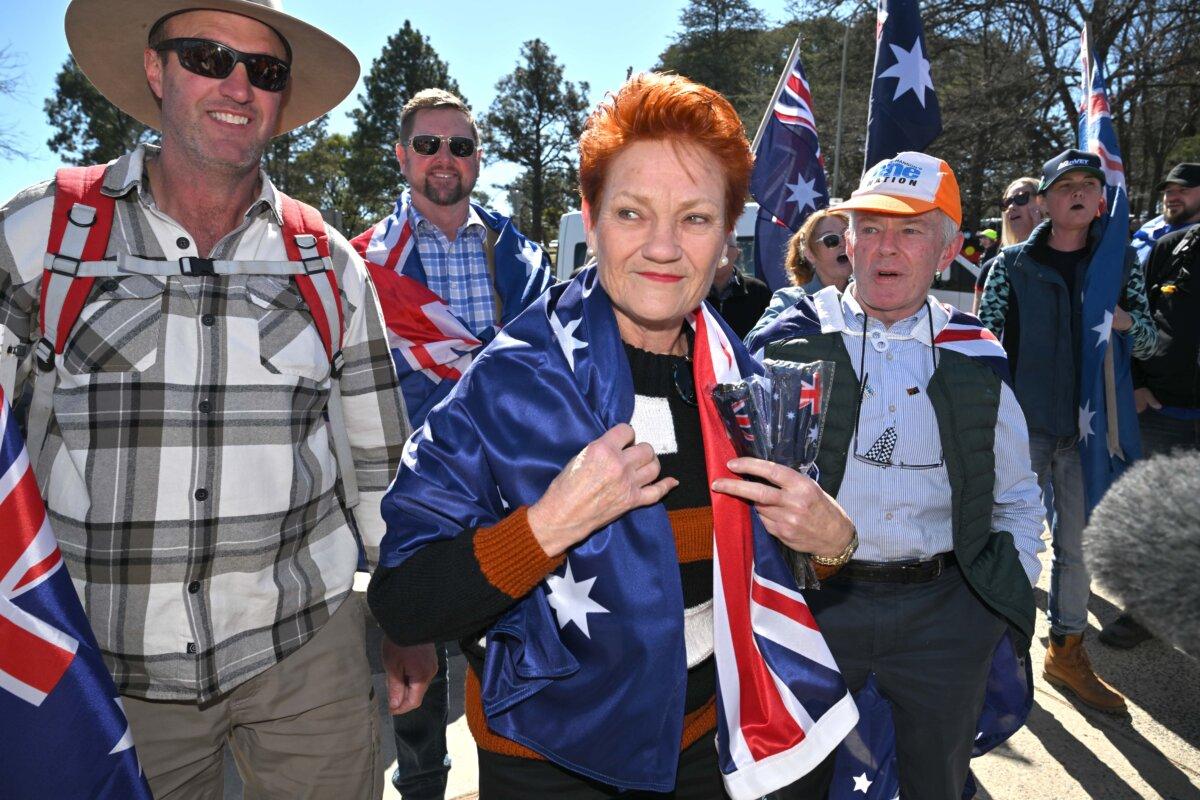
One Nation leader Pauline Hanson and Senator Malcolm Roberts addressed the marching crowd in Canberra, where hundreds of people gathered at Commonwealth Park and marched across a bridge to Parliament House.
Reflecting on the rally the day after, Hanson said, “I was so proud … It wasn’t about being politicians. We were there as grassroots Australians, standing with pride in our nation, in our flag, who we are as Australians.”
AAP contributed to this report.