Violent crime and the possession of weapons are on the increase, contributing to a rise in the prison population to figures not seen since 2019.
Overwhelmingly, it is people born in Australia committing these crimes (83 percent), new data for the year to June 30, 2025, from the Australian Bureau of Statistics (ABS) shows.
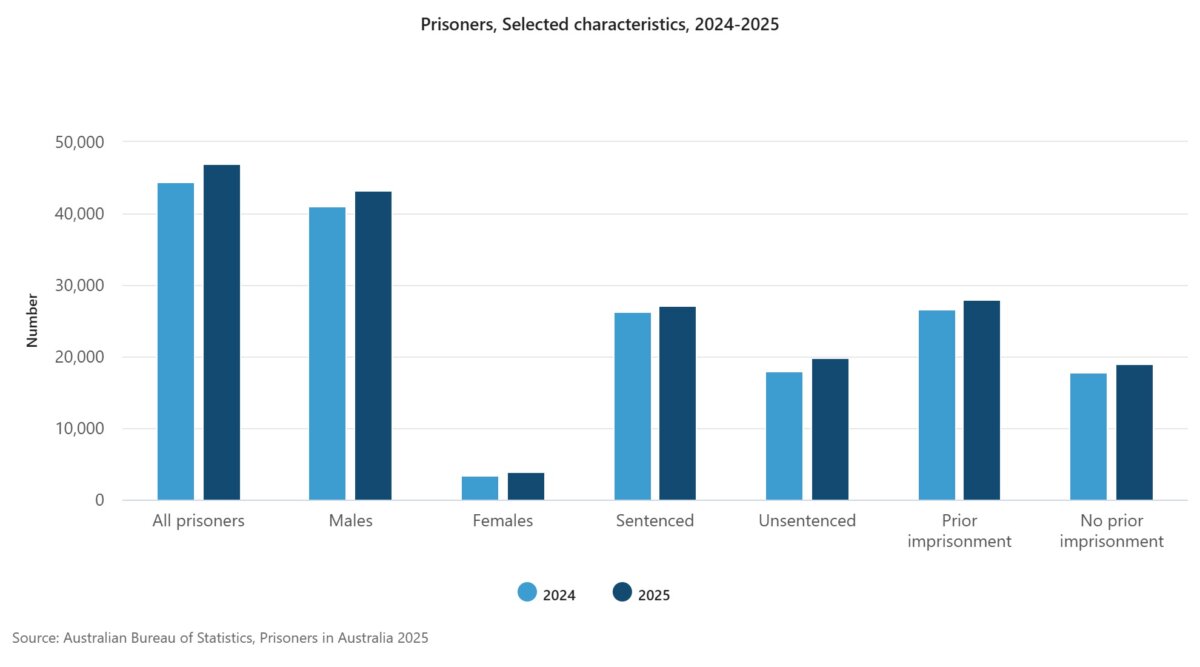
The country’s jail population increased by 6 percent in 2025 to 49,998. Even allowing for population growth, the figures are still up on a per capita basis, from 208 per 100,000 in 2024 to 216 in 2025, the highest imprisonment rate since 2019.
It was women who contributed the most to the percentage increase, with their incarceration numbers up by 12 percent (399) to 3,831. By comparison, the number of male inmates rose 5 percent (2,202), taking the total to 43,169.
The imprisonment rate for males was 404 per 100,000 of the adult male population, up from 391 in the previous year; while for females it was 35 per 100,000 of the adult female population, up from 32 in the previous year.
The total number of prisoners with Aboriginal or Torres Strait Islander heritage reached 17,432, which is 2,595 higher than in 2024.


Recidivist offenders (called “prisoners who had experienced prior adult imprisonment” by the ABS) increased by 5 percent (1,361) and represent almost 60 percent of the total prison population.
Sharp Increases in Violence, Weapons Charges
The proportion of people in jail for what are classed as violent offences has steadily risen since 2016.People jailed for “acts intended to cause injury” showed the sharpest increase of 29 percent over the past 10 years, with 13,663 prisoners in jail for that offence in 2025.
Sexual assault and related offences went up by 17 percent and illicit drug offences rose by 11 percent.
People charged with possessing prohibited and regulated weapons and explosives offences increased by 41 percent (360) to 1,232. Over the past decade, the number of people imprisoned for that offence category has more than doubled—it was just 512 in 2016.
Prisoners born overseas accounted for just 14 percent (6,541), of which the largest cohort was New Zealanders at 2 percent, and Britons and Vietnamese, both at 1 percent each.
The Northern Territory has by far the highest increase in violent offending over the year, followed by the ACT and Tasmania. However, it also has the lowest percentage increase of sexual assault-related charges, with NSW, Victoria and South Australia all leading on that metric.
| Acts intended to cause injury | Sexual assault and related offences | Offences against justice | Illicit drug offences | Dangerous or negligent acts endangering persons | Number of sentenced / unsentenced prisoners | |
| NSW | 28% | 19% | 12% | 7,411 / 5,753 | ||
| Vic | 24% | 19% | 12% | 4,008 / 2,588 | ||
| Qld | 29% | 15% | 11% | 6,439 / 4,784 | ||
| SA | 23% | 19% | 12% | 1,863 / 1,546 | ||
| WA | 26% | 14% | 15% | 5,127 / 3,324 | ||
| Tas | 37% | 18% | 8% | 455 / 343 | ||
| NT | 56% | 11% | 10% | 1,464 / 1,377 | ||
| ACT | 40% | 14% | 8% | 278 / 138 |
More People In Jail Awaiting Trial
The number of unsentenced prisoners rose by 10 percent (1,814) to 19,850 in 2025, meaning that over 42 percent of the people held behind prison walls hadn’t been convicted of an offence—they were there on remand awaiting trial and presumed innocent in the eyes of the law.The proportion of unsentenced prisoners has increased almost every year over the last decade, rising from 31 percent of the total in 2016.
But at the same time, the courts are not making effective use of tools like electronic monitoring and even home detention.
“There are those restrictions there and they can be used effectively to prevent people from attacking their former partner, whatever that situation is, [but] they’re not taking advantage of that,” he says. Hence the rising proportion of prisoners on remand.
The same climate, encouraged by politicians, means people are increasingly being denied parole, further crowding prisons.
Drugs Are The Major Cause of Crime, Advocate Says
Crime, he says, is mostly being driven by drugs, which are so readily available in Australia’s jails that very few people are not addicts by the end of their sentence. In fact, some become addicted while inside.“We did some research on this before the New South Wales Drug Summit, and we were amazed,” Collins says.
“They’re talking about 80 to 90 percent of people in prison using illicit drugs in jail, like actually in jail, and there’s research that says that 10 percent of people who are injecting, injected for the first time in prison. So they’re beginning [bad] habits that continue for a lifetime.”
Apart from the personal, family, and societal disruption that occurs when someone is arrested, it costs taxpayers $104,000 per prisoner per year to retain the existing system, which is another compelling reason for change, Collins says.
Part of the answer is to revolutionise the courts, which are still running on procedures devised centuries ago.
He said it would benefit everyone by holding court hearings within weeks after arrest.
“If I’m sitting in a cell, and I was accused of, for example, of beating my wife, my initial approach is, ‘Oh, no, that was stupid. What the hell did I do?!’” Collins says
“But after weeks of having people around me who are talking a whole different conversation, now I’m worried about where the drugs are coming from, and I’ve abandoned my wife out there; that doesn’t matter anymore. I’m angry now because I’ve lost everything I’ve known ... So the guilt I originally felt is now abandoned in this place. I now have anger and resentment.”