Alberta Premier Danielle Smith and Ontario Premier Doug Ford have announced the route for a proposed 3,300-kilometre pipeline to transport oil from Western Canada to refineries in southern Ontario.
The west‑to‑east crude oil pipeline project, dubbed the “Northern Shield Energy Corridor,” would extend from the town of Hardisty in east-central Alberta through Regina and Winnipeg and on to Sarnia, Ont., Ford said at a July 6 press conference with Premier Danielle Smith.
The premiers made the announcement in Alberta, where they were attending the Calgary Stampede.
The pipeline project stems from an agreement Ford and Smith made at last year’s Stampede to explore an energy corridor linking the two provinces. Ontario, Alberta and Saskatchewan signed a memorandum of understanding weeks later.
The project was designed to capitalize on the oil-refining capacity in Sarnia, a city in southwestern Ontario near the Michigan border, Ford told reporters.
The proposed pipeline, the focus of a feasibility study, would carry approximately 500,000 barrels of oil daily and could expand to 800,000 barrels per day. Ford told reporters Ontario uses roughly 400,000 barrels a day, so anything beyond that would give the province “reserves for a rainy day.”
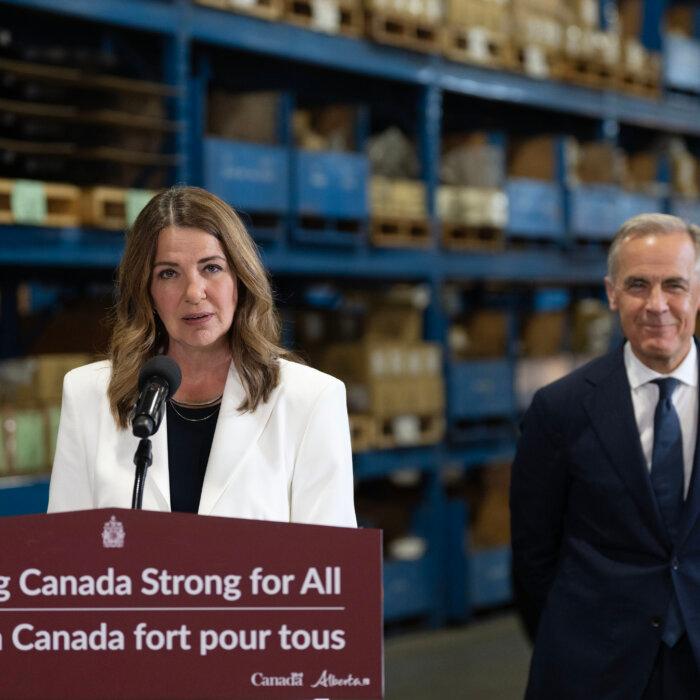
“It’s a win, win, win—a win for Ontario, a win for Alberta, and a win for all of Canada,” Ford said. “It’s a chance to create good-paying jobs that will bring our country together, and it’s a chance to make our country and our continent safer and more secure.”
Ontario is considering possible pipeline extensions to both new and existing ports, including the possibility of Manitoba and the Manitoba-Crown Indigenous Corporation investigating an extension to the Port of Churchill, Ford said.
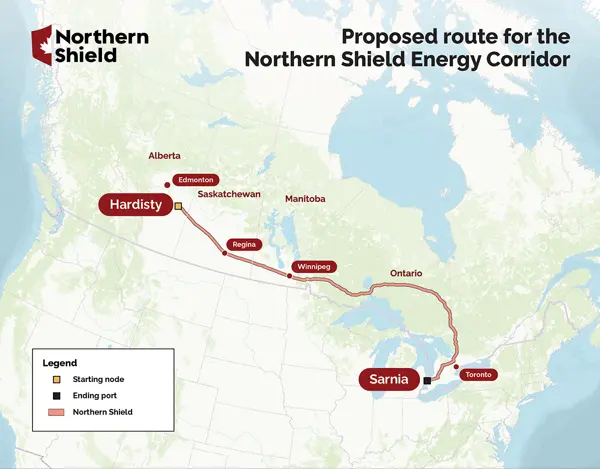
A map showing the proposed route for the Northern Shield Energy Corridor, travelling east from Hardisty, Alta., to Sarnia, Ont. Handout photo
Saskatchewan Premier Scott Moe has said he supports the proposal, adding that it would generate revenue needed to invest in health care, education and public safety. Manitoba Premier Wab Kinew has yet to say whether he is also on board.
Ford did not answer directly when a reporter asked whether Kinew’s administration has shown any signs of backing the project, which would likely need to pass through its jurisdiction.
“We'll work something out,” Ford said. “I think the world of Premier Kinew. I’ve said it 100 times, I think the guy is a champion, but he has to consult a little more with his folks in Manitoba.”
Smith also did not comment directly on Manitoba’s stance, but said public sentiment in Ontario about such a project has changed dramatically.
“Almost 70 percent of Ontario residents support new or expanded pipelines, and Alberta is here to support the needs of Ontario and all of Canada, with energy in support of a stronger economy, job growth, and prosperity for decades to come,” Smith said. “Pipelines have gone from impossible to a national imperative.”
Ford said there is no set timeline for the project yet.
“I'll have a better idea once we do this feasibility study,” Ford told reporters. “But we’re not going to hold back. We’re going to go full steam ahead.”
The July 6 announcement comes days after Smith proposed another new pipeline route from her province to the B.C. coast.
The pipeline plays a pivotal role in the energy deal that Smith finalized with Prime Minister Mark Carney, and Ottawa is expected to make a decision by October regarding its potential fast-tracking through the federal review process.
The interdependence of the proposed West Coast oil pipeline and the Pathways Project will likely translate to the east-west pipeline as well, Smith said. The federal and Alberta governments require the $16.5 billion Pathways carbon capture and storage network to proceed for the pipeline to be built, and vice versa.
“We’re going to be committed to continuing along that path,” Smith said. “And remember, the Pathways Project has three parts to it: one part is the carbon capture trunk line, but the other part is best available technology, and whether that’s nuclear or geothermal, that allows us to decarbonize, that’s going to be available to any operator once those types of technologies are mature.”