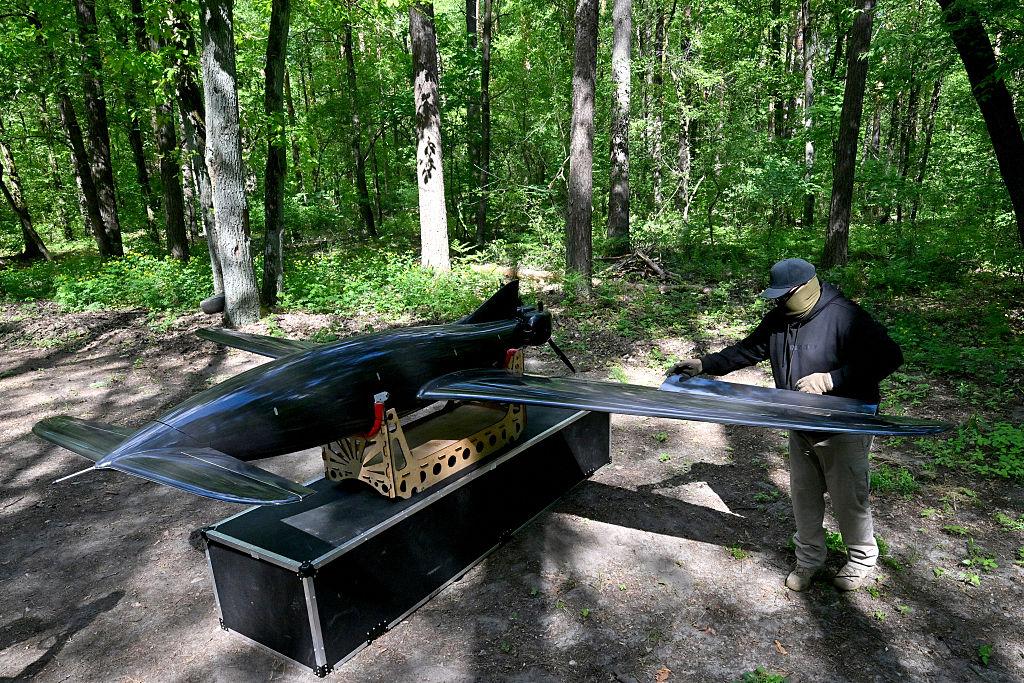
Police in Poland found a crater and debris from an unidentified object that disappeared from army radars tracking it in domestic airspace during Russian strikes on Ukraine on July 30.
Warsaw scrambled fighter jets to secure its airspace amid Moscow’s aerial bombardment of its neighbor, which killed at least eight people in neighboring Ukraine, including one in Kyiv, in attacks that stretched as far as the western city of Lviv, just over 40 miles from the Polish border.
“During nighttime hours, national and allied reconnaissance systems detected intense combat activity by the Russian Federation’s long-range aviation,” the Polish Operational Command of the Armed Forces said in a July 30 post on X.
“To ensure the safety of Polish airspace, the combat readiness of air defense system assets was elevated, including pairs of on-duty fighters and an early warning aircraft,” the post added, going on to say that “at 3:40 a.m., an unidentified object moving westward was detected in Polish airspace.”
Polish Operational Command said that an on-duty F-16 was then dispatched to the area to “identify and intercept” the object, but before it could be identified, “the object disappeared from radar system indications” at 3:46 a.m.
Subsequently, a helicopter was sent to the last known location of the object and located “the probable crash site of the object in an undeveloped area near the village of Tarnawa-Kolonia in the Lublin Voivodeship.”


“A Ground Search and Rescue Team and the relevant services were dispatched to the scene. Operational and securing actions are ongoing at the incident site,” Polish Operational Command said.
“An unidentified object moving westward was detected in Polish airspace,” the operational command of the armed forces said on X, adding that it disappeared from radars soon after the sighting at 3:40 a.m.
The crater was about 10 meters wide, Polish Interior Ministry spokesperson Karolina Gałecka said on X, adding that it was found just over a mile away from some buildings.
Police in the Lublin area said in a post on X that they received reports of a “powerful explosion” in Biłgoraj county, between the villages of Tarnawa Kolonia and Biskupice.
“Officers discovered a crater and scattered debris from an unidentified object in a field located about 2 km (1.2 miles) from the nearest buildings, between the villages,” the police added, saying that they had secured the area.
Polish Prime Minister Donald Tusk announced on X that he had established a special coordination team to investigate the incident and later posted a photograph of himself alongside investigators at the crash site.
Tusk told an emergency meeting, “All the indications are that it was a Russian Kh-101 ballistic missile, but we want to be 100 percent certain about the type of missile and who launched it,” adding that “there was no direct threat because the missile landed in an uninhabited area; we were ready to shoot it down had it continued its flight.”
Tusk’s view was backed up by an X post from Ukrainian Foreign Minister Andrii Sybiha, who said that “overnight, a Russian Kh-101 cruise missile crossed into Poland as part of Russia’s massive strike against Ukraine, violating NATO airspace.”
“This is yet another clear demonstration that strengthening Ukraine’s air defense now is urgent and serves as a guarantee for the protection of the entire Euro-Atlantic community,” Sybiha said, adding in a later post on X that he had spoken with Polish Foreign Minister Radek Sikorski.
Moscow has not yet commented on the incident in Poland, but the Russian Defense Ministry confirmed in a July 30 post on Telegram that it had “launched a massive strike using long-range air, land, and sea-based precision weapons, as well as attack drones, against military industrial facilities, telecommunications and logistics centers” across a range of cities in Ukraine.
Ukrainian President Volodymyr Zelenskyy said in a July 30 post on X that “Kyiv and the region, as well as our Dnipro, Lviv, Poltava, Kharkiv, Mykolaiv, Sumy, Vinnytsia, Cherkasy, and Ivano-Frankivsk regions, came under attack overnight.”
“Dozens of ordinary homes, civilian businesses, and infrastructure facilities were destroyed and damaged. More than 70 missiles were used in this strike, a significant number of them ballistic. There were also over 280 attack drones,” he said, adding that Ukrainian air defenses had managed to down the majority of the drones and a “significant number of cruise missiles.”