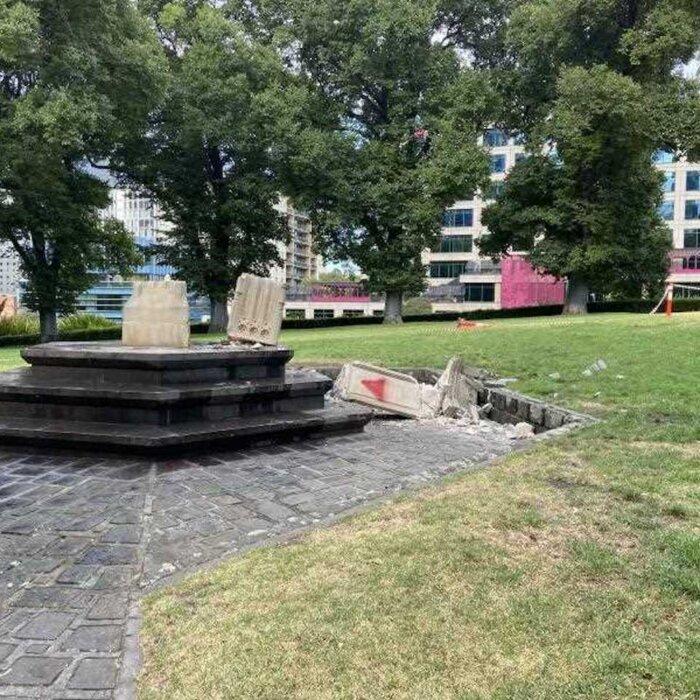
Tasmania Police are actively investigating the toppling of a 103-year-old Anzac monument in the town of St. Helens.
It’s believed to have occurred some time between Jan. 28-29.
The obelisk was a tribute to World War I diggers, and a police image shows the top half of the structure broken off completely and left on the steps of the monument.
“The St. Helens cenotaph in Tasmania was dedicated in 1923 to local men who died in World War I,” wrote the British Australian Community on X.
“Among those commemorated are two brothers” whose names were Clarence and Herbert Gardiner.
Clarence was wounded in Gallipoli before passing away in Malta at the age of 21.

Herbert was 23 when he was killed in action in Belgium.
The RSL Tasmania said Australians should reflect on the incident.
“A cenotaph is not simply stone and mortar. It is memory made visible. It represents young men and women who never returned home, families and communities who carried grief for a lifetime, and generations who understood that freedom is neither automatic nor free.
“These monuments anchor our towns in shared history and collective gratitude.”
String of Attacks on Australian Historical Monuments, Structures
There has been an uptick in heavy vandalism against Australian monuments to history or colonialism in recent years with a major uptick in recent weeks.On Jan. 14, vandals in the New South Wales (NSW) town of Walgett targeted a 100-year-old Anzac memorial, which was knocked over and shattered.
A second monument in the same park was also attacked.
On Jan. 23, vandals defaced the Eltham War Memorial in Melbourne’s northeast with red paint and slogans.
Then on Jan. 24, vandals attacked a popular wedding venue in Melbourne’s Queen Victoria Gardens, covering each pillar in Aboriginal flag graffiti.
And on Jan. 28, Melbourne’s oldest surviving building was defaced with red paint. The La Trobe Cottage was home to Lieutenant-Governor Charles Joseph La Trobe
Footage of the attack was later shared online by the vandals.