Four people are facing charges in connection with an investigation into a carfentanil trafficking network that operates from the greater Montreal area to export the highly potent synthetic opioid to the United States, mainly via the dark web, police say.
Sûreté du Québec’s anti-organized crime squad arrested two men and two women on the morning of Feb. 25 following a joint investigation between the police force’s cybercrime unit, the U.S. Department of Homeland Security, and U.S. Customs and Border Protection.
Wanya Nathan Ellis and Cheyanne Buchanan-Dennis, who are both from Sainte-Catherine, Que., Darren McAlpine of Delson, Que., and Geneva Fournier of Châteauguay, Que., are facing possession for the purpose of trafficking, drug trafficking, and possession of a prohibited weapon charges.
The arrests stemmed from a series of searches last December that resulted in the confiscation of a cache of drugs and weapons, police said.
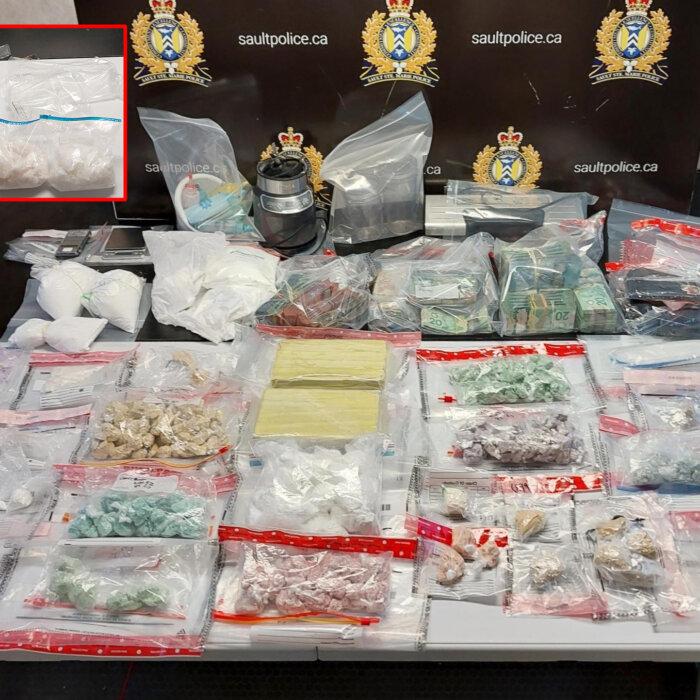
Officers seized more than 600,000 tablets, which included methamphetamines, metonitazenes, MDMA, and benzodiazepines, along with cannabis, cocaine, tools facilitating trafficking through the dark web, brass knuckles, a loaded nine-milimetre handgun, and multiple rounds of ammunition.
“Metonitazene and protonitazene are substances not widely known to the public at present, but they are considered more potent than fentanyl,” police said.
The warning was about a counterfeit cough syrup that was being promoted as a legitimate pharmaceutical product. Public health said in the warning that individuals who ingest the substance could be subjected to an “unpredictable and toxic mixture” that heightens the likelihood of an overdose.
Protonitazene is a synthetic opioid that is three times more potent than fentanyl and can induce life-threatening toxic effects even in extremely small doses.
Carfentanil Trafficking
The U.S. Drug Enforcement Administration (DEA) describes carfentanil trafficking as a serious and evolving component of the global opioid crisis, involving an extremely potent synthetic opioid that is “one of the deadliest fentanyl analogues.”It is often mixed into other illegal drugs, making them deadlier due to the high potency of the synthetic opioid, the DEA said.
Carfentanil was originally developed to tranquilize large animals such as elephants and is estimated to be 10,000 times more potent than morphine and 100 times stronger than fentanyl.
“Because of its strength, a nearly microscopic amount of carfentanil can induce a powerful, and often deadly, effect in humans,” the DEA said.
The Toronto agency said carfentanil is typically found in combination with other high-potency opioids as well as with other central nervous system or respiratory depressants, like benzodiazepine-related drugs and veterinary tranquilizers.
Of the 179 samples collected in Toronto that contained carfentanil between October 2019 and August 2025, 88 percent contained at least one other high-potency opioid and 62 percent contained at least one benzodiazepine-related drug or veterinary tranquilizer, the service said.
Samples collected this year between Feb. 7 and 20 found that 30 percent of expected fentanyl samples contained multiple high-potency opioids, including carfentanil, fluorofentanyl, and/or a methylfentanyl-related drug.