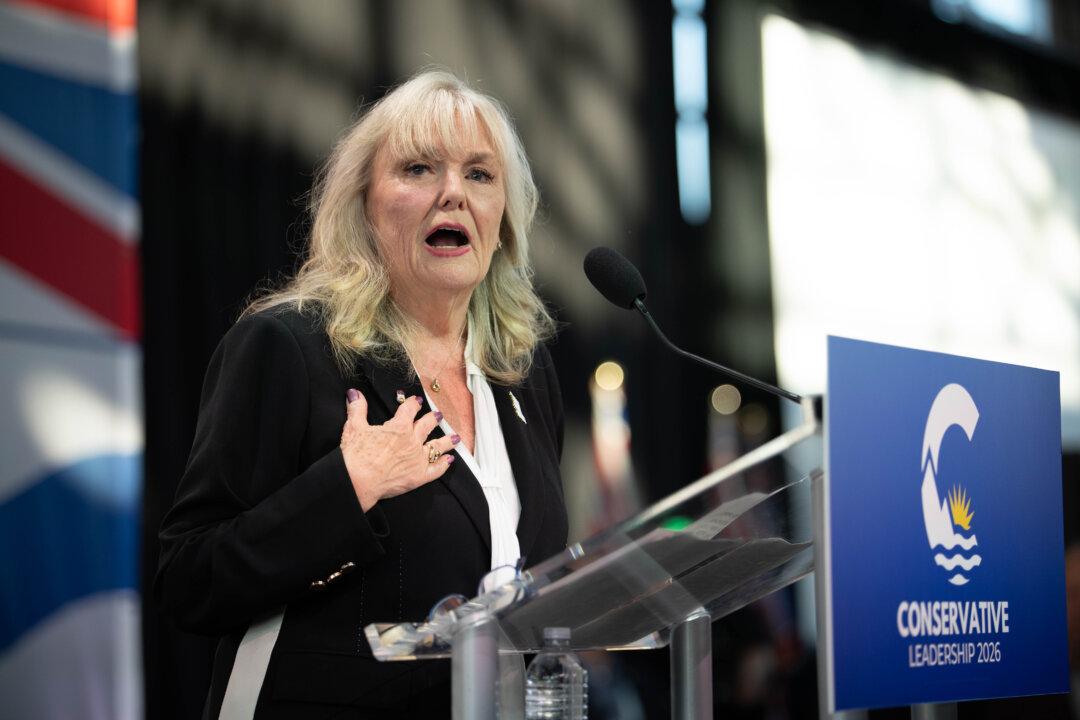
“These stories that were on the faces of the people I met, the woman suffering from cancer who had just overcome days of radiation treatment who showed up at my town hall in Stettler to tell me to keep going. I say to her, ‘you don’t give up, so I don’t give up.’”
He began his speech by thanking former Tory MP Damien Kurek, who gave up his seat in the Conservative stronghold riding so Poilievre could have another chance to return to the House of Commons.
In his bilingual speech, the Conservative leader laid out what his party will be focusing on going forward as it takes on the minority Liberal government.
“Us Conservatives have our work cut out for us this fall as Parliament returns. We will not only oppose out-of-control Liberal inflation, crime, immigration, cost-of-living, and housing crisis, but we will propose real solutions,” he said.

Poilievre said his party is ready to work with “any party to get results,” and that he will propose a Canadian Sovereignty Act to boost prosperity.
“This act would legalize pipeline construction, rapid mine approvals, LNG plants, nuclear plants,” he said, making an apparent reference to the Liberal government’s Impact Assessment Act which Alberta and the Conservatives have dubbed the “no more pipelines act.” The Carney Liberals say under their newly passed Building Canada Act, major projects of national interest will be expedited, and legislation standing in the way can be bypassed.
Poilievre added that his proposed act, which includes many of the ideas Tories campaigned on ahead of the April 28 federal election, would remove the industrial carbon tax and electric vehicle mandates, and allow Canadians to avoid paying capital gains tax when proceeds are re-invested in Canada.
“This is an idea I hope the Liberals will steal,” he said, repeating a comment the Tories made at the time of the federal election, saying the Liberals had copied many of their policies.
The Conservative leader repeated his party’s focus on launching a campaign to oppose the federal government’s looming electric vehicle mandates, saying it’s not practical in Canada’s cold climate. The Liberals have said the mandates are needed to achieve net-zero emissions targets, and that the government is helping to build more infrastructure to help with the wide adoption of electric vehicles.
Poilievre also repeated his party’s criticism of the federal government’s immigration policies, saying the Liberals have engaged in “open borders experiment of mass immigration.”
“Conservatives welcome lawful, orderly immigration, but it has to be done in our national interest, the right people and in the right numbers,” he said. “Over the next several years, we need to have more people leaving than coming so that citizens in Canada can afford homes, can find jobs, and health-care.”
Results
With 285 of 286 polls reporting as of the morning of Aug. 19, Poilievre had gained 80.4 percent or 40,548 of the total 50,434 valid votes. Voter turnout was at 58.8 percent.Kurek won the April 28 election with 82.8 percent or 53, 684 of the total 65,198 votes, while the Liberal candidate came in at a distant second with 11.7 percent.
Byelection
Poilievre lost his Ottawa-area riding of Carleton, which he had held for more than two decades, in the April 28 election. Liberal candidate Bruce Fanjoy won the riding by more than 4,500 votes.Following the election, Poilievre suggested that his loss in Carleton was due to his stated plans to reduce the size of the federal government, which could have proven unpopular with the many government workers in the riding.
Kurek, who had held Battle River–Crowfoot since 2019, officially resigned his seat on June 17, after which Carney called the byelection. Carney had said that he would call the byelection as soon as possible, and that there would be “no games.”
With Parliament returning in September, Carney and Poilievre will face each other in the House for the first time.
Kurek said it had been “nothing short of a privilege” to serve the people of the riding, and that he looked forward to supporting Poilievre in the race and then “running here again in the next general election.”
Election Protest
The Alberta riding was targeted by the Longest Ballot Committee (LBC) protest movement, which is the same organization that targeted Poilievre’s former riding of Carleton and resulted in 91 names being on the ballot. The LBC is demanding that Canada change its first-past-the-post election system with a proportional representation system.With a record number of candidates running in the Battle River–Crowfoot byelection, Elections Canada announced in late June that the vote would use a special ballot requiring voters to write in the name of their chosen candidate, instead of marking a standard list of names.
Elections Canada said votes for candidates would be counted even if their names were spelled incorrectly.