This copy is for your personal, non-commercial use only. Distribution and use of this material are governed by our Subscriber Agreement and by copyright law. For non-personal use or to order multiple copies, please contact The Epoch Times Reprints.
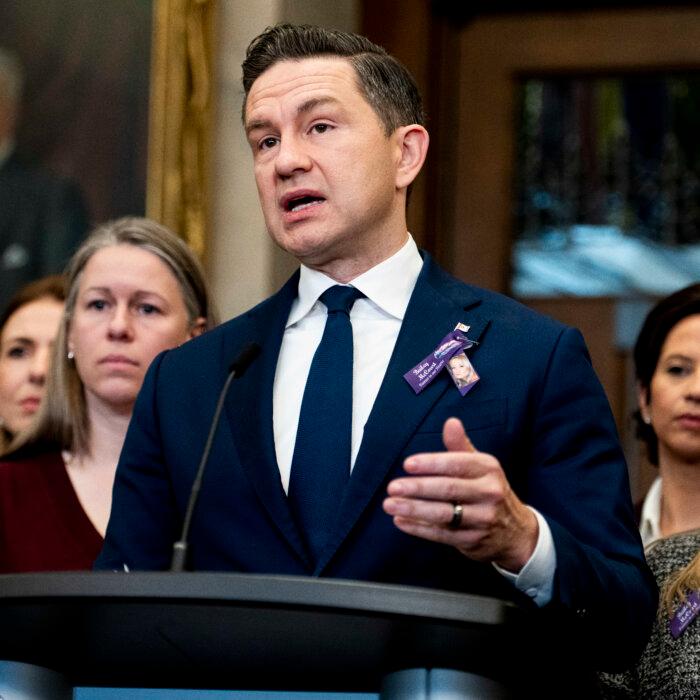
Conservative Leader Pierre Poilievre says he believes younger Canadians have made more sacrifices than any generation since World War II, and pushed back against the prime minister’s recent comments ahead of the federal budget that Canadians must be prepared to make “some sacrifices.”
“I mean this literally ... this young generation has sacrificed more than any generation since the Second World War. There is no doubt in my mind that all of you are working harder and longer for less than your parents and probably your grandparents,” Poilievre said during a rally in Toronto on Oct. 30.
Poilievre told the audience of young Canadians that they had sacrificed home ownership because of rising housing costs, their food and nutrition due to rising grocery costs, and their employment opportunities due to “employment-killing taxes, red tape, and temporary foreign worker programs.”
The Conservative leader noted that youth unemployment in Canada is at nearly 15 percent, which is the highest number in a decade and a half outside of the COVID-19 pandemic. Poilievre said this metric has risen from when Prime Minister Mark Carney took office in March, when it was 13.7 percent.
“You ask, ‘What did I do wrong? Why can’t I find a place to work?’ … The answer is, you did absolutely nothing wrong. You did everything right. Your phone should be ringing off the hook with job offers because you are qualified, and you have been preparing for this moment to contribute to our economy,” Poilievre told the audience.
Poilievre also said the prime minister’s promises had been replaced with “grim warnings,” and that Carney had “said young people are going to have to make more sacrifices.” Poilievre said young Canadians had “already sacrificed enough” and deserved a “bright future of homes, jobs, and hope.”
On Oct. 22, Carney made an address to University of Ottawa students where he said Canada’s economy was doing “reasonably well” in light of U.S. tariffs. He said the upcoming Nov. 4 budget will focus on growing non-U.S. exports, getting major projects approved via the Major Projects Office, reducing immigration while prioritizing skilled workers, and reducing emissions while ensuring Canada is an “energy superpower.”
“To be clear, we won’t transform our economy easily or in a few months. It will take some sacrifices, and it will take some time,” Carney told the audience. The prime minister added that his government would work “relentlessly to cut waste and drive efficiencies” and would be transparent when needing to make “difficult choices.”
Carney has previously said that the budget will involve less spending on government operations while protecting programs and initiatives that support the most vulnerable Canadians. Interim Parliamentary Budget Officer Jason Jacques recently projected that the federal deficit could reach $68.5 billion this year, which is up from an estimated $51.7 billion last year, and Government House Leader Steven MacKinnon has said the budget will have a “substantial” deficit.
MacKinnon also said on Oct. 26 that the minority Liberals did not currently have the necessary votes to pass the budget, since they require the support of at least one other opposition party to pass it, lest Parliament be dissolved and an early election triggered.
In recent years, the Conservatives have increased their share of votes among young Canadians. An April 27 poll by Ipsos released one day ahead of this year’s federal election suggested that support for Conservatives and Liberals among voters aged 18-34 was tied at 38 percent. In 2018, an Ipsos poll suggested that in the same age group, the Conservatives had 24 percent support, while the Liberals had 33 percent.