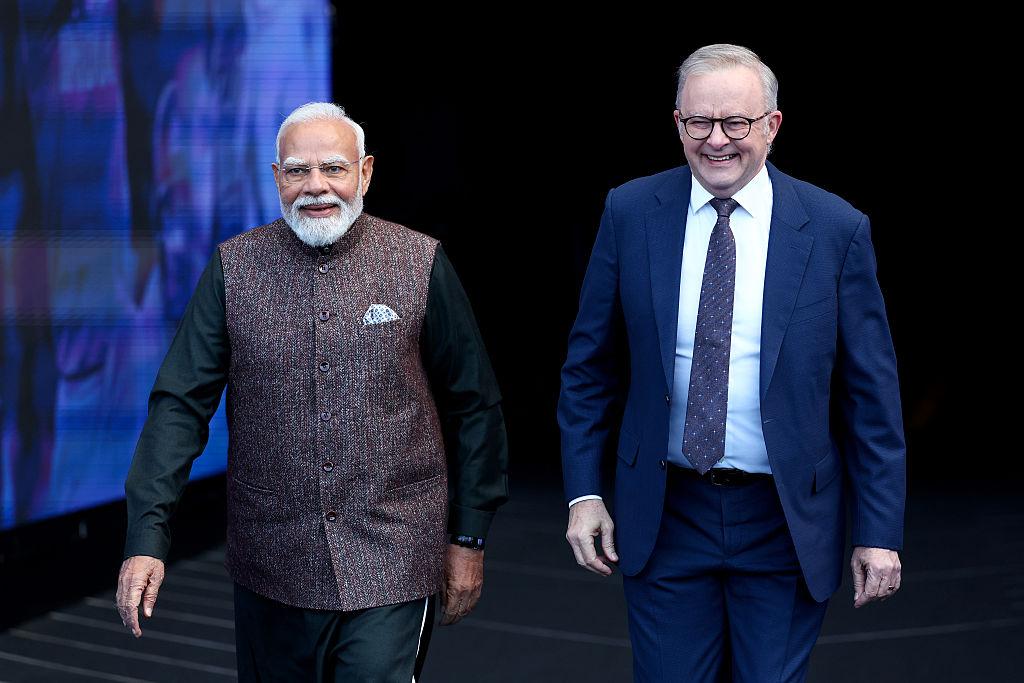
Prime Minister Anthony Albanese hopes respect for U.S. President Donald Trump will be returned to him during a long-awaited meeting in Washington D.C.
The confirmation of the October bilateral followed Albanese meeting with Trump for the first time at a gala dinner hosted by the U.S. president for world leaders at the U.N. summit.
Albanese said he did not feel the need to present Trump with an offering at their meeting, as other world leaders have during White House talks, but said the relationship between the two countries was strong.
“I feel like I need to treat [Trump] with the respect that the president of the United States deserves, and I expect that to be returned,” he told ABC’s Insiders program on Sunday.
“We’ve had five either phone conversations or greetings in person now, and they’ve all been warm, constructive, positive, and optimistic.
“It is in both Australia’s interests and the interests of the United States that we continue to have a good relationship.”
A potential deal on tariffs is expected to be on the agenda for the meeting, as well as the future of the AUKUS deal, with the United States undertaking a review of the trilateral security pact that would give Australia nuclear submarines.
Albanese signalled supplies of critical minerals from Australia to countries such as the United States could also factor in negotiations.
“Critical minerals could become certainly (part of AUKUS), because a range of the equipment, what’s required for defence of all of our three nations, will be critical,” Albanese said.
“Minerals will play a role in that. What we are talking about is making sure that we maximise the return to Australia.”
Australian officials are still trying to determine the full impact of the latest round of tariffs imposed by Trump on pharmaceuticals imported to the United States.
The president said a 100 percent tariff would be placed on branded or patented pharmaceutical product imports from Oct. 1, unless a pharmaceutical company was building a manufacturing plant in the United States .
Pharmaceuticals are one of Australia’s biggest exports to the United States, worth $2.2 billion, and there are fears the Australian biotech company CSL could be affected.
Health Minister Mark Butler said work was under way to determine how the tariffs would impact Australian goods.
“The vast bulk of our exports to the U.S. are actually blood and plasma products, so it’s not entirely clear whether they are captured by the scope of the announcement the president made,” he told Sky News.
“There’s a very high likelihood the major exporter that accounts for the vast bulk of our exports to the U.S. will not be captured by this new announcement.”
Opposition foreign spokeswoman Michaelia Cash said tangible results needed to come from the talks between Albanese and Trump.
“Australians don’t expect their prime minister to be scared. They expect their prime minister to deliver outcomes,” she told Sky News.
“The relationship in Washington is not strong, and because it’s not strong, Albanese is not able to pick up the phone, like other world leaders are able to do, and speak directly to the U.S. president about the impact of (the tariff) announcement on Australia.”