The Philippines stated on March 16 that it rejected Beijing’s claims to sovereignty over the entire South China Sea and denied a claim by the Chinese Embassy that a Filipino diplomat had conceded 36 years ago that the disputed Scarborough Shoal was not part of its territory.
Rogelio Villanueva, a spokesman for the country’s Department of Foreign Affairs (DFA), told a briefing that the Philippines had “indivisible, incontrovertible and longstanding sovereignty” over Scarborough Shoal and several islands in the Spratly archipelago.
“China must be reminded that maritime and territorial claims are subject to established international legal procedures and dispute settlement mechanisms, not through unilateral proclamations or social media posts,” Villanueva said.
He was responding to a March 14 post on X by the Chinese embassy in Manila that said a former Philippine ambassador, Bienvenido A. Tan Jr., had written to a German ham radio operator, Dieter Löffler, in 1990, saying that Scarborough Shoal “does not fall within the territorial sovereignty of the Philippines.”
Villanueva said that the DFA “will not engage in conjecture or speculation over a document of uncertain origin and authenticity and certainly without value,” according to Philippine broadcaster ABS-CBN.
“There is no merit in debating supposed documentary artifacts produced by third parties and presented as posts on social media, especially if these third parties have vested interests and willfully misconstrue and misrepresent established facts,” he said.
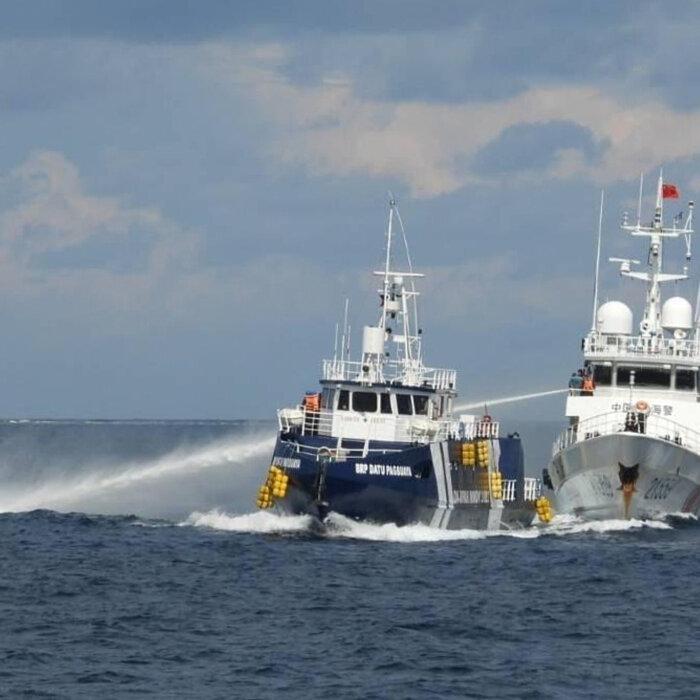
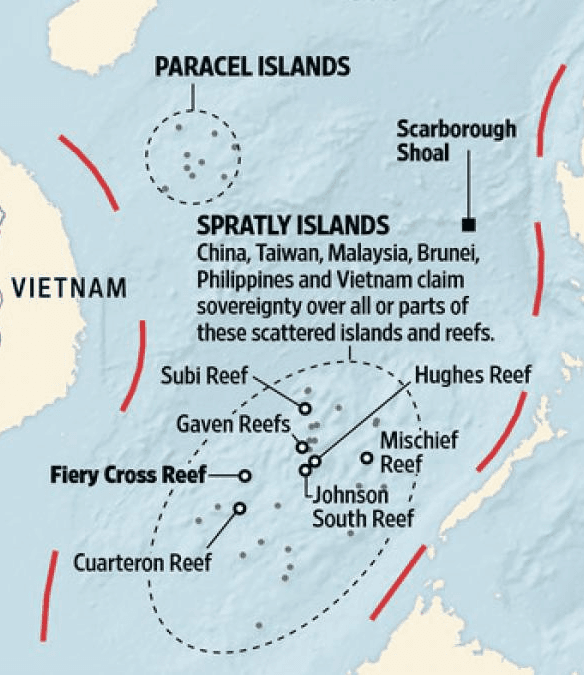
Beijing and Manila both claim the Scarborough Shoal, which lies strategically close to international shipping lanes linking China to the Straits of Malacca and onward to India, the Middle East, Europe, and Africa.
The shoal takes its English name from the British merchant ship, the Scarborough, which was grounded on the atoll in 1748. The shoal is known as Huangyan Island in China and the Panatag Shoal, or Bajo de Masinloc, in the Philippines.
In recent years, China has acted increasingly aggressively toward the Philippines, Vietnam, and Malaysia, all of which have disputes with China in the South China Sea.
The shoal is about 124 nautical miles from the coast of the Philippines and inside its exclusive economic zone and is renowned for its plentiful fish stocks.
In the Paracel Islands, both China and Vietnam have used dredged sand to reclaim land and boost their sovereignty claims.
Further south, the Spratly Islands archipelago is hotly disputed between China, Vietnam, and the Philippines.
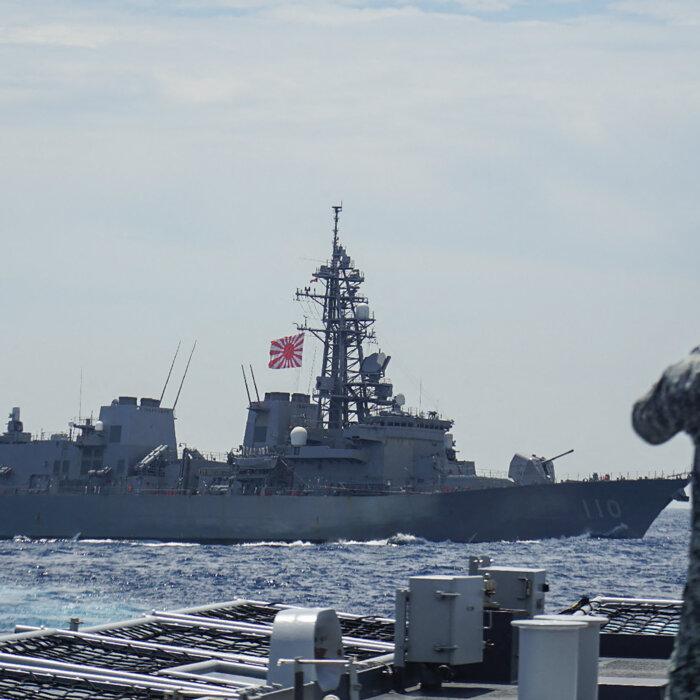
Last month, the navies of the United States, Japan, and the Philippines held joint exercises in the South China Sea to demonstrate their commitment to an open Indo-Pacific.
China Lost Arbitration Ruling
China claims most of the resource-rich waterway, rejecting a 2016 ruling by the Permanent Court of Arbitration, based in The Hague, that has voided Beijing’s claims to the area.In a March 14 post on X, the Chinese Embassy in Manila stated that China’s position on the South China Sea is “clear and consistent.”
“China has indisputable sovereignty over the Nanhai Zhudao (the South China Sea Islands) and its surrounding waters, supported by historical and legal evidence,” the embassy stated.
“The Philippines’ illegal occupation of some islands and reefs in the Nansha Qundao (the Spratly Islands) since the 1970s is the root cause of the dispute. Differences should be resolved through negotiation and consultation, not by unilaterally insisting on one’s own position.”
The Epoch Times reached out to the Chinese Ministry of Foreign Affairs for comment but did not receive a response by publication time.