PARIS—When Paris Saint-Germain won its second Champions League title on May 30, the celebrations in the French capital once again gave way to a night of arson, looting, and clashes with police across some 15 cities.
In the weeks since, the violence has hardened into a fixed reference point in France’s long-running argument over immigration, assimilation, and public order.
According to a poll commissioned by French newspaper Le Figaro, National Rally President Jordan Bardella, who is expected to replace Marine Le Pen should she be barred from the 2027 presidential race over her ongoing legal troubles, has reached a record high in French public opinion after the riots, becoming the most popular political figure in the country.
The episode sharpened a divide that has shaped French politics for years: whether such outbreaks are a problem of public order and social conditions, or the symptom of a deeper fracture tied to immigration and national identity.
Citing the recurrence of such incidents, several analysts told The Epoch Times that they are concerned about growing public anger and the potential for escalating civil unrest, drawing parallels with the anti-immigration riots that erupted in Belfast, Northern Ireland, on June 9.
The unrest followed the circulation of a widely shared social media video showing a Sudanese immigrant brutally attacking a Scottish man the previous day.
Recurring Pattern
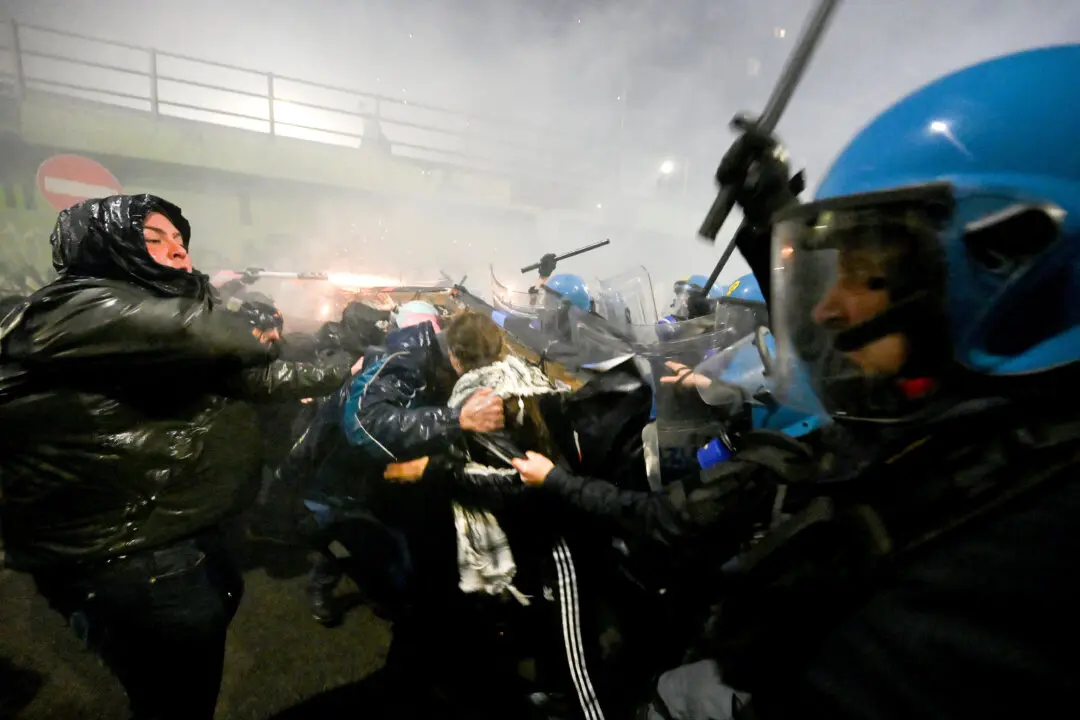
The disorder in Paris followed a now-familiar script. During the night, rioters looted shops, torched vehicles, and repeatedly forced their way onto the Paris ring road, while some groups of young people waved Algerian and Palestinian flags and set off large quantities of fireworks.
Some vandalized bus shelters; others piled up bicycles and rubbish bins and set them alight, fired firework mortars at officers, and hurled insults at the police. France deployed 22,000 officers, and one group tried to storm a police station in the upscale 8th arrondissement before being pushed back.
Residents near the Champs-Élysées described scenes of fear as the disorder spread to central neighborhoods.
“The rioters smashed everything, burned everything. A vehicle right in front of our home caught fire. We were very frightened, we felt in danger,” one resident, who preferred to remain anonymous out of safety concerns, told The Epoch Times.
Another, who also asked to remain anonymous out of safety concerns, voiced frustration at the cost.
“It makes me furious, because we are the ones who will end up paying for all of this. Every time it is the same. We can’t take it anymore,” she said.
For Ivan Rioufol, a veteran conservative columnist and author of “The Coming Civil War,” the recurrence was no surprise. In an interview with The Epoch Times, he argued that the state readily deployed armored vehicles and crowd-control weapons against farmers or Yellow Vest protesters, yet hesitated before urban riots, “paralyzed by the fear that a single death among the rioters would set the country ablaze.”
Emmanuel Grégoire, the Socialist mayor of Paris, denounced the violence but called the incidents isolated, saying they would take nothing away from the city’s collective pride after Paris Saint-Germain’s victory.
Rioufol allowed that the rioters were a minority, but added that “revolutions are historically always made by minorities,” describing a mobilized group able to tie down considerable police resources.
Pointing to the influence of Islamism in immigrants’ suburbs, he said: “These individuals … are also the armed wing of an ideological and political project. By replaying the Israeli–Palestinian conflict on French soil, and by imitating its symbols and actions through these miniature intifadas, they are engaging in a political act.”
According to a survey conducted by French polling firm Ifop, 59 percent of French Muslims aged 18 to 24 believe that Sharia law should take precedence over the laws of non-Muslim countries.
Jean-Pierre Colombies, a former police commander turned commentator and author of the recent book “The Dark Side of the Police,” offered a more operational reading.
The crackdown that politicians of all stripes demand is, he argued, “largely illusory”: few arrests end in conviction, because under the rule of law, prosecutors can charge only a proven offense, and the officers who seize suspects amid chaotic street scenes are often unable to document what each one actually did.
He framed the violence as “a social fact, not a news item,” the product of a state that, in his telling, has withdrawn from neighborhoods and even whole towns where public authority has thinned.
What had changed over time, he said, was the scale: looting once concentrated on the Champs-Élysées now flares across dozens of towns at once.
2 Readings of the Violence
The political reaction split along predictable lines. On June 1, Bardella called the scenes “civil war” and drew an “evident link” with immigration, declaring that “the first means to restore security in France is to stop immigration.”
On the left, the violence was read very differently. Former Prime Minister Dominique de Villepin rejected that reading outright.
“It’s a lie,” he said, demanding an apology and insisting that the Republic must judge acts and individuals, “not populations or origins,” while warning against casting blanket suspicion on French citizens of immigrant background, whether of the second, third, or fourth generation.
Thomas Legrand, a journalist at the social justice-oriented daily Libération, argued that the violence was not caused by immigration but by “segregation” and the alleged “poor social conditions” in affected neighborhoods, along with a lack of “real diversity.”
France Unbowed MEP Manon Aubry, while acknowledging acts of vandalism, accused conservatives in the West of “targeting this huge popular celebration, these scenes of joy, unity, and fraternity.”
Rioufol dismissed the refusal to see an immigration dimension as “intellectual laziness.” He said that most of those arrested were French citizens, but argued that nearly all were French, of immigrant background, making immigration, in his view, the root cause. The problem, he said, was “French citizens who do not see themselves as French.”
Colombies faulted a left he accused of courting an uprooted electorate for votes, and a “demagogic right” that, in his view, has long reduced the issue to law-and-order slogans—an approach he called “bound to fail” unless it confronted decades of failed assimilation, which he linked to mass immigration and what he described as decolonial ideology taught in French schools.
What the Data Show
France’s most serious recent episode of urban unrest came in the summer of 2023, after a police officer fatally shot 17-year-old Nahel Merzouk, a French national of Algerian descent, during a traffic stop in Nanterre.
The officer claimed self-defense, but the killing set off eight nights of rioting, arson, and looting that spread from Paris’s suburbs to towns across the country.
At its peak, the government deployed 45,000 police and gendarmes. The employers’ federation Medef estimated the direct economic damage at more than 1 billion euros ($1.1 billion), excluding destroyed public buildings and schools, as well as lost tourism revenue.
A 2023 report by the General Inspectorate of Administration, commissioned by the Interior and Justice Ministries, found that 79 percent of the 385 convicted individuals held French citizenship.
Citing data from the Paris Police Prefecture, it noted that these French nationals were predominantly young people of immigrant background, second- or third-generation, mainly from North Africa and sub-Saharan Africa.
Rioufol situated the May 30 riots, along with previous unrest, within what he describes as a “counter-society” shaped by North African and sub-Saharan immigration, which he sees as overlapping with the “New France” that left-wing leader Jean-Luc Mélenchon has himself described as an emerging electoral bloc.
Following the 2023 riots, Macron stated that “90 percent of those arrested are French nationals,” while noting that France does not collect official ethnic statistics. He attributed the unrest to “socio-economic difficulties,” “integration issues,” and the impact of social media on “the functioning of democracy.”
The Paris Police Prefecture did not respond to a request for comment regarding the profile of those arrested on May 30.
The competing diagnoses extend to public spending. Critics among conservatives point out that, despite 200 billion to 400 billion euros ($230 billion–$460 billion) invested in suburban development programs over recent decades, crime rates in those areas have not fallen significantly.
By contrast, France’s poorest rural departments, such as Dordogne and Creuse, consistently record some of the country’s lowest crime rates, according to data from the Interior Ministry and INSEE, the national statistics institute.
Remigration Debate
Jean-Yves Le Gallou, president of the French foundation Polémia, cofounder of the Iliade Institute, and author of “Remigration: For a Europe for Our Children,” said in an interview with The Epoch Times that the Paris riots strengthened the case for halting further immigration as a first step, describing the rioters as unassimilated youths.
“If we fail to halt mass immigration, the disturbing scenes we have witnessed in May and in previous decades will keep repeating, and grow only more violent,” he said.
The unrest on May 30 coincided with the second Remigration Summit, held the same day in Porto, Portugal. The gathering, organized by Austrian identitarian activist Martin Sellner, with the presence of former U.S. Border Patrol Chief Greg Bovino, brought together politicians, activists, and commentators who advocate policies to reverse migration flows.
Jean-Yves Le Gallou attended the summit and tied the Paris scenes to its theme.
“We were in Porto at the exact moment when events in Paris provided a powerful, real-life advertisement for why we need this policy,” he told The Epoch Times, referring to remigration.
Footage of burning cars, vandalized storefronts, and clashes with police spread rapidly on social media and in international outlets. Tech billionaire Elon Musk shared a video of the Paris riots on X, captioned “Problems in Paris,” a post that drew millions of views and reignited debate over public security in major European cities.
Conservative figures across Western Europe amplified the footage as evidence for their immigration positions. Among them, Alternative for Germany leader Alice Weidel, whose party had by then surged to become one of the most popular political forces in Germany, relayed Musk’s post with a single word: “Remigration.”