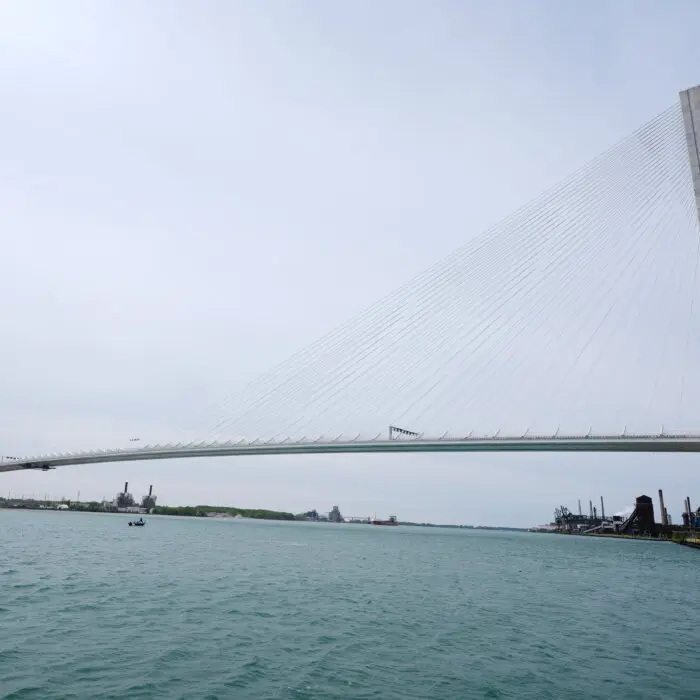
The full text of the agreement surrounding the opening of the Gordie Howe International Bridge has been released following calls from the opposition and media for clarification about its contents.
The agreement defines net revenue as “all revenues collected with respect to the bridge,” less operating costs. Ottawa must also obtain Washington’s permission for any toll-rate adjustments during the first 15 years of the bridge’s operations.
The agreement, however, does not mention interest costs or repayment of the construction debt of the $6.4 billion bridge. That omission appears to differ from comments Prime Minister Mark Carney made in an interview with CTV Calgary on July 12, in which he said “net profits” would be split in half after Canada was repaid its debts. That condition does not appear in the published agreement.
Carney later told reporters on July 16 that Canada would split net revenues with the United States over the first 15 years “after operational costs,” with expenses including staffing, maintenance, and snow removal. He said the sharing of toll revenue will not happen until the debt to Canada is repaid.
Opposition parties had criticized the government for confusing messaging on the details and called for the deal to be publicly released.
Poilievre noted the prime minister said any sharing of toll revenue would not happen until all the debt was paid to Canada, while the agreement’s text said Canada will give the United States 50 percent of revenues before the debt is repaid.
“Just profit sharing on a bridge 100 percent built with our tax dollars. The opposite of what you said. How do we trust anything else you say about dealing with the U.S.?” Poilievre said on social media.
Industry Minister Mélanie Joly was asked by reporters on July 22 why Canada had agreed to split bridge revenues with the United States when Washington had not paid to build the bridge. She said that question should be directed to Carney and Canada-U.S. Trade Minister Dominic LeBlanc.
“I think it is important to be able to work on the stability of the relationship between Canada and the U.S. including when it comes to the Gordie Howe Bridge,” Joly said, adding that Ottawa has a goal of ensuring Canadians get “good value for money.”
The bridge will be officially opened on or before July 27, and the two parties will “work together to hold a ceremonial opening event no later than” Aug. 3, according to the agreement.
After U.S. President Donald Trump recently announced new 50 percent tariffs on a range of Canadian products, Canada had pulled out of the joint celebration marking the opening of the bridge.
“In light of trade action threatened by the United States earlier this week, it would be inappropriate to proceed with a celebratory event between the two countries,” a spokesperson from Infrastructure Minister Gregor Robertson’s office had said in a statement on July 21.