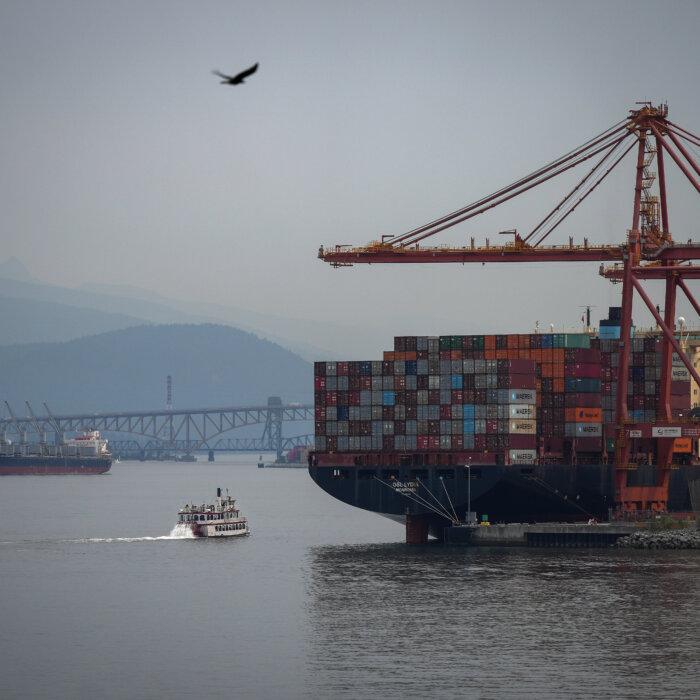
Minister of Transport Steven MacKinnon says Ottawa has referred a major expansion plan for the Port of Vancouver to the Major Projects Office.
MacKinnon said the plan, if approved, will help double Canada’s non-U.S. exports in the next 10 years and provide crucial infrastructure for a proposed West Coast oil pipeline.
“Just like the opening of the St. Lawrence Seaway, the Gateway Strategy represents the kind of nation-building infrastructure that will diversify trade and strengthen our economy for decades to come,” MacKinnon said during a July 16 press conference at the port in Delta, B.C.
‘Gateway Strategy’
The referral opens up the possibility of fast-tracking by the Major Projects Office (MPO), but does not mean the expansion plan is automatically approved or fast-tracked.

The MPO assesses and consults on projects referred to it and if it designates the project as being of national importance under the Building Canada Act, the project’s approval could be sped up to within two years.
Pipeline
The port’s potential expansion is especially relevant to Alberta’s proposed pipeline to B.C.’s southern coast.
The proposal was submitted to the MPO July 2 and proposes a roughly 1,200 kilometre route carrying up to 1 million barrels per day of crude oil from Bruderheim Alberta to the Roberts Bank Terminal 2 (RBT2) in Delta.
The pipeline project is forecast to cost between $35 billion and $44 billion, and it would be backed by the government-owned Trans Mountain Corporation and the Alberta Petroleum Marketing Commission, with Pembina Pipeline Corporation owning 10 percent interest in the pipeline during construction.
The MPO will decide by Oct. 1 whether the pipeline proposal qualifies as being in Canada’s national interest and is eligible for fast-tracking.
2 Potential Major Projects
MacKinnon said that the July 16 announcement involves related but separate processes.
The RBT2 expansion has already received federal environmental approval but still needs final permits and has not yet been built. It is currently being considered for fast-tracking by the MPO, while the broader Gateway Strategy has been sent to the MPO to plan and coordinate port, rail, and bulk-export infrastructure and to decide whether it should be approved as a fast-tracked major project.
Alberta’s proposed oil pipeline is separate and remains at an earlier stage, having only been submitted earlier this month.
The RBT2 project would increase the Port of Vancouver’s container-handling capacity by 50 percent and West Coast container capacity by approximately 30 percent, according to Ottawa. It also says the terminal could unlock more than $100 billion in additional annual trade capacity, contribute more than $3 billion to Canada’s GDP each year, and support more than 17,000 ongoing jobs during operations.
Vancouver Fraser Port Authority President and CEO Peter Xotta emphasized the difference between Alberta’s pipeline proposal and the RBT2 project.
“Obviously the RBT2 project is much further along,” Xotta said July 16. “There’s lots of discussion to be undertaken with respect to the energy project … and we’ll be working with the Major Projects Office on the details around that.”
MacKinnon also emphasized that ongoing consultation will still be taking place with First Nations before RBT2 is potentially designated as a major project by the MPO.
“First of all, the potential listing is subject to ongoing conversations and consultations with our First Nations partners, the chief, her community, the Musqueam, and other affected or potentially affected indigenous nations,” MacKinnon told media July 16. “So that is the process that we’re starting today.”
He said the broader Gateway Strategy covers issues such as rail bottlenecks, modern port facilities, increased export capacity for Prairie producers and miners, and environmental protections.
“That is a very complicated piece of work of interconnected pieces, protecting the environment all the way through,” he said. “So we’ve asked the Major Projects Office to undertake the work that is needed to scope that project.”
Conservative MP and transportation critic Dan Albas noted that it has taken more than a decade for RBT2 to secure permits, and asked for more details related to the latest announcement.
Tsawwassen First Nation Chief Laura Cassidy said the project’s economic benefits may be national, but its environmental, cultural, and harvesting effects would be felt most directly by her nation.
“Those commitments cannot be weakened or set aside in the name of efficiency or expediency,” she said, referring to the conditions and agreements already attached to RBT2.
The broader Gateway Strategy also calls for developing additional industrial land for bulk terminals and addressing rail congestion. Dry and liquid bulk products, including grain, potash, petroleum products, and canola oil, account for approximately 70 percent of the port’s total tonnage.
MacKinnon described the Gateway initiative as a generational project intended to connect Canadian producers with rapidly growing markets in Asia.
“This is an essential project for our collective future in this country,” he said.
The federal government says it facilitates $350 billion in annual trade with 170 countries, and MacKinnon noted that it handles more cargo than Canada’s next five largest ports combined.