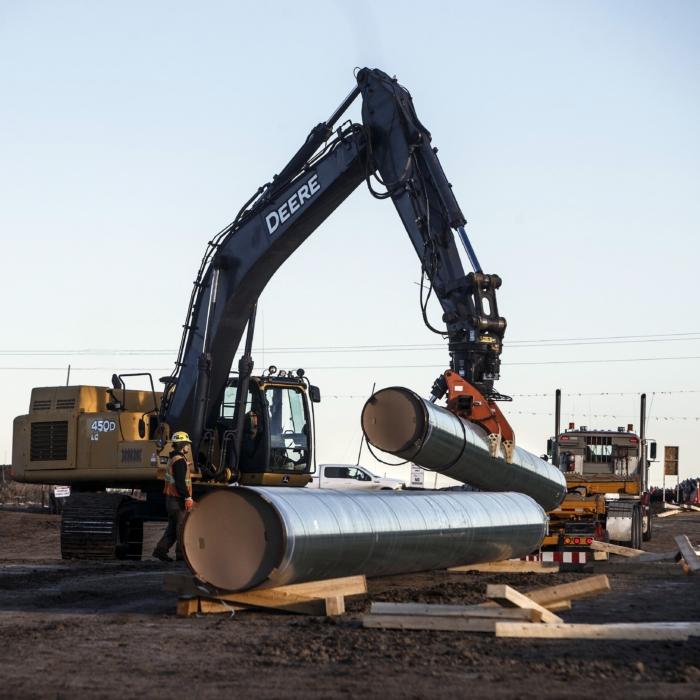
The federal government is moving to designate the proposed oil pipeline from Alberta to the West Coast as a project of “national interest,” enabling expedited approvals and exempting it from some federal environmental review requirements.
According to a notice published in the Canada Gazette on Aug. 1, interested parties will have until Sept. 18 to submit comments on the national interest designation for the pipeline.
According to a notice published in the Canada Gazette on Aug. 1, interested parties will have until Sept. 18 to submit comments on the national interest designation for the pipeline.
The notice states that the 1,250-kilometre West Coast Oil Pipeline would transport one million barrels per day of crude from Bruderheim, Alta., to Delta, B.C., where it would then be shipped to international markets.
The notice states that the project is being advanced by Trans Mountain Corporation, Alberta Petroleum Marketing Commission, and Pembina Pipeline Corporation, who will “form and lead a new jointly owned entity.”
The notice states that the project is being advanced by Trans Mountain Corporation, Alberta Petroleum Marketing Commission, and Pembina Pipeline Corporation, who will “form and lead a new jointly owned entity.”
Under the Building Canada Act, the federal government will launch a 30-day notice period on the pipeline and consult with the governments of Alberta and B.C. before listing it under Schedule 1 as a project of national interest.
Ottawa and Alberta first signed a memorandum of understanding on the potential pipeline in November 2025, which included commitments by Alberta to pair the proposed pipeline with a carbon capture project, while also increasing the province’s industrial carbon tax.
Ottawa and Alberta first signed a memorandum of understanding on the potential pipeline in November 2025, which included commitments by Alberta to pair the proposed pipeline with a carbon capture project, while also increasing the province’s industrial carbon tax.
The two governments announced a revised agreement in May 2026 to push back the date for an effective industrial carbon price of $130 a tonne by a decade, to 2040. Ottawa had previously proposed to increase the tax to $170 per tonne by 2030.
The federal government has said it will work to designate the pipeline as a project of national interest before Oct. 1, 2026, and approve it by Sept. 1, 2027. The Alberta government has said it hopes the pipeline will be completed no later than 2034.
While Prime Minister Mark Carney had previously indicated that the building of the new pipeline could require the lifting of the Oil Tanker Moratorium Act, which prohibits tankers from carrying more than 12,500 metric tons of oil off the North Coast of B.C., he announced on July 2 that this would be kept in place as part of an infrastructure agreement signed with British Columbia.
While Prime Minister Mark Carney had previously indicated that the building of the new pipeline could require the lifting of the Oil Tanker Moratorium Act, which prohibits tankers from carrying more than 12,500 metric tons of oil off the North Coast of B.C., he announced on July 2 that this would be kept in place as part of an infrastructure agreement signed with British Columbia.
Alberta Premier Danielle Smith later announced the pipeline would terminate on British Columbia’s southern coast rather than its northern coast, with the route expected to largely follow the existing Trans Mountain pipeline corridor.