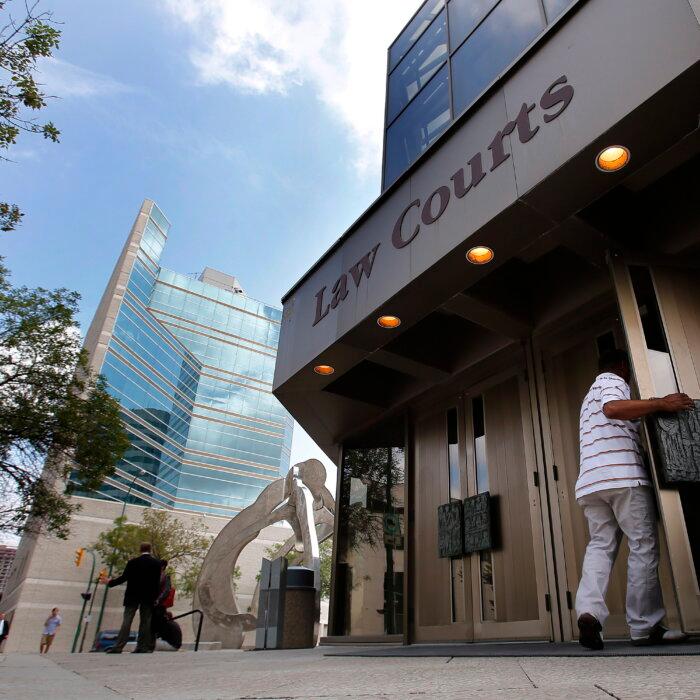
An aboriginal man found driving around a small central Ontario city with a crack pipe on his lap and a “killing machine” rifle in the backseat was handed a suspended sentence by a provincial court judge who cited his “intergenerational trauma” from residential schools as a mitigating factor.
Jesse Garlow, a convicted drug trafficker, had been in custody since June 2024 when he was sentenced earlier this month by Justice Brenda Green of the Ontario Court of Justice. She granted him credit for 774 days in jail, adding 258 days to his credit for enduring what she called “horrendous” conditions during his time at Central East Correctional Centre, a maximum security facility in Lindsay, Ont.
Garlow also received three years of probation along with the suspended sentence. The Crown had been asking for three-and-a-half years in jail.
“A sentence reduction is not a reflection of a judge being ‘soft on crime,’” Green said in her Nov. 4 decision. “It is our obligation as the gatekeepers of justice to address, redress and hopefully ameliorate institutionalized abuse.”
She called Garlow, a Mohawk from Six Nations of the Grand River First Nation, located near Brantford, Ont., a victim of “colonialism.”
“There is a clear, causal nexus between his father’s brutalization in residential schools and the trail of damage and devastation that slammed like a wrecking ball through the next generation,” Green wrote.
“It is important to carefully review the aggravating circumstances of the offence and any mitigating circumstances of this offender, the applicable sentencing principles including the unique experiences of Aboriginal people, and any similar precedents with respect to the applicable range of sentencing to arrive at a fair and balanced sentence.”
The judge ordered a lifelong weapons ban and Garlow also lost all items that were seized from him when arrested by police, including a flame thrower found in his trunk, the rifle, drugs, and $5,000 cash.
June 7 Incident
Police initially pulled Garlow over on June 7, 2024, because the car he was driving was swerving on the road, according to court documents. A search of the vehicle turned up a modified loaded firearm in a bag in the backseat, as well as a flame thrower and crow bars in the truck. He was under a weapons prohibition at the time.“This firearm was designed for one purpose, as a killing machine,” Green wrote with reference to the modified weapon. “This gun is obviously not intended for hunting anything other than human beings. It is designed to maim and/or kill in a spray of bullets. Simply brandishing it would cause sheer terror.”
She said Garlow “vehemently” denied possessing the gun for any nefarious purposes.
“This assertion is difficult to reconcile with the other items recovered from his vehicle and the nature of this firearm was not an amusing toy. It was modified to cause maximum harm,” she wrote, while noting that Garlow was “consistently” remorseful for his actions.
Green also wrote that to describe his background as “tragic would be an understatement.” She added there was an “undeniable link” between his criminal activity and “his experiences as an Indigenous person.”
Green said she reviewed two Gladue reports on Garlow, one from 2015 and an updated version in 2025. Gladue reports contain “unique information” about aboriginal offenders, according to Legal Aid Ontario.
Garlow’s father was taken to a residential school after his father was killed and his mother was not able to care for her children, according to the court decision. The court says the father was “raised in an extremely abusive environment.”
Green says the father was in and out of jail until he met Garlow’s mother.
She said Garlow had some stability and a middle class life after his father was released from prison and married his mother. His mother died when he was 9 or 10 years old, which disrupted the family, she wrote.
“His father could not cope with her loss. He was drinking heavily and briefly returned to a life of crime.”
Garlow was “shuffled” between homes until he ended up living with his father again, Green said.
‘Unstable’
Garlow had a close relationship with his maternal grandfather, but the grandfather was murdered by his wife when the boy was 11, the judge said.“Both of his grandfathers had been murdered and his grandmother and mother were dead. The devastating impact this would have on a boy is incomprehensible,” Green wrote in the court decision. “In addition to these losses, his relationship with his father was very unstable.”
Green said Garlow’s grades started to slip at school and he would get into fights with other students. He then started to skip school and use drugs.
“His family home became the party place where he would drink and abuse drugs with his dad. Tensions built up until father and son eventually had a physical fight,” said the decision.
Garlow was expelled from school at the age of 17. He went on a trip with a friend, and upon his return, he discovered that his father was missing. His father had relocated without any prior notice or warning, leaving Garlow to live with an allegedly abusive uncle. According to Green, he did not see his father again for several years.
Garlow’s criminal record started in 2003 when he was 19, she wrote, noting that he was “caught in a repetitive cycle of drug abuse and crime interspersed with periods of stability” for years.
He has an array of convictions between 2003 until 2011 for various property offences, breaches of court orders and possession of unlawful substances. He was arrested again in 2015 for robbery and other property offences and faced drug trafficking charges in 2018, according to the court decision. He was sentenced to 14 months for the charges in 2015 and was given two-and-a-half years in jail in 2018.
Green said the discrimination and “mistreatment” of First Nations people was a “national shame” that was “exemplified” in Garlow’s life and has played a role in his decisions. She noted that he has since gained custody of his son and is in a stable relationship.