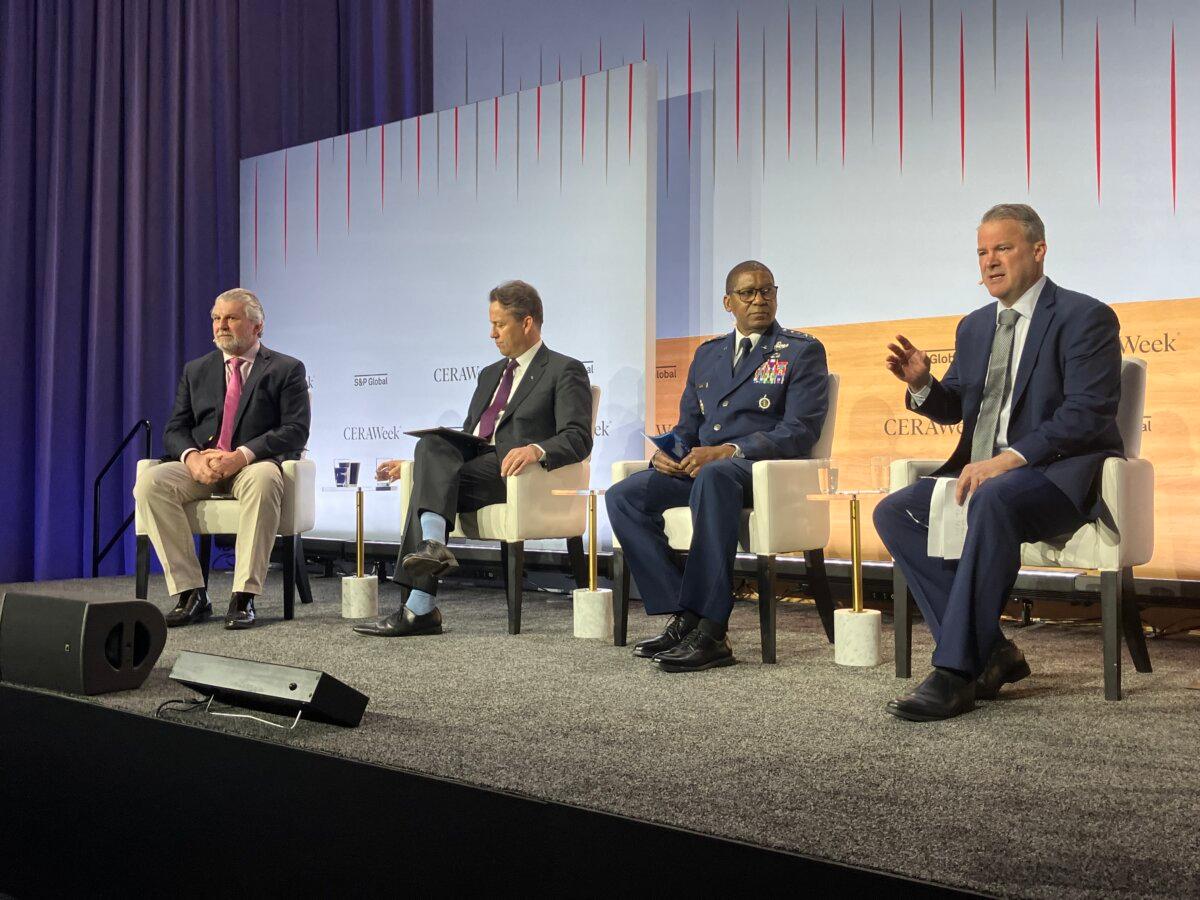
HOUSTON—The longer ships remain trapped inside the Persian Gulf and oil tankers stack in the Arabian Sea, the more likely Persian Gulf states will reach a deal with Iran to allow commerce to resume in the Strait of Hormuz, global market and insurance analysts said in a March 24 CERAWeek by S&P Global forum.
The United States gets little oil and no gas from the Persian Gulf, although the nation’s manufacturers are, to varying degrees, reliant on petrochemicals, minerals, and other refined products from the region. Farmers worldwide, including in the United States, import fertilizer materials from the Gulf.
The Trump administration said it’s in contact with elements within Iran’s government in talks that could lead to opening the strait, and forum participants said there are also back-channel discussions between members of the Gulf Cooperation Council (GCC)—Bahrain, Kuwait, Oman, Qatar, Saudi Arabia, the United Arab Emirates—and Tehran.
“Maybe they find an accommodation and just accept the fact ... that the Iranians control the north Gulf and Strait of Hormuz, because it’s very difficult to see a military solution,” said Sankey, a veteran analyst who referred to unfolding events since the United States and Israel began Operation Epic Fury on Feb. 28 as “Gulf War III.”
He was joined in the forum at the 44th annual CERAWeek by S&P Global conference by Nick Studer, CEO of London-based Oliver Wyman and Marsh Management Associates; U.S. Transportation Command leader Air Force Gen. Randall Reed; and Jim Burkhard, S&P Global head of crude oil market research, energy, and mobility.

“I think the U.S. plan will come with naval support, and that may get things moving a little bit,” Studer said. “But ultimately, ships are really moving with Iranian permission.”
As a global insurance broker and risk adviser, he said Marsh understands oil and liquified natural gas tankers are easy targets.
“We have a long experience in Ukraine,” Studer said. “That’s a very different situation, because the Ukrainians have beaten back the Russian navy to the east shore of the [Caspian] sea [using drones and missiles].”
He noted that Ukrainians on March 3 severely damaged the Russian-flagged liquefied natural gas carrier Arctic Metagaz with a naval drone in the Mediterranean Sea, and on March 23, Ukraine launched drone attacks against Russian Baltic Sea ports.
“So, threats everywhere,” Studer said. “I don’t think anyone in the world can be talking to more clients about risk than us at Marsh. And when we look across the world, we’re seeing what I call ‘an everything, everywhere, all at once challenge.’”
Sankey noted that despite a coordinated effort by the United States, European Union nations, and China, missile and drone attacks by Iran-allied Houthi terrorists in Yemen reduced Suez Canal traffic by 60 percent to 80 percent over the past three years.
The Houthis have been “very quiet” for months, he said, but few ships were plying the Red Sea to avoid the threat, although traffic is now ticking up.
“One of the things that concerns me the most is the Iranians seem to have the Houthis still up their sleeve as we’re loading the Red Sea with crude,” Sankey said. “So, you know, the nightmares are compounding at this point.”
Threat ‘Now Is Permanent’
Studer agreed with Sankey that there is no military solution that ensures the safety of shipping traffic, especially not in the Arabian Sea, the 24-mile-wide Strait of Hormuz, and the Persian Gulf.“[Iran’s] coastline is twice as long as the Texas coastline on the Gulf and you know, your enemy can fire a missile from the back of a pick-up truck from ... 100 miles,” Studer said.
Contrary to the general impression, shipping lines can get insurance, “but ship owners don’t want to put the crews at risk,” he said. He also said there is a growing “humanitarian issue” unfolding in the Persian Gulf, as up to 20,000 crewmen are idling on anchored ships.
“Many of those ships are short on food,” Studer said. “Reverse osmosis doesn’t work well if you’re sitting in mud, so they’re short on water. And ironically when you’re sitting on top of millions of barrels of oil, they don’t have [fuel for] generators. So, there’s a real challenge there.”
That’s why, Sankey said, the ultimate solution will be negotiated between Persian Gulf states and Iran.
It’s “very difficult” to see how it’s possible to unseat the regime in Tehran “without the potential for civil war,” Sankey said.
Mixed messages emerging from Tehran, as cited by U.S. President Donald Trump, mean there could be “a split leadership,” he said.
“These communications ... seem to indicate a split amongst various factions in Iran, which is also nightmarish in its own way,” Sankey said.
He acknowledged that a GCC–Iran deal would require concessions by all to be supported by the United States and Israel.
“Ultimately, everybody does want to live happily ever after, so you have to get the Iranians to accept an Israeli state,” he said. “You probably have to get the Israelis to accept a two-state [solution with Palestinians]. ... That’s a demand of the GCC, so there are some very big issues here that need to be addressed.”
But extraordinary measures are needed, Sankey said. Otherwise, everyone loses.
“Obviously, this is a threat that now is permanent,” he said.