Mexican President Claudia Sheinbaum says there is no need for a bilateral trade agreement with Canada because there is already a three-country free-trade agreement with the United States.
“We have the trade deal with the United States, Canada, and Mexico… There is no need,” Sheinbaum said during an Aug. 6 press conference when asked by reporters if a bilateral agreement with Canada was likely.
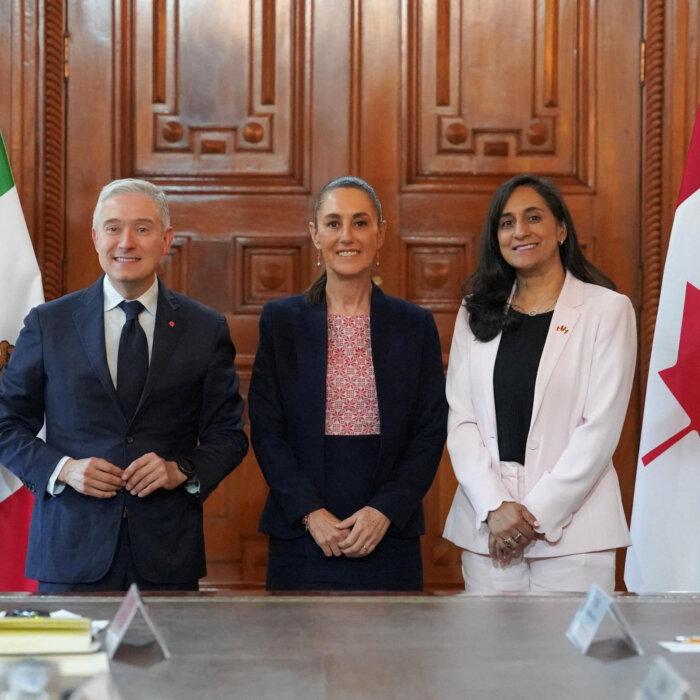
Sheinbaum’s comments come after an Aug. 5 meeting in Mexico City with Canada’s Finance Minister Francois-Philippe Champagne and Foreign Affairs Minister Anita Anand.
Sheinbaum described her meeting with Canada’s ministers as “very good” and said Prime Minister Mark Carney will “soon” visit Mexico for direct talks, though a date for the meeting has yet to be finalized.
The meeting with Anand and Champagne was “a preparatory meeting” for Carney’s visit, Sheinbaum added.
She said an increase in direct trade with Canada was one of the subjects addressed during this week’s meeting, but she emphasized that this did not suggest a separate trade deal from the United States-Mexico-Canada Agreement (USMCA) was currently on the table.

“There’s the framework to strengthen the Mexico-Canada relationship, as we’re doing with other countries as well,” she said.
He said the mission was about getting “to know each other a bit better,” noting that the countries discussed collaboration in sectors such as energy, automotive, and security.
Champagne and Anand said they were especially focused on boosting the resilience of supply chains with Mexico, increasing port-to-port trade, advancing artificial intelligence and the digital economy, and collaborating on energy security.
“After the meeting with President Sheinbaum, we then were put in touch with additional ministers so that we can broaden the efficacy and the emphasis that Canada is placing on the relationship with Mexico,” Anand said, adding that “what we would really like to see is a full-court press on ministers engaging with their counterparts across government, and that’s what we'll continue to work on.”
The ministers would not confirm if they had shared strategies with their Mexican counterparts or Sheinbaum on how to address U.S. President Donald Trump’s tariffs.
Trump raised tariffs on Canada to 35 percent on Aug. 1, a day after he announced a 90-day reprieve for higher tariffs on Mexico. Trump said he decided against increasing the existing 25 percent tariff on Mexico to 30 percent after a discussion with Sheinbaum.
Anand and Champagne did not answer questions from reporters regarding the potential reasons Mexico received an extension while Canada did not. Anand emphasized that the economic relationship each country has with the United States is different.
“We have over $2 billion of trade passing through the Canada-U.S. border every single day, and we also have different economic profiles, different levels of integration, and a long-standing economic and defensive security relationship that is perhaps the most integrated in the world,” she said.
Carney told reporters earlier that day that he planned to speak to Trump “when it makes sense.”
“I haven’t spoken to the president in recent days,” Carney said during an Aug. 5 press conference in West Kelowna, B.C., but added that the 35 percent tariff on Canadian goods applies only to products that don’t fall under the USMCA.
This means 85 percent of trade between Canada and the United States remains tariff-free, Carney said.
When questioned regarding the future of a trade deal with Canada, Trump replied “he’s called,” seemingly referring to Carney, but has said little on the matter in recent days.
New Approach
Ottawa has said it is looking to diversify trade to reduce reliance on the United States and Champagne confirmed that approach during his virtual press conference.He said Canada is seeking reliable trade partners and characterized the trip to Mexico as part of a wider strategy aimed at diversifying Canada’s trade relationships, particularly in light of the United States adopting a tariff-oriented stance.
“As we strive to provide more certainty and diversify our export markets, forging closer partnerships like the one we enjoy with Mexico is how we chart a new way forward with partners we can trust,” he said.
Anand said the visit represents the next phase in Ottawa’s plan to restore connections with Mexico, a bid that began when Carney invited Sheinbaum to the G7 Leaders’ Summit in Alberta this summer, where the two leaders conducted talks.