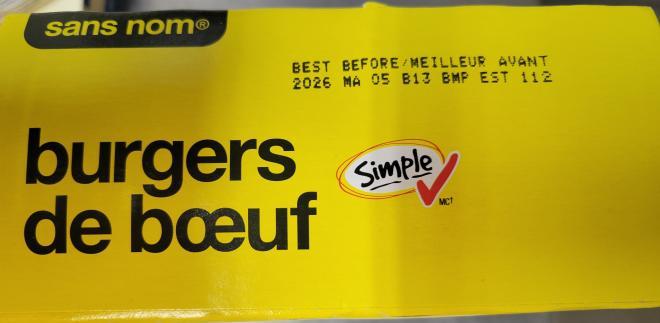
A nationwide recall has been issued for No Name brand beef burgers after testing by the Canadian Food Inspection Agency found possible E. coli contamination.
The frozen burgers are being removed from store shelves following the detection of E.coli O157:H7 in test results by the agency.
Class 1 represents the highest level within the three-tier classification system, indicating a significant risk that consumption of the tainted food could result in severe health issues or even death.
No illnesses have been reported thus far, but the agency is warning people against consumption of the product. CFIA said the burgers should be thrown out or returned to the location where they were purchased.
The affected burgers come with a ‘best before’ date of May 5 and a UPC code of 0 60383 37333 7, according to the advisory.
The CFIA said it is currently conducting a food safety investigation, which may lead to the recall of other products and is also in the process of verifying that all recalled burgers have been removed from the marketplace.
E. Coli Dangers
Food contaminated with strains of Escherichia coli—better known as E. coli—can result in an infection known as food poisoning or E. coli gastroenteritis.“Food contaminated with E. coli O157:H7 may not look or smell spoiled but can still make you sick,” the agency said. “If you think you became sick from consuming a recalled product, contact your healthcare provider.”
Most people fully recover at home, but those who become severely ill need to be hospitalized, the agency’s website says. In rare cases, some may face life-threatening symptoms such as stroke, kidney failure, and seizures.
This type of food poisoning is most dangerous for pregnant women, the elderly, children younger than five, and those with compromised immune systems.