The survey found that 38 percent of Canadians oppose governments providing financial incentives to encourage the construction of artificial intelligence (AI) data centres, while another 26 percent somewhat oppose such incentives. Meanwhile, 6 percent support them, 22 percent somewhat support them, and 8 percent are unsure.
“Two thirds of Canadians at least somewhat oppose the government providing financial incentives to encourage the construction of AI data centres in Canada,” said the survey report, released this week.
The survey was conducted online from July 28 to 30 among 1,104 randomly selected Canadians aged 18 and older. It has a margin of error of plus or minus three percentage points, 19 times out of 20.
Respondents most commonly cited high electricity demand (26 per cent), environmental harm (18 per cent), and heavy water use (16 per cent) as their top concerns about building AI data centres in Canada.
The strongest pockets of opposition came in the Prairies, comprising Alberta, Saskatchewan, and Manitoba, where 49.9 percent were opposed to the incentives, compared to 38 percent overall nationally. A further 22.6 percent of respondents in the Prairies also said they were somewhat opposed to incentives.

B.C. followed the Prairies, with 39.5 percent of residents outright opposed to the incentives, compared with 38 percent in Ontario, 30.5 percent in Quebec, and 30.2 percent in Atlantic Canada.
When asked to choose between AI data centre development and resource protection, 46 percent said both should receive equal priority, while 40 percent said protecting energy, water, and land should take priority. Just 9 percent said investment in AI data centres should be the higher priority.
AI Expansion
Alberta has also been actively seeking investment in AI data-centre projects, with the province emerging as a major location for proposed developments. Alberta has created a framework allowing data centres to bring their own electricity generation to meet their power needs, while also providing a pathway for them to connect to the provincial grid.
Canada had 337 data centres in 2025, ranking fifth globally behind the United States, Germany, the United Kingdom and China, according to Stanford University’s 2026 AI Index Report, which cites Cloudscene data. Data centres typically provide computing and data-storage services, while AI data centres use high-powered chips to train and operate AI systems and can require significantly more electricity and cooling resources.
Both Ottawa and Alberta say AI data centres will boost Canada’s competitiveness in the AI field, attract significant investment, and lead to job growth.
However, the Nanos poll found Canadians were divided over the economic promises of AI data centre expansion, with 44 percent saying they thought there would be a positive or somewhat positive effect on the Canadian economy, 32 percent who expected a negative or somewhat negative effect, 14 percent who said the effect would not be negative or positive, and 9 percent who were unsure.
Protests and Opposition
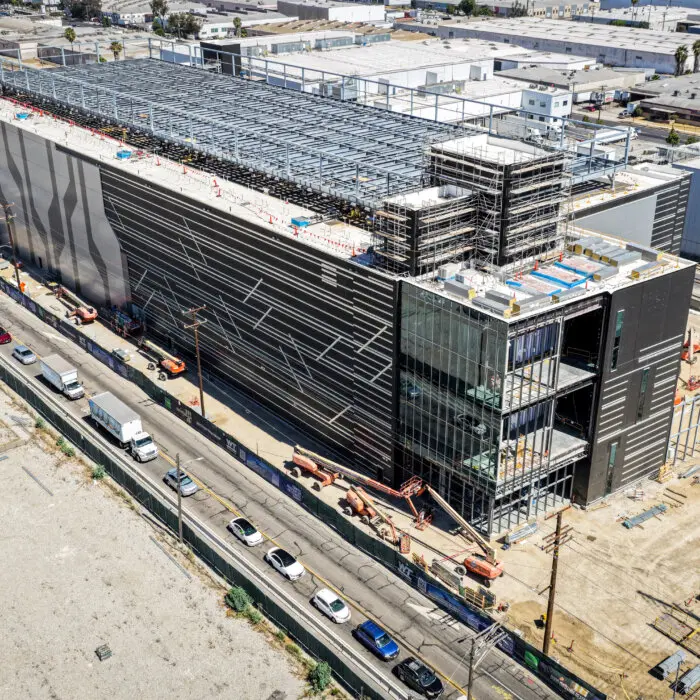
Large-scale data centres have been met with opposition in several provinces amid ongoing protests.
Sturgeon County Mayor Alanna Hnatiw said residents’ concerns were valid, while underscoring the need for strong oversight as the AI data-centre sector expands.
The company’s first application to the Alberta Utilities Commission was denied in March due to filing deficiencies and the company submitted a new application in April.
Residents who oppose the project say they are worried about noise pollution, environmental impact, water usage, and emergency planning, and are skeptical of the promised economic benefits to the town. Supporters say it will bring enormous economic benefits to the town and region.
Beyond Alberta, Manitoba Premier Wab Kinew also recently rejected a proposal for a hyperscale AI data centre southeast of Winnipeg, saying it would use too much electricity and have too many potentially negative environmental impacts when judged against the purported economic benefits.
Demonstrators in Vancouver have also protested against further development of AI data centre projects, with more than 15,000 people having signed an online petition calling for the proposed Telus development to be halted as of late June.