“Following the launch of U.S. combat operations in Iran, Americans worldwide and especially in the Middle East should follow the guidance in the latest security alerts issued by the nearest U.S. Embassy or consulate,” the department stated.
In a March 1 X post, State Department Assistant Secretary for Consular Affairs Mora Namdar shared an image detailing travel advisory levels for various regions.
Iran, Iraq, and Lebanon were designated “Level 4: Do Not Travel For Any Reason.” In Iran, there is no U.S. Embassy. Americans in the country were advised by the U.S. Embassy and Consulate in Iraq to keep a low profile and limit their movements or shelter in place. U.S. citizens already in Iraq should exercise caution, limit movements, and shelter in place as required. In Lebanon, any American should “depart now via commercial options,” the post states.
Bahrain, Israel, Kuwait, Pakistan, and Qatar were classified as “Level 3: Reconsider Travel.” For Bahrain, Israel, Kuwait, and Qatar, a “shelter in place” recommendation is in effect. For Pakistan, authorities advise Americans to exercise caution and avoid large gatherings. Some places in Pakistan have a Level 4 designation.

Egypt, Jordan, Oman, Saudi Arabia, and the United Arab Emirates (UAE) were designated as “Level 2: Exercise Increased Caution.” A shelter in place advisory is applicable to Jordan, Oman’s Duqm and 62 miles within Salalah, Saudi Arabia’s Dhahran, and the UAE. For Egypt, the advisory asked U.S. citizens to exercise caution.
Bahrain
In a March 1 security update, the U.S. Embassy in Bahrain stated that it was tracking confirmed reports of the Crowne Plaza Hotel in the capital city of Manama being struck in attacks on March 1, resulting in injuries.“We advise U.S. citizens in Bahrain that hotels might be a target for future attacks, and encourage U.S. citizens to avoid hotels in Manama,” the update reads.
The embassy told Americans in Bahrain to immediately seek cover if there were loud explosions or sirens.
Inside a home or building, people should go to the lowest level of the structure that has the fewest exterior walls, openings, and windows. They should then close any doors and sit close to an interior wall, away from windows and openings.
Qatar
The U.S. Embassy in Qatar warned in a March 1 advisory that there has been an “ongoing threat of drone and missile attacks from Iran and significant disruptions to commercial flights” in the country.Kuwait
In Kuwait, the U.S. Embassy asked all Americans in the nation to shelter in place until further notice, according to a March 1 security alert. The airspace in Kuwait remains closed.UAE
For the UAE, the U.S. Embassy asked U.S. citizens in a March 1 alert to remain in their residence, hotel, or other secure structure and to stay away from windows.Saudi Arabia, Oman
As for Saudi Arabia, the U.S. Embassy stated in a Feb. 28 security alert that the U.S. Mission to Saudi Arabia has asked its personnel to limit nonessential travel to any military installations in the region.“We recommend American citizens in the Kingdom do the same,” the embassy stated.
Jordan
The U.S. Embassy in Jordan stated on March 1 that reports suggest that drones, missiles, and rockets have entered Jordanian airspace.Pakistan
The U.S. Embassy and Consulates in Pakistan warned in a March 1 security alert that they were “monitoring reports of ongoing demonstrations at the U.S. Consulate General in Lahore and violent protests at the U.S. Consulate General in Karachi, as well as calls for additional demonstrations at the U.S. Embassy in Islamabad and the U.S. Consulate General in Peshawar. U.S. government personnel have been directed to restrict their movements until further notice.”In its security alert, the embassy asked U.S. citizens in Pakistan to monitor local news and observe personal security practices, including avoiding large crowds and being aware of their surroundings.
Flight Disruptions, Military Operations
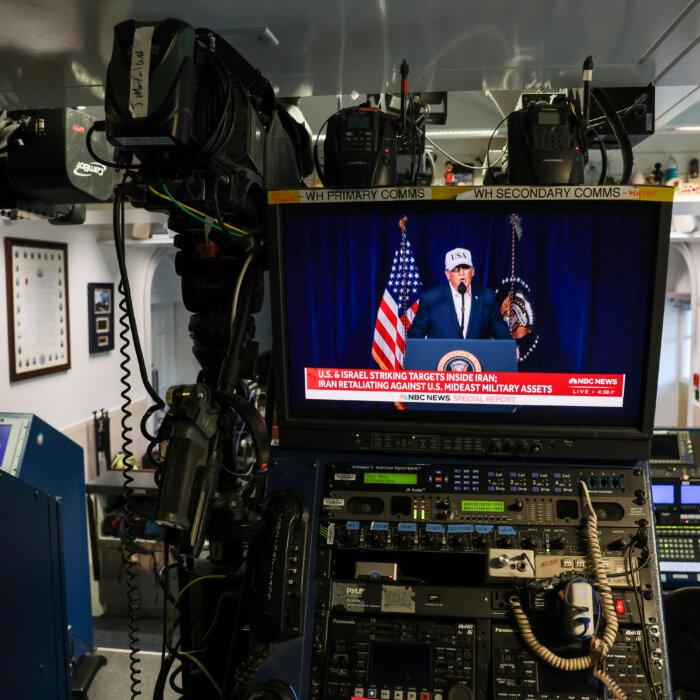
The U.S. and Israeli militaries launched coordinated strikes to topple the Iranian regime on Feb. 28 and succeeded in eliminating Iranian leader Ali Khamenei and other top Iranian officials. Israel stated that a second wave of strikes against Iran was launched on March 1.On March 1, thousands of flights were canceled or delayed across many of the busiest airports in the Middle East.
Critical transport hubs, including Dubai, UAE; Abu Dhabi, UAE; and Doha, Qatar, were shut down or faced significant disruptions after Iran attacked its neighboring Gulf nations.
According to a March 1 X post from the U.S. Central Command, the strikes on Iran, dubbed Operation Epic Fury, are aimed at dismantling the Iranian regime’s security apparatus, prioritizing locations that pose an imminent threat.
The United States has deployed a wide range of military assets as part of the operation, including nuclear-powered aircraft carriers, B-2 stealth bombers, F-35 stealth fighters, and guided missile destroyers.
In a March 1 video posted on Truth Social, U.S. President Donald Trump said Operation Epic Fury was one of the “largest, most complex, most overwhelming military offensives” the world has ever seen.
“An Iranian regime armed with long-range missiles and nuclear weapons would be a dire threat to every American. We cannot allow a nation that raises terrorist armies to possess such weapons that would allow them to extort the world to their evil will. Not going to let it happen,” Trump said.
“We’re undertaking this massive operation not merely to ensure security for our own time and place. But for our children and their children, just as our ancestors have done for us many, many years ago, this is the duty and the burden of a free people. These actions are right, and they are necessary to ensure that Americans will never have to face a radical, bloodthirsty terrorist regime armed with nuclear weapons and lots of threats.”