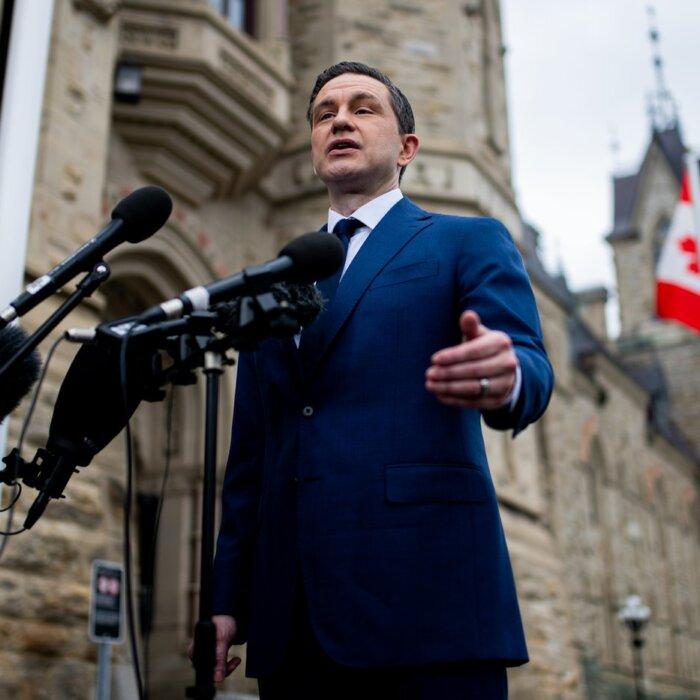
The number of candidates running in the Alberta federal byelection next month has now surged past 200 as a protest group seeking electoral reform targets the riding where Conservative Leader Pierre Poilievre is attempting to regain a parliamentary seat.
The tally surpasses the group’s goal of 200 candidates and more than doubles the record of 91 candidates that the group ran in the Carleton riding that Poilievre lost during the April 28 general election.
Former Alberta MP Damien Kurek stepped down as MP in Battle River-Crowfoot in May to give Poilievre the opportunity to return to the House of Commons after the Tory leader lost his long-held Carleton riding.
The Longest Ballot Committee is a group calling for electoral reform. It sent an email to supporters in May to ask those living in or near the riding to help make the 200 candidate goal happen by collecting nomination signatures.
The potential for the candidate list to expand even further for the Aug. 18 Battle River-Crowfoot byelection remains. Candidates have until the close of business on July 28 to submit their nominations to Elections Canada.

The Longest Ballot Committee has been coordinating candidates to participate in byelections in recent years to advocate for electoral reform. The group also signed up 91 candidates to participate in the LaSalle-Emard-Verdun byelection in Quebec last September.
Having ballots with more than 90 candidates in the last federal election as well as in the 2024 Quebec byelection resulted in a ballot roughly a metre in length. The oversized ballots caused delays in the vote counting process.
With the ballots for the Battle River-Crowfoot byelection sure to exceed the length of all previous ballots, Elections Canada is trying to find solutions to make voting more manageable.
Ballot Protest Opinions
Chief Electoral Officer Stéphane Perrault has voiced concern in the past about the current nomination rules that allow such lengthy ballots. He said the size of the ballots mean a reduced font size, which makes it difficult for some voters to read.Perrault has advocated for a change to the law so one person can no longer sign candidacy papers for multiple candidates. Elections Canada said he is likely to “have more thoughts to share” with Parliament if he is invited to offer his expertise in future meetings.
The current ballot for Battle River-Crowfoot has one name that shows up more than 100 times: Tomas Szuchewycz. Szuchewycz is serving as the official agent for all participants running under the Longest Ballot Committee.
The letter noted the Longest Ballot Committee had declared its intent to “flood the ballot” with more than 200 names in the upcoming byelection.
“This is not democracy in action,” says the letter signed by Poilievre and Tory MP Michael Cooper, shadow minister for democratic reform. “It is a deliberate attempt to manipulate the rules, confuse voters, and undermine confidence in our elections.”
The letter urges Ottawa to “take immediate steps” to propose legislation when Parliament resumes in September, mandating that candidates obtain signatures from at least 0.5 percent of the riding to submit a candidacy, rather than merely 100 individuals. It also requests that signatories be permitted to endorse only one candidate, and that official agents be limited to represent “only one single election candidate at any given time.”
Group Agenda
The Longest Ballot Committee was formed to protest Canada’s first-past-the-post system and argues that a non-partisan body rather than politicians should be in charge of election rules. The group was at one time affiliated with the satirical Rhinoceros Party of Canada, which was founded in 1963 and has policies such as making “Sorry” the new official motto of Canada and illiteracy “the third official language.”The recent targeting of the upcoming Battle River-Crowfoot byelection comes after the group scrapped its plans to target the seat held by Liberal MP and former Deputy Prime Minister Chrystia Freeland during the recent federal election to focus solely on Poilievre’s Ottawa-area riding.
Poilievre ultimately lost in the April 28 election to Liberal candidate Bruce Fanjoy. Fanjoy received 50.8 percent of the vote and Poilievre received 45.8 percent, placing second for the first time since he was elected in 2004.
The protest group’s actions have spurred complaints in the form of two petitions.
“This petition seeks to address the growing discontent with the Long Ballot process in Canada that is making a mockery of our democracy,” the description for the petition reads.