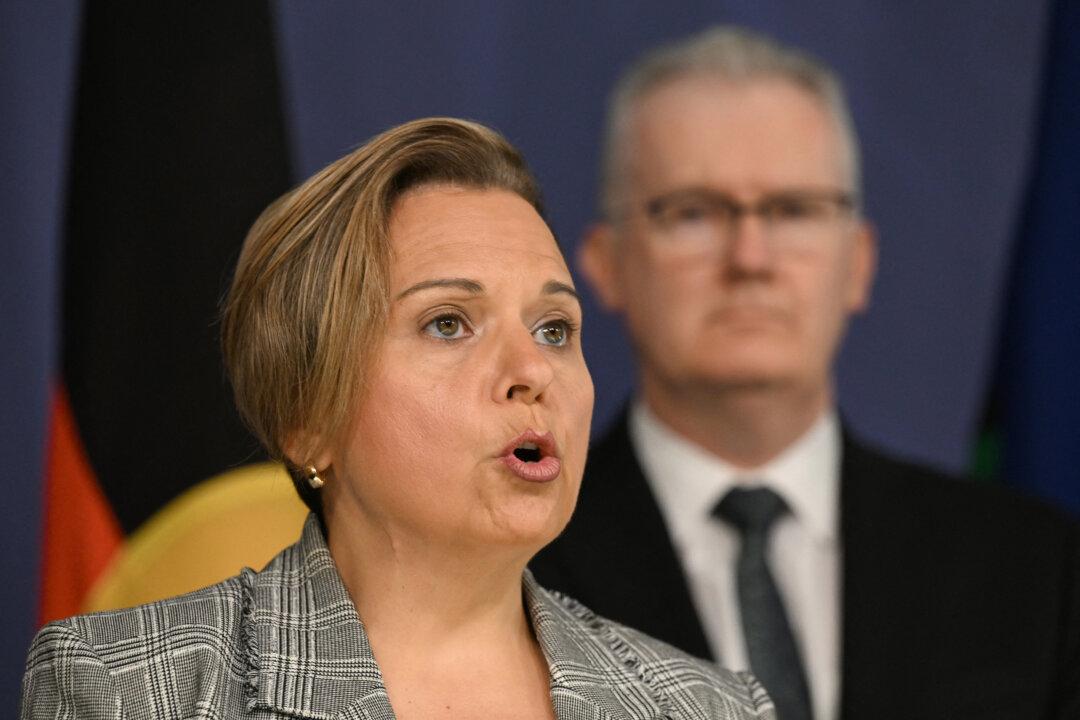
CANBERRA, Australia—Days after teenagers lodged a High Court challenge to overturn Australia’s looming social-media ban, federal Communications Minister Anika Wells has vowed to defend the law—saying she has the backing of parents to do so.
“They (parents) know, and we know that this will not be perfect … but for the seven out of 10 kids who witness online harm, we have to give this a crack,” Wells told the National Press Club, one week before the ban comes into force.
The court challenge, filed against Wells and eSafety Commissioner Julie Inman Grant, argues the ban will drive young people into more dangerous online spaces and be widely circumvented.
From Dec. 10, Snapchat, TikTok, Facebook, Instagram and YouTube must remove accounts belonging to users under 16, with companies facing fines of up to $50 million for failing to comply.
Wells stressed that penalties will not be immediate.
“Now for those waiting [to hear] who is getting stuck with the first $50 million fine on 10 December, the bureaucrats ministry will back me up here,” she said.


“Regulation rarely acts fast, and certainly not that fast. Information gathering and enforcement powers lay with the eSafety Commission.”
Reassurance on Data Safety
The law’s success hinges on age-assurance technology, a system privacy advocates view cautiously, which Wells said would need “days or weeks” to implement.Platforms have floated using external companies to perform biometric checks—including facial-age estimation—spurring further concerns about data harvesting.
Wells offered reassurance about data safety.
“Well, I think the very fun and snappy 1,200-page age assurance trial report gave us all a great deal of comfort that these things are possible and that there is a range of techniques.”
She also said eSafety Commissioner Julie Inman Grant had set “guardrails” on how data could be collected and disposed of.
“They must not capture everything, and they need to dispose of it quickly.”
Wells also highlighted that platforms already hold vast amounts of user information.
“We give so much of our data voluntarily to these platforms. They already have the data that they need about how old you are based on information you have voluntarily given them.”
Global Momentum Builds
The laws have already gained attention worldwide with Denmark, Greece, Romania, France, New Zealand, Malaysia and the European Commission eyeing their own versions.“Parents, not algorithms, should be raising our children,” said EU President Ursula von der Leyen.
Minister Wells said American social psychologist Jonathan Haidt called the Australian legislation “by far the most important single piece of legislation ever enacted on planet Earth to protect children in the internet page.”
When asked whether she expected a strong response from the United States—particularly the Trump administration, which has received lobbying Big Tech firms on the ban—Wells said several U.S. jurisdictions were already pursuing similar measures.
“A couple of the cases I talked about in my speech today were the northern Californian district, where the governor of California has tried to do even bigger moves in this space.”
Minister Faces Scrutiny Over Travel Costs
The minister’s appearance also turned to her own travel costs, after it was revealed her trip to the U.N. General Assembly in September cost taxpayers nearly $95,000—including more than $35,000 for her own flights.She defended the expense.
“That trip was undertaken as the minister for communications … I will continue to be transparent about what that cost, what it looks like, what we did, in the usual way.”