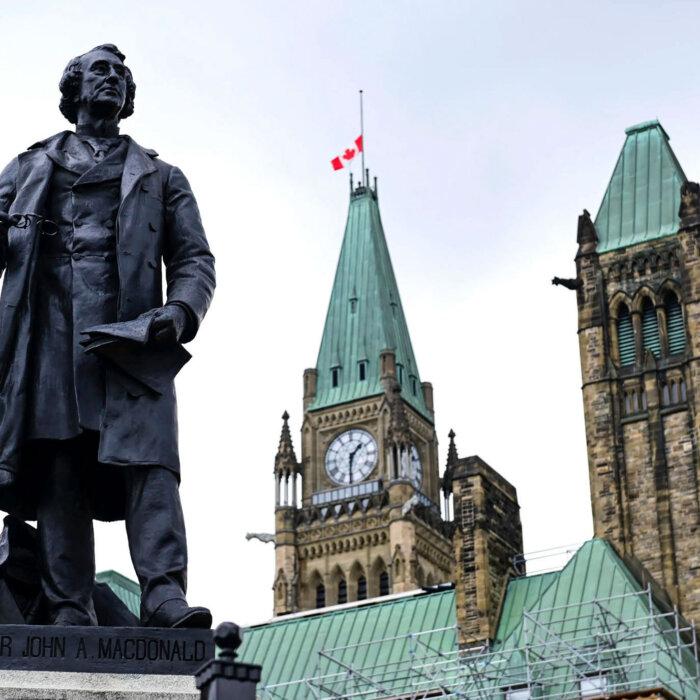
Seven out of 10 residents in Kingston, Ont., want the statue of Sir John A. Macdonald brought back to City Park following its removal in 2021, a new poll has found.
The poll, conducted by Nanos Research, found that 59 percent of Kingston residents said they would “support” returning the statue to its original location of City Park, while another 12 percent “somewhat support” the move—bringing total support to 71 percent. Meanwhile, 20 percent oppose the statue’s return, and 9 percent are unsure.
About 86 percent of Kingston residents said they were aware the statue had been removed from City Park, while 14 percent said they were not aware.
The survey text, read to participants by polling agents via telephone, said the Macdonald statue is “currently stored in a warehouse, out of public display.”
Support for the statue’s return was highest among older Kingston residents, with 85 percent of residents over the age of 55 wanting it returned. Approximately 67 percent of residents aged 35 to 54 support the statue’s return, along with 53 percent of residents aged 18 to 34.
The poll also found that the longer residents have lived in Kingston, the more likely they are to express support for returning the statue to its original location. Roughly 78 percent of residents who have lived in Kingston for more than 30 years expressed support. Meanwhile, 72 percent of residents who have lived in the city for 16 to 30 years expressed support, along with 52 percent of residents who have lived in the city for 15 years or less.
The statue’s return is supported by 77 percent of homeowners and 58 percent of renters, the poll found.
It also found that a majority of Kingston residents across all levels of education support restoring the statue to its location in the park.
Statues Targeted
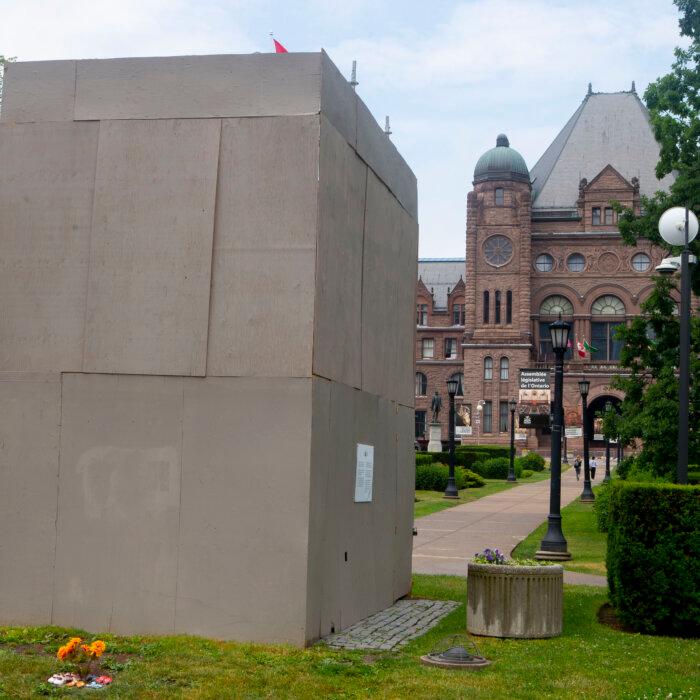
The statue in Kingston was one of many Macdonald statues targeted in recent years. Several Macdonald statues were vandalized in May 2020 during protests across Canada after the death of George Floyd, a black man who died during his arrest in Minneapolis, Minn. The city of Kingston installed several cameras and posted notices around its Macdonald statue in September 2020 after the other statues had been targeted by activists and others.Statues of Macdonald were further targeted in 2021 after members of the Tk’emlúps te Secwépemc First Nation said ground-penetrating radar had detected potential gravesites of 250 indigenous children at the location of a former residential school in Kamloops, B.C. The site has not yet been excavated to confirm the presence of remains. Excavations at other sites in Canada cited as potential burial grounds have not found any remains so far.
Macdonald statues were also removed from Hamilton, Charlottetown, and Regina. Several streets, buildings, and institutions have also been renamed to erase figures associated with residential schools.
Historic Designation
Macdonald was designated a national historic person in 1927 for serving as Canada’s first prime minister and for helping forge what Parks Canada describes as a “lasting alliance of British and French Canadians from different political backgrounds under the Liberal-Conservative party banner.” He also served multiple terms as co-premier of the Province of Canada between 1856 and 1862, was a member of the Great Coalition, and played a key role in shaping the British North America Act, 1867.“No federal board has the right to cancel the first prime minister of our country,” Poilievre said. “Sir John A. Macdonald deserves to be clearly recognized for his role in the foundation of the wonderful country we get to call home.”