Nearly three-quarters of Canadians support the construction of an oil pipeline to either the West or East Coast, a new poll indicates.
Quebec has long been opposed to such infrastructure. Attitudes appear to be changing in the new climate of U.S. tariffs, however. Fifty-nine percent of Quebecers now say they support a pipeline to the West Coast, while 55 percent are in favour of a pipeline to the East Coast, the survey found.
Pipeline support wasn’t nearly so high 10 years ago. Support for pipelines hovered at approximately 50 percent leading up to 2024, but the persistent tariff threats issued by U.S. President Donald Trump have greatly contributed to the shift in perception, the Environics report noted.
“This surge in support for pipelines is striking given that the public remains skeptical about the oil and gas industry’s commitment to reducing its environmental damage,” the report said. “Canadians appear to be prioritizing positive economic news following a decade of slow growth, and are currently on board with using all of the country’s resources to break the log jam and generate economic activity.”
The survey, performed last month, found that support is especially strong in Alberta, among Canadians 45 and older, and among those with annual household incomes of more than $150,000.
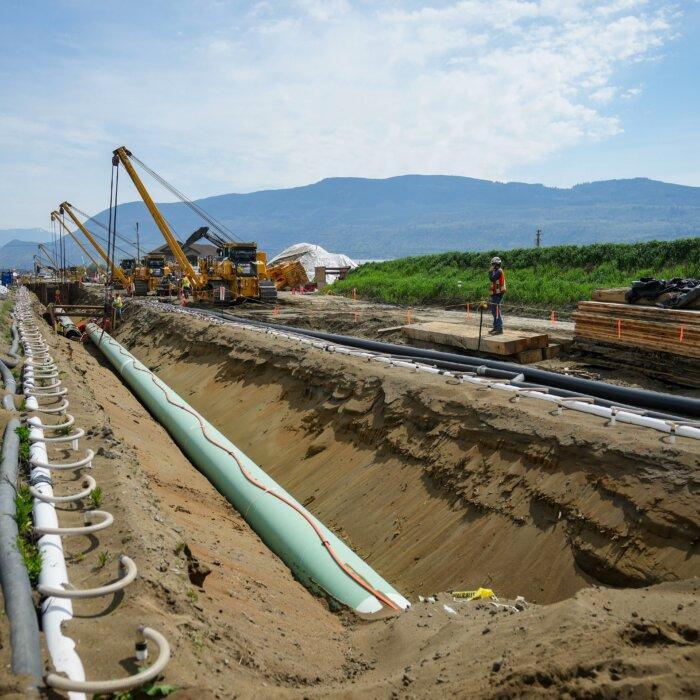

The current level of support for oil infrastructure comes as U.S. President Donald Trump threatens to raise tariffs to 35 percent effective Aug. 1 on all Canadian goods not covered under the United States-Mexico-Canada Agreement (USMCA). Trump has placed 50 percent tariffs on Canadian steel and aluminum, 25 percent tariffs on cars and auto parts, and 10 percent tariffs on oil and potash.
Pipelines have emerged as one way for Canada to diversify its trade export markets to lessen its reliance on the United States.
Prime Minister Mark Carney, who has pledged to turn Canada into an “energy superpower,” has said he will work with provinces and stakeholders to develop nation-building projects. He said that could include pipelines if there is a “consensus” among all impacted provinces.
Energy Agenda
In his plan to make Canada an energy powerhouse, Carney has said he wants to focus on a mixture of conventional and green energy projects, saying that pipelines alone will not make Canada a superpower.While 81 percent of those polled said they are in favour of investing in clean technology and sustainable energy, half of Canadians do not want that to be the lone strategy.
The survey found Canadians are largely on board with splitting national focus equally among traditional and green energy projects. Fifty percent of those polled said Ottawa should prioritize both types of projects equally. Twenty-six percent said the focus should be on green energy alone and 13 percent favoured only conventional projects while 11 percent were uncertain.
“This pattern holds across regions, with majorities in every province … favouring a mix of clean and conventional energy,” the report authors said, noting that Quebec is the one exception where only 38 percent want both and 41 percent prefer clean energy alone.
Support for a diverse range of projects grows with age, the report noted. While 36 percent of Canadians under 30 are in favour of a mixture, that increases to 60 percent for those 60 and older.
Oil Sands Support
Environics has also been monitoring the level of Canadian support for the oil sands in Alberta. Oil sands are a major source of oil and Canada has the largest reserves of any nation in the world.Support for the project has risen to 62 percent this year, a figure not seen since 2012, while 38 percent are against it. Support was highest in Alberta at 76 percent, followed by the Atlantic provinces at 66 percent, Ontario at 64 percent and Saskatchewan/Manitoba at 63 percent. Support for oil sands rose the most in British Columbia where it jumped 10 points to 61 percent and in Quebec where it rose 15 points to 50 percent.
Despite the support from the public for natural resource development, 78 percent of respondents said they were worried about environmental impacts caused by industry and business. The public also said it was skeptical about the oil and gas sector’s dedication to mitigating its environmental impact.