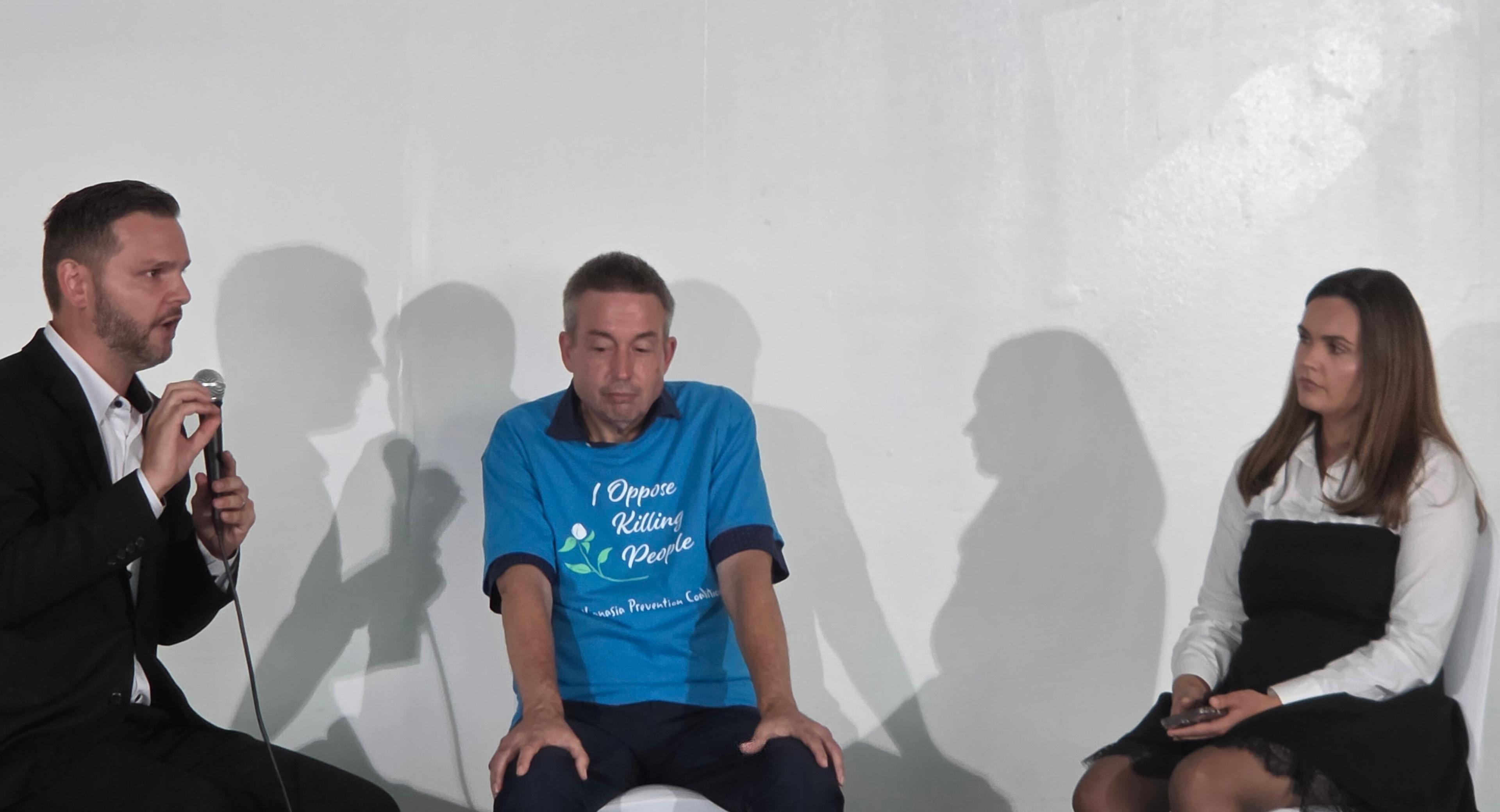
“I think that euthanasia and assisted suicide are basically the cynical solution to everything that ails us. Palliative beds are really expensive—body bags are not,” said Jonathon Van Maren, author and communications director at the Canadian Centre for Bio-Ethical Reform.
Van Maren made the comments while speaking at an Aug. 13 conference on Canada’s MAID regime, organized by journalist Rachel Parker in Lincoln, Ont., just outside St. Catharines. During a panel discussion, Parker suggested that MAID was increasingly being viewed as an “answer to our health-care crisis,” a point Van Maren expanded upon.
Van Maren said he had spoken to an Alberta nurse who told him that people on waitlists for mental-health services die before receiving care “all the time.” He also linked Canada’s health-care challenges and the rise in MAID to the country’s aging population and what he described as an inverted population pyramid.
“[In Canada] you’re having 100,000 abortions every year. In addition to that, you have an enormous number of people who have opted not to have children. So we have an upside-down family tree of four grandparents, two parents, one kid, and that has created inevitable problems that euthanasia ends up being the solution for,” he said.
Van Maren also raised concerns with the wording of Canada’s MAID laws. He noted that most people know someone with an “irremediable” medical condition, such as chronic pain or mental health struggles. Canada’s euthanasia laws state that one may seek the procedure if they are 18 years or older, have a “grievous and irremediable medical condition,” and can give informed consent free of external pressure.
“Imagine that person going into this medical institution, explaining their symptoms, not being able to access care, and getting offered assisted suicide instead. This could happen to anybody,” he said.
“Having an irremediable medical condition, well, what does that mean? There’s no definition to it. Obviously, the government put out guidelines, but the guidelines aren’t anything legal,” he said during the panel discussion.
MAID guidelines state that a grievous and irremediable medical condition means the illness is “serious and incurable,” that the person is in an advanced state of irreversible decline, and that the condition causes them “intolerable” physical or psychological suffering.
Future of MAID
Van Maren said the students were persuaded by the argument that, by defining who is eligible for MAID, the government effectively distinguishes between people whose lives are deemed “so worthless that they can get assisted suicide whenever they want” and those whose lives are considered “so valuable that they are not permitted to get a lethal injection.”
“Choice is one of the last things a lot of young people hold as very sacred. And when you can puncture that balloon, it’s quite effective, because it’s really hard to get around the fact that the Canadian government is deciding whether or not your life is worth living,” he said.

Van Maren said a possible silver lining of Canada’s rapid expansion of MAID is that it may have prompted other countries to reconsider or refrain from adopting similar euthanasia laws.
Canada has been cited as a cautionary example in several countries during debates over assisted-dying legislation.
During consideration of the legislation in the United Kingdom, opponents repeatedly pointed to Canada’s MAID system as a warning about the potential risks of expanding eligibility for assisted death. This included written evidence submitted to the UK Parliament titled, “Euthanasia and Assisted Suicide: Canada’s Cautionary Tale.”
Schadenberg also pointed to Slovenia, where opponents successfully campaigned to overturn the country’s assisted-dying law in a referendum. He said the campaign described assisted suicide as “poison” and connected the issue to concerns about the country’s health-care, pension and disability systems.
The expansion was initially scheduled for March 2023, but the government had since postponed the change several times, with news reports about Canadian veterans being offered the procedure unprompted also influencing the public debate.
While the eligibility is set to automatically expand to those with mentally illness on March 17, 2027, Prime Minister Mark Carney said following the committee report’s release that it provided a “clear” direction for the government. Justice Minister Sean Fraser said the government would review the report over the summer before making a decision.