
President Donald Trump’s son-in-law and U.S. special envoy Jared Kushner is planning to visit Israel for talks with Prime Minister Benjamin Netanyahu as Washington seeks to bridge differences over Hamas disarmament and the timing of an Israeli withdrawal from Gaza amid Trump’s push for a lasting regional peace.
Israeli diplomatic officials told Epoch Magazine Israel that Kushner is expected to travel with Nikolay Mladenov, CEO of the Trump-backed Board of Peace, and meet with Netanyahu and other senior Israeli officials.
The talks are expected to focus on dismantling the Hamas terrorist group’s military capabilities, transferring civilian and security control in Gaza to a new Palestinian administration, and the prospect of an Israeli withdrawal, according to the officials.
They said the visit is intended, in part, to assess the gaps between the Israeli government and the Trump administration regarding a 15-point implementation plan advanced by the Board of Peace.
Dispute Over Withdrawal

Speaking at the start of a government meeting on Aug. 9, Netanyahu said Israel would not withdraw from its current positions in Gaza until Hamas had been fully disarmed.
He said disarmament must cover all of Hamas’s weapons and must be genuine rather than “fictitious.”
Netanyahu said Israel was discussing the issue with Washington and that some U.S. proposals were acceptable, while others were not.
“As long as I am prime minister, a Palestinian state will not be established, neither in Gaza nor in Judea and Samaria,” Netanyahu said, using the biblical names for the West Bank.
A central dispute concerns the sequence of disarmament, the transfer of authority in Gaza, and an Israeli withdrawal.
Israel says Hamas must surrender its weapons before Israeli forces withdraw beyond their current positions. Hamas and other Palestinian factions have agreed to a gradual process for dismantling and storing weapons but have sought to link that process to Israeli pullbacks.U.S. envoy Jared Kushner looks on during a press conference upon the signing of the declaration on deploying post-ceasefire force in Ukraine during the Coalition of the Willing summit on security guarantees for Ukraine, in Paris, France, on Jan. 6, 2026. (Ludovic Marin/AFP/Getty Images)
‘Grinding and Technical Work’
The Board of Peace’s 15-point roadmap calls for the process of storing heavy weapons and dismantling military production sites, weapons depots, and tunnels to begin after a new Palestinian administration enters Gaza and an International Stabilization Force deploys.
The process would be carried out gradually under the authority of the new Palestinian administration, which would eventually become the only body permitted to possess or control weapons in Gaza.
The roadmap links the weapons-decommissioning process to a phased Israeli withdrawal. However, the Board of Peace clarified on Aug. 3 that Israeli forces would not withdraw beyond the Yellow Line until the decommissioning of Hamas’s light and heavy weapons and tunnels was complete.
The 15-point roadmap is intended to implement Trump’s broader 20-point plan, which calls for Gaza to become a demilitarized, terror-free territory governed by an apolitical Palestinian committee.
Trump’s 20-point plan bars Hamas and other armed factions from any role in governing Gaza and requires the destruction of tunnels, weapons-production facilities, and other military infrastructure.
It also calls for the progressive transfer of Israeli-held territory to the International Stabilization Force, with the pace of withdrawal tied to agreed security and demilitarization milestones.
Israeli officials say allowing the Palestinian administration and international force to deploy before Hamas is fully disarmed departs from Israel’s understanding of the original framework.
The Board of Peace maintains that the roadmap is consistent with Trump’s plan and does not require Israel to withdraw beyond the Yellow Line before Hamas relinquishes its weapons.
“The goal is clear and is not in question: the complete decommissioning of weapons in the Strip and the transition away from rule by the gun to civilian governance,” the board said following an Aug. 3 meeting with Netanyahu. “Reaching it will be a process.”
Mladenov described the negotiations as “slow, grinding and technical work.”
The change followed a request from Mladenov to suspend targeted strikes for two weeks to give the disarmament talks a better chance to succeed.
The war began after Hamas-led terrorists attacked southern Israel on Oct. 7, 2023, killing about 1,200 people and taking more than 250 hostages.
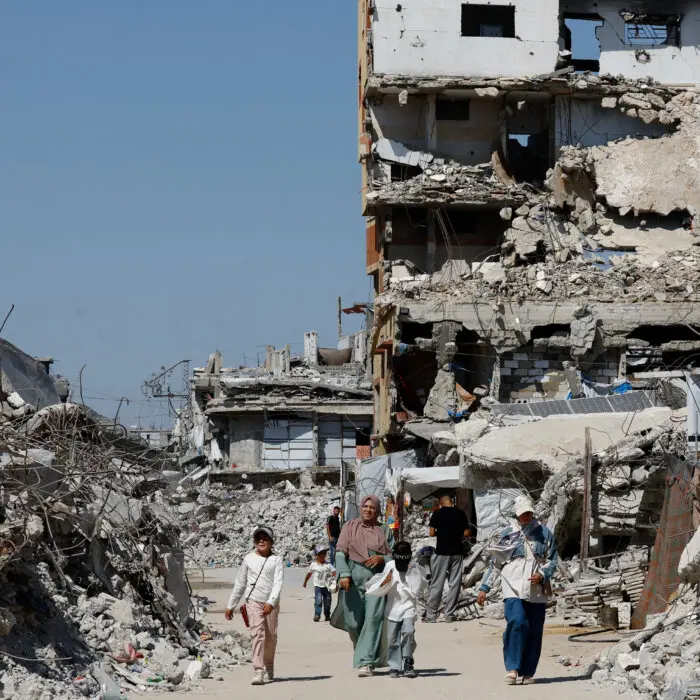
Israel’s subsequent military campaign has devastated much of Gaza, killed tens of thousands of Palestinians, and displaced most of the territory’s population.