This copy is for your personal, non-commercial use only. Distribution and use of this material are governed by our Subscriber Agreement and by copyright law. For non-personal use or to order multiple copies, please contact The Epoch Times Reprints.
Japanese Prime Minister and president of the ruling Liberal Democratic Party (LDP), Shigeru Ishiba, walks in front of a board with red paper roses showing elected candidates in Tokyo, Japan on July 20, 2025. Franck Robichon/Pool via Reuters
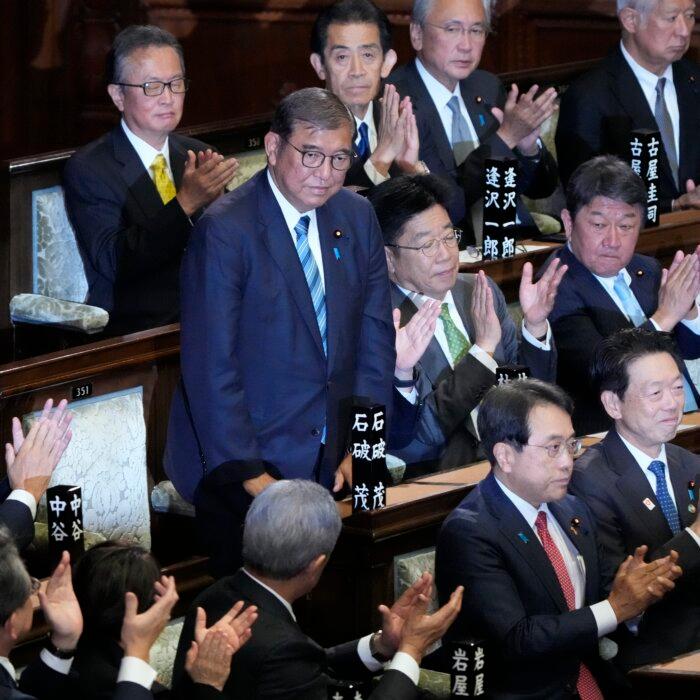
Japanese Prime Minister Shigeru Ishiba, leader of the center-right Liberal Democratic Party (LDP), said on July 21 he would not stand down after losing a key election on July 20.
The parliamentary election defeat came as Japan faces an Aug. 1 deadline to strike a tariff deal with the United States.
The LDP and its junior coalition partner, Komeito, were trying to hold onto a majority in the 248-seat upper house, the House of Councillors, but fell three seats short in the July 20 vote.
During a press conference on July 21, Ishiba said: “While I painfully feel my serious responsibility over the election results, I believe I must also fulfill my responsibility I bear for the country and the people so as not to cause politics to stall or go adrift. Challenges such as [the] global situation and natural disaster won’t wait for a better political situation.”
The LDP lost control of the more powerful lower house of the National Diet, the House of Representatives, in October 2024.
Ishiba said the LDP and Komeito had agreed to maintain their coalition, while seeking cooperation from opposition parties.
The Democratic Party for the People—which campaigned for higher take-home pay, according to a report in the Japan Times—was the big winner and is expected to increase its number of seats from four to 17.
Another gainer was the nationalist Sanseito, which campaigned on stricter regulations on foreigners and traditional gender roles, and which is set to win 14 seats.
Yoshihiko Noda, leader of the center-left Constitutional Democratic Party of Japan—which won 22 seats—told national broadcaster NHK his priority was to form an alliance among the opposition.
Noda—who was prime minister from September 2011 to December 2012—said, “Public opinion clearly said ‘no’ to the Ishiba government.”
Ishiba said it made no sense to create a political vacuum as the country faced a series of challenges, including the tariff deadline with the United States.
The Path to a Solution
He said he was staying on “to put the pressing issues on a path to a solution.”
Japan’s chief tariff negotiator, Economic Revitalization Minister Ryosei Akazawa, will be in Washington this week for an eighth round of trade talks.
Ishiba said he hoped to reach a mutually beneficial deal with President Donald Trump “as soon as possible.”
On July 7, Trump issued letters announcing reciprocal tariffs on a number of countries, including 25 percent tariffs on Japan and South Korea.
In the letters, released on social media platform Truth Social, Trump warned that the tariffs could be increased if the countries raise their own trade barriers, or fail to address long-standing trade imbalances with the United States.
In September 2024, the LDP chose Ishiba, 68, to take over as leader and prime minister from Fumio Kishida, after a series of corruption scandals saw the party’s support drop below 20 percent.
It was the fifth time that Ishiba—who has been in the Japanese Parliament since 1986 and was defense minister between 2007 and 2008—had bid for leadership of the party.
Japan’s Inflation Woes
On taking office, Ishiba said that his priority would be revitalizing consumption while protecting people from rising inflation.
But inflation rose from 2.5 percent to 4 percent between October 2024 and January 2025, before falling back to 3.3 percent after the Bank of Japan raised its interest rate to 0.5 percent in January.
Ishiba promised to “quickly analyze the results and learn the lesson” from the election defeat.
On July 20, he told TV Tokyo: “We are engaged in extremely critical tariff negotiations with the United States. ... We must never ruin these negotiations. It is only natural to devote our complete dedication and energy to realizing our national interests.”
The LDP—a pro-business party with a long tradition of support for the United States—has ruled Japan for most of its post-war history.