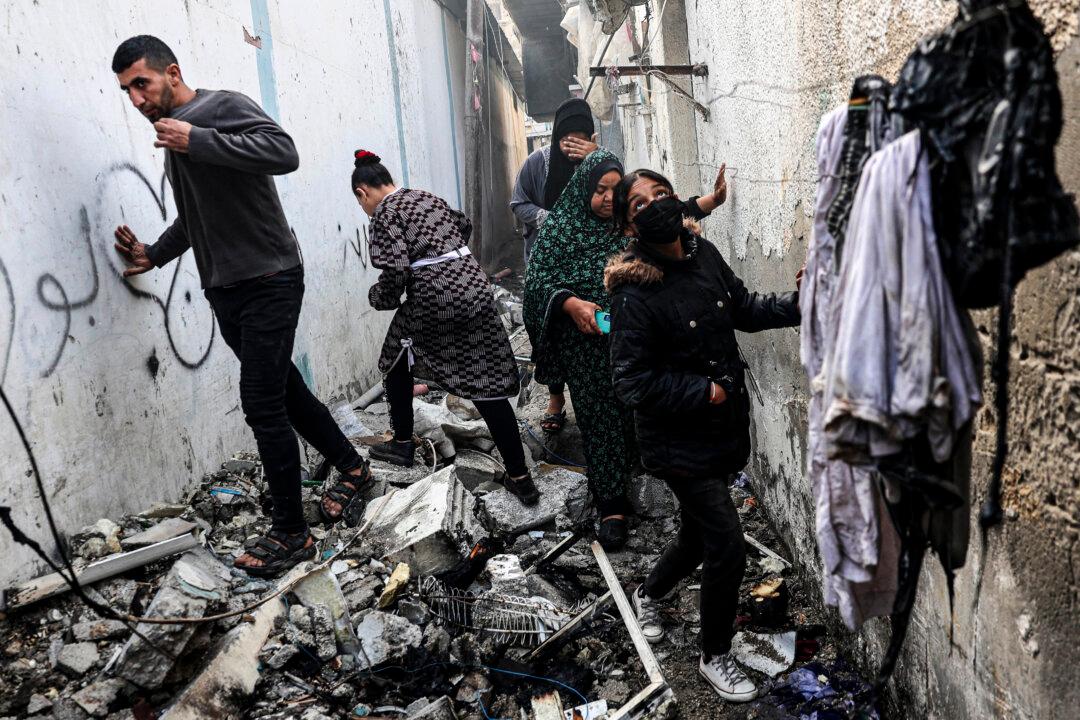
Israel targeted a school that it said was a terrorist command center with airstrikes on Oct. 10, killing 28 people, according to the Palestine Red Crescent Society.
Palestinians said the school was being used to house evacuees. Medics said another 54 people were wounded.
The Israel Defense Forces (IDF) said on Oct. 10 it had carried out a “precise strike on terrorists” who maintained a command center in the school, which sits in Deir Al-Balah, between Gaza City and Khan Yunis.
“The command and control center, which was embedded inside a compound that previously served as the Rufaydah School, was used by the terrorists to plan and execute terrorist attacks against IDF troops and the state of Israel,” the IDF said.
“Prior to the strike, numerous steps were taken to mitigate the risk of harming civilians, including the use of precise munitions, aerial surveillance and additional intelligence.”
Israel faces pressure from the United Nations, which accuses it of war crimes and crimes against humanity connected to destroying Gaza’s health system.
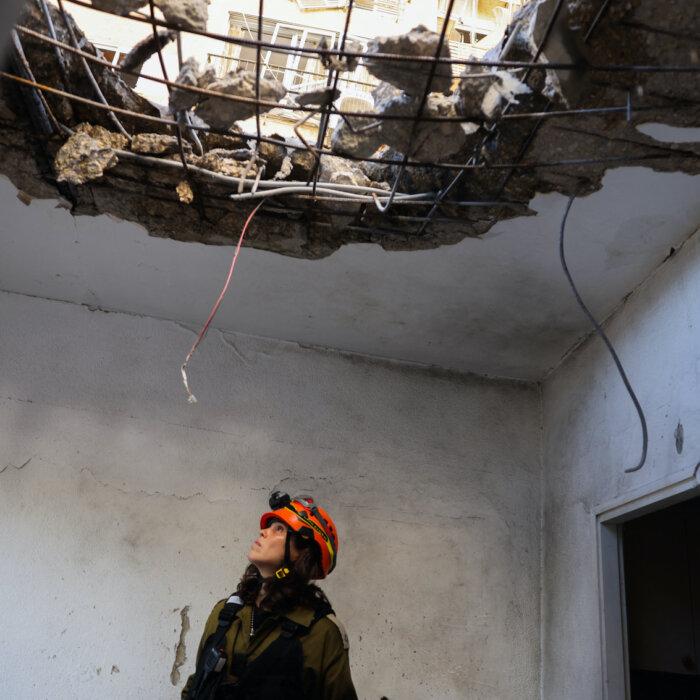
The IDF ordered three Gaza hospitals to evacuate, according to Palestinian health officials. The IDF has accused Hamas of storing weapons and locating command and computer facilities in or underneath them.
Also on Oct. 10, the Israeli military said it had eliminated at least 12 terrorists—two platoon leaders and 10 fighters, all of whom it named—in a separate strike on a command and control center. The center previously served as a medical compound for Jabalya in the Gaza Strip, the IDF said. The eliminated terrorists were from Hamas or Islamic Jihad, according to the IDF.
The army called the school and medical compound site “a further example of the Hamas terrorist organization’s systematic abuse of civilian infrastructure in violation of international law.”
Across the Lebanese border, in the aftermath of an Israeli operation, the lead IDF spokesman demonstrated what he called another “abuse of civilian infrastructure.”
Israeli Rear Adm. Daniel Hagari, whose video presentations are usually made at a podium indoors, appeared in a video on Oct. 10 wearing a helmet and tactical vest, with dust visible on his pants, and carrying a rifle.
In the video, Hagari says he is speaking from a Shia village close to the Israeli border and that “every house is a terror base.” “I want you to see in your own eyes what we found here today,” he says.
The village appears shattered by combat. Hagari steps through a large hole in the wall of a house.
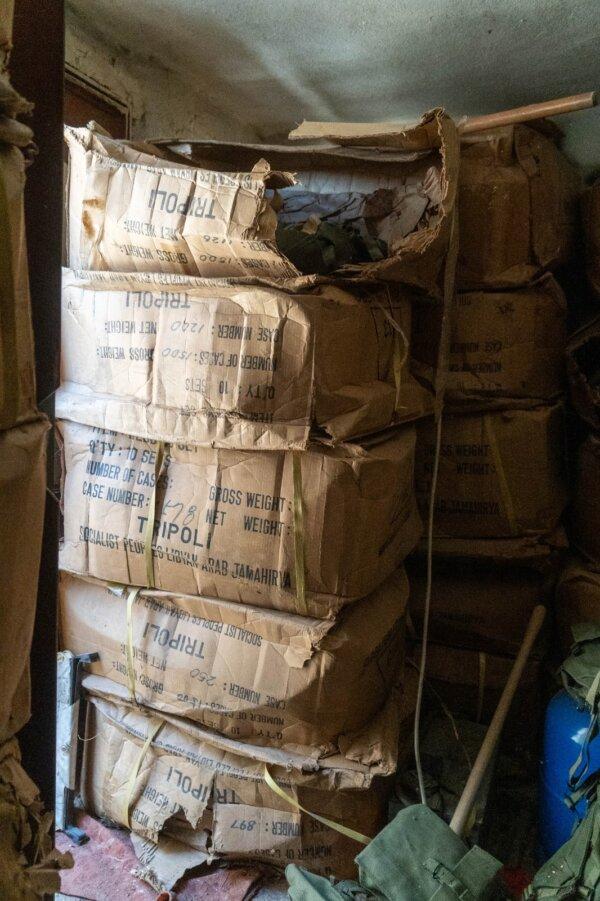
He then walks around the house, showing supplies piled in each room and picking up and showing to the camera gear such as combat vests, helmets, and night-vision goggles. In another room, weapons can be seen, including a box of hand grenades and another large box with explosive rocket-propelled grenades.
In the video, Hagari hoists up what he says is a sniper barrel, at least five feet long and with a sizable optical scope. He shows a combat rifle with a bipod, then sets it aside.
“This is a Lebanese village, a Shia village, built by Hezbollah. Every house has gear ready for the raid,” he says.
Hezbollah, which is an internationally designated terrorist organization, is planning a raid against Israel called “Conquer the Galilee,” “a massacre on a larger scale then the 7th of October, for Northern Israel, with this gear over here,” he says.
Military strategists have said Hezbollah, backed by Iran, was the originator of the tactics used in Hamas’s Oct. 7, 2023, raid and had worked on them for up to two years.
Hamas put the tactics into practice first. Its raid, on a Saturday morning that was both the Jewish Sabbath and a religious holiday, resulted in the deaths of 1,200 people, primarily Jewish civilians, the kidnapping of 250, the wounding of thousands, and the destruction of Israeli border communities.
Hagari did not identify the Lebanese village. The IDF said that soldiers from its 91st division had located large stores of weapons in civilian homes, including a missile launcher “with dozens of ready-to-fire missiles aimed at Israeli communities in the Galilee.”
The IDF, Hagari said, intends to “clean” the border region so that Israel’s northern residents, who have fled their homes or endured missile strikes and air-raid sirens for more than a year, can go home free of Hezbollah’s threat.