The Israeli government unanimously approved a proposal on June 28 to formally recognize the Armenian Genocide, marking a significant shift in the country’s longstanding policy and prompting an immediate condemnation from Turkey.
Israeli Foreign Minister Gideon Sa'ar said that Israel has a moral and historical duty to recognize the mass killing of Armenians during the final years of the Ottoman Empire.
“It is never too late to do the right thing,” Sa'ar said.
The Ottoman government, Sa’ar said, carried out the systematic persecution of the Armenian population through forced labor, deportations, and death marches across the Syrian desert. He added that about 1.5 million Armenians died during the campaign and that centuries of Armenian cultural heritage in Anatolia were destroyed.
More than 30 countries have already recognized the Armenian Genocide, including the United States, France, Germany, Canada, Italy, Greece, and Russia.

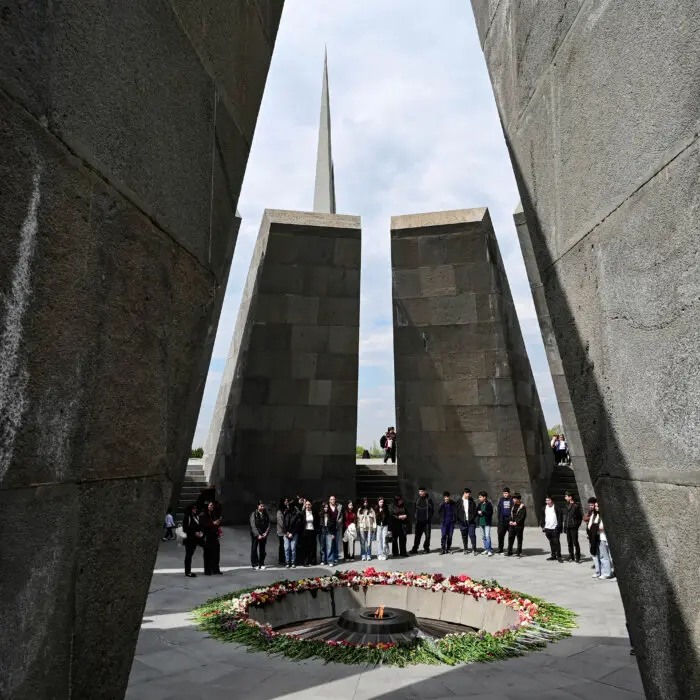
“I think the time has come for Israel, as a Jewish state, to formally accept this position,” Sa'ar said.
He rejected suggestions that the move was intended as retaliation against Turkey’s government.
“Furthermore, the fact that Turkey promotes false narratives against Israel does not grant it immunity from historical truths,” Sa'ar said.
Turkey Condemns Israeli Decision
The recognition places Israel among a growing number of countries that officially recognize the Armenian Genocide, a characterization that Turkey continues to reject.The Turkish Foreign Ministry criticized Israel’s decision, adding that Israel was diverting attention from allegations related to the war in Gaza.
“The Israeli government, which has been carrying out systematic persecution against the Palestinian people before the eyes of the entire world and is currently before the International Court of Justice in the case concerning the commission of the crime of genocide against Gazans, seeks to cover up its own crimes through the political decision it has adopted regarding the events of 1915,” the ministry said.
The statement also described the Israeli decision as “a malicious attempt” that ignores legal and historical facts. Turkish officials said they would continue working for what they described as accountability for Israel’s actions in the region.
Israel and Turkey have experienced increasingly strained relations since the start of the war in Gaza.
Azerbaijan Urges Israel to Reconsider
Azerbaijan also criticized Israel’s decision, saying it distorted the historical record. The Azerbaijani Foreign Ministry described the move on June 29 as “a matter of serious concern.”“The distortion of the historical facts surrounding the events of 1915, and the reduction of a complex historical issue to a political decision without a sound legal or scholarly basis, are unacceptable,” the ministry said.
Azerbaijani officials said the decision would not promote reconciliation or mutual understanding and instead “deepen existing divisions and undermine efforts to achieve lasting peace and stability in the region.”
Baku called on the Israeli government to reverse its decision. The ministry said that Azerbaijan remains committed to “upholding historical truth, respecting the principles of international law, and promoting lasting peace and stability in the region.”
Azerbaijan’s response also reflects its close relationship with Turkey, which has long supported Baku politically and militarily.
The Turkish Foreign Ministry describes the relationship as a strategic partnership dating to Azerbaijan’s independence in 1991.