This copy is for your personal, non-commercial use only. Distribution and use of this material are governed by our Subscriber Agreement and by copyright law. For non-personal use or to order multiple copies, please contact The Epoch Times Reprints.
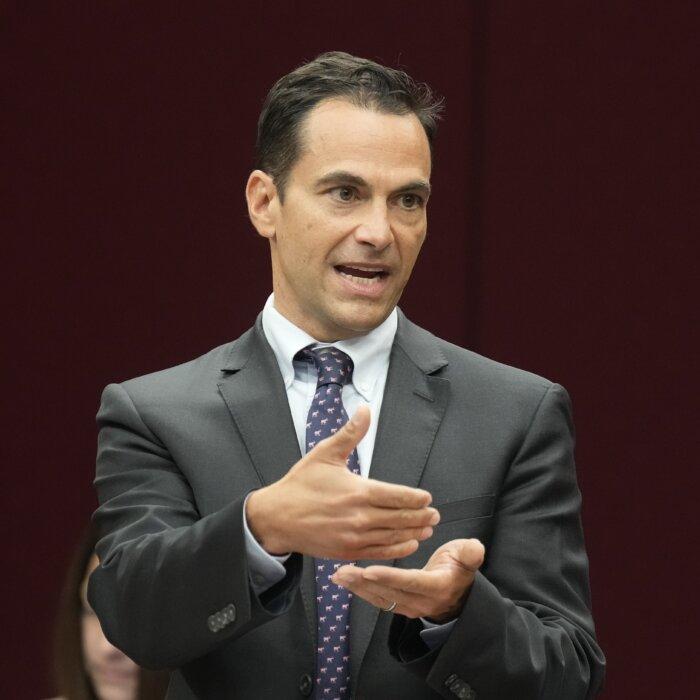
Jason Jacques, interim Parliamentary Budget Officer, appears at the Standing Committee on Government Operations and Estimates on Parliament Hill in Ottawa on Sept. 16, 2025. The Canadian Press/Adrian Wyld
As Ottawa begins its search for a permanent parliamentary budget officer (PBO), interim PBO Jason Jacques says he’s throwing his hat in the ring.
Jacques said he will “absolutely” apply for the position, during an interview with CTV Question Period host Vassy Kapelos aired on Nov. 16.
“From my own perspective, having worked in the office since the beginning, I think it’s important that parliamentarians have the choice,” Jacques told Kapelos.
“They’ve seen what I plan on doing and how I plan on managing the office. They have the choice for this approach, the current approach, or they have a choice for a new approach.”
Jacques, a veteran of the Office of the PBO, was appointed by the Liberal government in September as interim PBO for a period of six months following expiry of Yves Giroux’s term. A PBO can serve a term of up to seven years with an opportunity to have the position being renewed, but Parliament must approve a permanent appointment.
The federal government began the hiring process for a new permanent PBO last week, issuing an online job posting that says the Office of the PBO’s mandate is to provide “non-partisan, authoritative analysis on the state of the nation’s finances, the government’s budget and estimates, and economic trends.”
The posting also lists personal attribute requirements including “tact and discretion” and notes that the candidate must have experience in communicating “complex issues and expert assessments in a neutral way.”
Kapelos asked Jacques whether he thought the inclusion of those qualities was aimed at him.
“I hope it is,” Jacques responded, adding that he has worked on Parliament Hill for 17 years and has “dealt with thousands of parliamentarians.”
“I have a lot of experience—probably more experience than most people around town do—in dealing with parliamentarians across political parties who come from different cultural backgrounds, different linguistic backgrounds.”
Jacques also said he has experience “tactfully and discreetly” working with different political parties around their platform promises, “even in situations where they don’t necessarily like the numbers that we’re giving back to them.” He said he thinks these are “an essential part of the character” that a PBO candidate should have.
If Prime Minister Mark Carney and the members of Parliament decide to go in a different direction and hire a different candidate for the permanent position, Jacques said he would “certainly respect that.”
“I certainly plan to be with the office, regardless of the outcome, to support whoever is in that role,” Jacques said.
‘Unsustainable’ Fiscal Trajectory
Following his appointment as interim PBO, Jacques expressed concern over the federal government’s rising deficits, while his office’s Sept. 25 economic outlook projected the government’s budget deficit would reach $68.5 billion. He called Canada’s fiscal trajectory “unsustainable” while testifying before the House of Commons government operations committee on Sept. 25.
Jacques told the committee that the fiscal outlook was “not a funny fiscal outlook,” adding that he thought “everybody should be concerned.” He also said the PBO’s report marked “the first time in 30 years that I’ve seen the [debt-to-GDP] ratio going up over time,” instead of declining or at least remaining stable.
The Carney government’s first budget, tabled on Nov. 4, projects the federal deficit to reach $78.3 billion this fiscal year and a debt-to-GDP ratio that is expected to climb before stabilizing in the years ahead.
In its Nov. 14 budget analysis report, addressing “issues for parliamentarians,” the PBO said the Liberal government’s budget has an “overly expansive” definition of capital investments that overstates capital spending by $94 billion. The report said the government wouldn’t be able to meet its promise of balancing operational spending by 2028–29 if it used a stricter definition of capital spending.
The PBO recommended that the federal government create “an independent expert body to determine which federal spending categories and measures qualify as capital investment.”
The PBO report also said that even with Ottawa’s efforts to reduce spending, the federal debt-to-GDP ratio is projected to be higher than in the 2024 fall economic statement and is no longer on a declining path. The PBO noted that the government has “abandoned” its previous fiscal anchor of reducing the debt-to-GDP ratio over the medium term.
Meanwhile, the Liberal government has defended its upcoming budget, saying the spending is necessary in response to U.S. tariffs.
‘Consensus’
The Conservative Party has called for the Liberals to appoint Jacques to a full seven-year term as PBO, arguing that his six-month term is a “short leash” that could allow the government to “fire him for telling the truth.”
Carney said during debate in the House of Commons on Sept. 17 that when it came to the possibility of making Jacques’ term permanent, he would speak with opposition party leaders to obtain “a consensus on that appointment.”
Since the Office of the PBO was established in 2006, there has only been one other interim officer—Sonia L‘Heureux, who served a six-month term in 2013 after Kevin Page resigned in March of that year. L’Heureux was then replaced by Jean-Denis Fréchette in September 2013.