Prime Minister Mark Carney met with Polish Prime Minister Donald Tusk in Warsaw on Aug. 25 to discuss developing stronger ties between the two countries, including enhanced cooperation on energy, defence, and trade.
“The enhanced Canada-Poland strategic partnership will catalyze more European investment into Canada, create more demand for Canadian exports abroad, and reinforce Canada’s defence presence in Europe for greater security, stability, and prosperity,” Carney said.
The agreement between the two countries includes the promotion of partnerships around energy projects like liquefied natural gas, offshore wind, critical minerals, and small modular reactors. Canada and Poland will launch a bilateral dialogue to support such efforts, and a Polish nuclear energy trade mission will come to Canada in November.
Canada and Poland also agreed to boost trade and investment, with collaboration on a business, trade, and energy mission of Polish companies to Canada. Both countries will “work to realize the full benefits” of the Canada–European Union Comprehensive Economic and Trade Agreement signed back in 2017, which has resulted in merchandise trade between Canada and Poland doubling.
The two countries will also be collaborating on defence by encouraging strategic partnerships between defence industries, including in supporting Ukraine’s military. Canada and Poland will explore options to conduct joint procurements, and their military cooperation will cover areas such as radars, surveillance and reconnaissance technologies, and artificial intelligence, the two governments said.

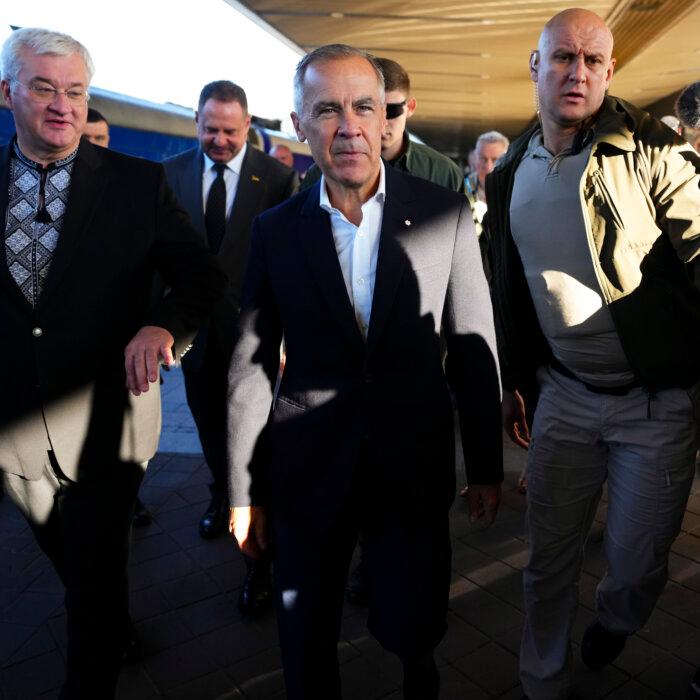
A day earlier, Carney also made a visit to Ukraine to meet with President Volodymyr Zelenskyy, where he reiterated Canada’s support for the country in its war against Russia. Carney also suggested Canadian troops could be sent to Ukraine as part of security guarantees for the country, but did not say whether they would be there as part of a peacekeeping force or in a training capacity.
Carney’s trip to Ukraine comes as efforts to end the war between Ukraine and Russia have been ramping up, with U.S. President Donald Trump recently meeting with Russian President Vladimir Putin and then inviting Zelenskyy and other European leaders to the White House to debrief.
Following the meeting with Carney on Aug. 25, Poland’s Tusk said his country was not prepared to offer troops as part of its security guarantees to Ukraine, but that it would help organize logistics for Ukraine and assist in the defence of the Belarusian border.
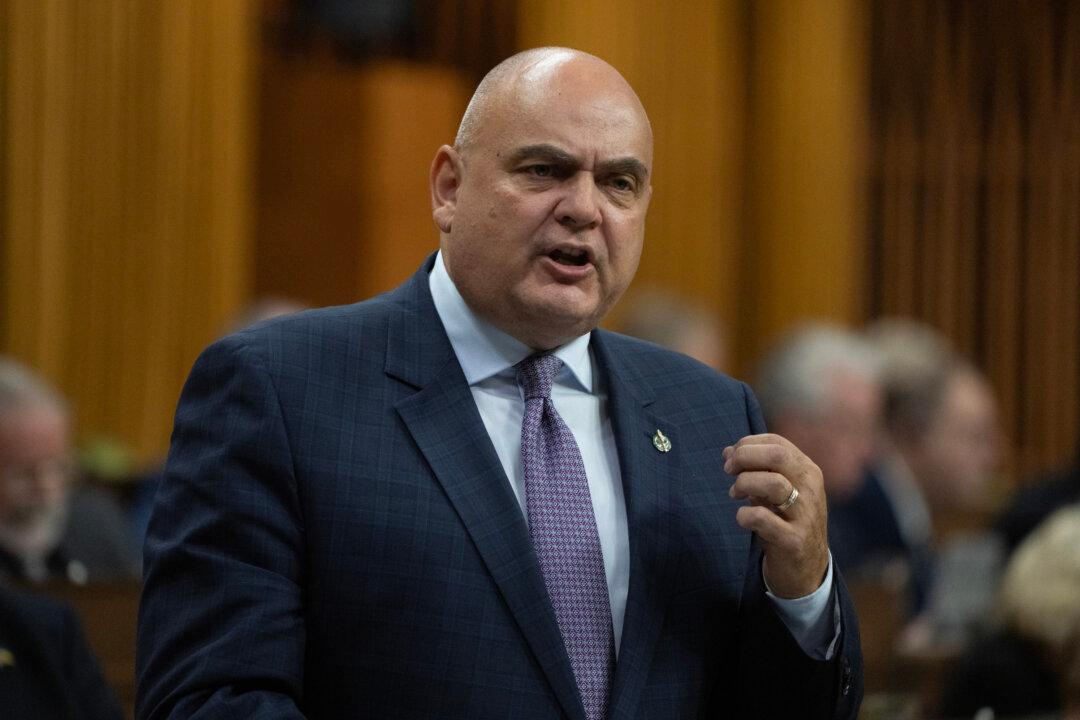
Carney was also accompanied during his trip to Poland by Defence Minister David McGuinty. The defence minister told reporters that Carney had been clear that while he was not ruling out having Canadian troops in Ukraine, “he was speaking in the context of a whole series of possible responses,” which could also include continued financial and logistical assistance, or intelligence support for the country.
McGuinty also said that his attendance alongside Carney to Poland, which is atypical, is an indication that “the landscape has changed” and Canada is building relationships with other countries as “part of our diversification efforts.” Carney has said that in the face of changing U.S. foreign policy, his government is looking to diversify partnerships, and has increasingly worked on forging new relationships with European countries.
“The prime minister was very clear that on the defence front, we would be diversifying, which is why we signed on to the European Union arrangement,” McGuinty said in reference to Canada joining the defence procurement program ReArm Europe in June.
Following the meeting with Tusk in Warsaw, Carney is heading to Germany to meet with German Chancellor Friedrich Merz to discuss trade and defence cooperation, before going to to Latvia.