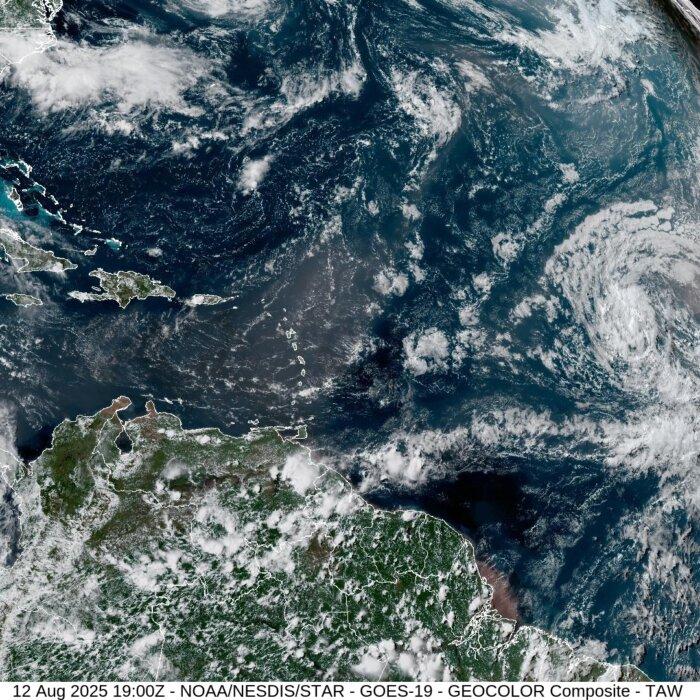
Hurricane Erin was downgraded overnight, although it is growing in size after it spent Friday night and Saturday transforming from a tropical storm into a Category 5 hurricane, the National Hurricane Center (NHC) said in updates.
Wind speeds remain formidable, with maximum sustained speeds coming in at 125 mph, down from 160 mph, the Miami-based NHC said.
It is not expected to make landfall, although it will likely “produce life-threatening surf and rip currents” for landmasses in the region this week, including along much of the U.S. East Coast from Florida to the mid-Atlantic.
“Locally considerable flash and urban flooding, along with landslides or mudslides, are possible,” the NHC said.
A Category 4 storm has the potential to cause “catastrophic damage,” while a Category 3 storm—with windspeed between 111 to 129 mph—has the potential to cause “devastating damage.”

The National Weather Service in San Juan had issued an alert for Saturday night for nearly two-thirds of Puerto Rico, warning of 50 mph winds. Power was knocked out to about 130,000 customers in the territory.
Despite the downgrade, the forecaster said that Erin is in the process of growing to become “a larger system.”
Fluctuations Expected
“Fluctuations in intensity are expected over the next day or two due to inner-core structural changes,” the NHC added in its 2 a.m. update.“Hurricane-force winds extend outward up to 25 miles (35 km) from the center and tropical-storm-force winds extend outward up to 205 miles (335 km).”
The system is forecast to move west-northwest on Sunday at around 14 mph, reaching southeast of the Bahamas on Sunday night before turning more northward on Monday and Tuesday.
The Tropical Storm Watch remains in effect for the Turks and Caicos Islands as Erin approaches.
“The core of Erin is expected to pass to the east of the Turks and Caicos Islands and the southeastern Bahamas tonight and Monday,” the forecast read.
The forecaster said that the tropical storm watches for St. Martin, St. Barthelemy, and Sint Maarten had been lifted.
As a precaution, the federal government has deployed more than 200 employees from the Federal Emergency Management Agency (FEMA) and other agencies to prepare for the storm. Puerto Rico Housing Secretary Ciary Pérez Peña said that 367 shelters were inspected and ready to open if needed.
Officials in the Bahamas also prepared shelters and urged people to monitor the storm’s progress.
Erin is the first hurricane of the season to reach Category 5 wind speeds—earlier than is typical for the first half of hurricane season. The most powerful storms tend to form later in the year, with the season typically peaking in mid-September.
The Atlantic hurricane season, which runs from June 1 to Nov. 30, is predicted to be busy this year, with six to 10 hurricanes forecast, including three to five expected to reach the major status of a Category 3.