News Analysis
As the federal government continues to grapple with debt, provinces have been experiencing a similar challenge in recent years, marked by increasing debt in relation to their economic size and deteriorating finances.
The 10 provinces’ combined yearly deficit was on track to nearly triple in one year, rising from an estimated $10.6 billion in the 2023–24 fiscal year, or 0.4 percent of GDP, to the nearly $28 billion projected in 2024–25, or 0.9 percent of GDP, according BMO’s provincial monitor in April 2024. BMO forecast in July that the combined provincial budget deficit was on track to rise to nearly $45 billion in 2025–26, or 1.4 percent of GDP.
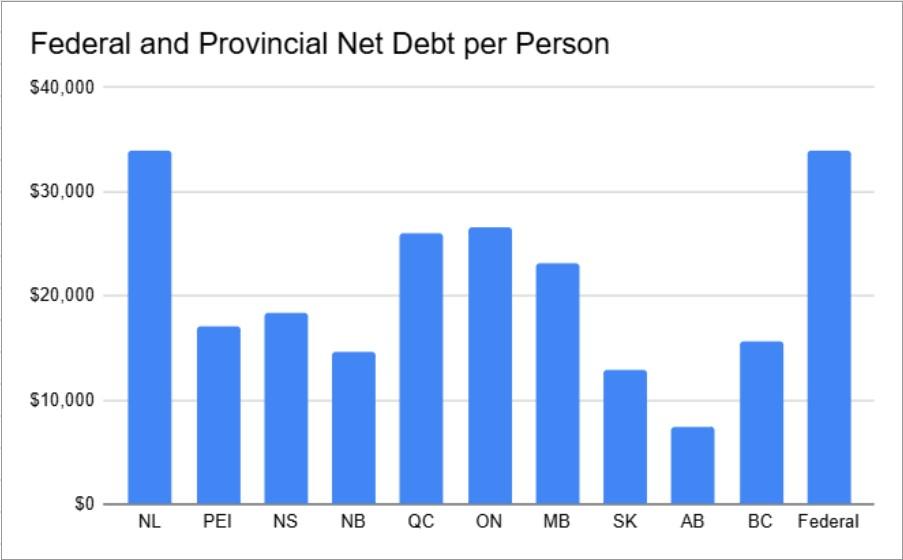
Data source: Fraser Institute. The Epoch Times
As spending continues to outpace income, the provinces can expect to see their ongoing deficits grow their accumulated debt to larger and larger amounts, with higher interest rates making the debt increasingly difficult to pay off.
Meanwhile, although Ottawa’s budgetary deficit has fallen from $61.9 billion in 2023–24 to an estimated $46 billion in 2024–25, or 1.5 percent of GDP, according to a June report from the Parliamentary Budget Officer (PBO), the C.D. Howe Institute projects the federal deficit will be more than $92 billion in 2025–26 due to boosting military spending to hit NATO’s target of 2 percent of GDP by the end of that fiscal year.
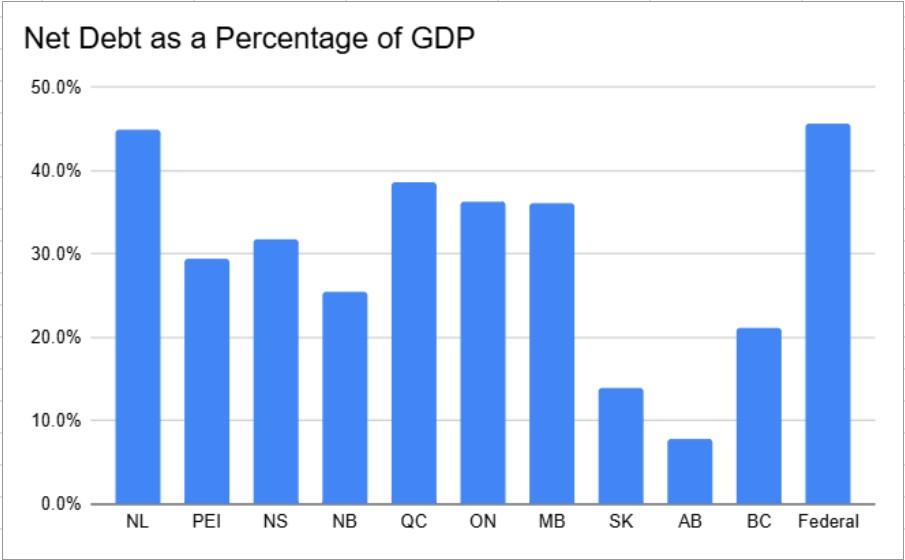
Data source: Fraser Institute. The Epoch Times
When it comes to debt relative to the size of the overall economy, the federal net debt-to-GDP ratio grew from 32.7 percent in 2007–08, just before the 2008–09 recession, to 45.7 percent in 2024–25, the Fraser Institute said in a study released in July.
Provincial net debt-to-GDP increased from 20.5 percent to 29.1 percent over the same 17-year period, the study indicated. Alberta (7.8 percent), Saskatchewan (14 percent), and British Columbia (21.1 percent) had the healthiest net debt-to-GDP levels in 2024–25, although those levels were all higher than the ones in 2007–08 (-13.4 percent, 11.2 percent, and 11.9 percent respectively).
Newfoundland and Labrador (44.9 percent), Quebec (38.6 percent), and Ontario (36.3 percent) had the worst debt-to-GDP ratios in 2024–25, with N.L.’s ratio having increased from 35 percent and Ontario’s from 26.6 percent since 2007–08, and Quebec’s having decreased from 41.5 percent that year. In Manitoba, Nova Scotia, P.E.I., and New Brunswick, the figures were at 36.1 percent, 31.7 percent, 29.5 percent, and 25.4 percent respectively in 2024-25, compared to 21.2 percent, 35.6 percent, 29 percent, and 24.9 percent in 2007-08.
“A rising debt-to-GDP ratio indicates government debt has grown at an unsustainable rate (in other words, debt levels are growing faster than the economy),” the Fraser Institute said in a commentary in February.
Jack Mintz, President’s Fellow of the School of Public Policy at the University of Calgary, says the federal and provincial governments have seen a deterioration of their finances in recent years and projected the situation would worsen in the coming years.
“We’ve got some major issues. We could end up seeing a spiralling of debt,” Mintz said in an interview. “If governments keep spending a lot of money and don’t raise taxes, it’s going to be more debt than ever next year.”
IceCap Asset Management economic analyst Richard Dias says the fiscal situation for the provinces and federal government is “not good” and is made worse by a lack of political will to meaningfully raise taxes or reduce spending.
“Imagine you’re a politician and you’re like, ‘OK, I’m going to cut services and raise taxes.’ No one’s going to vote for you, right?” Dias told The Epoch Times.
“So, what ends up happening is people basically refuse to take any pain, but the pain will come.”
Provincial Snapshots
The provinces’ total debt levels are concerning because citizens are responsible for both federal and provincial debt, Mintz said. He noted that the federal government’s fiscal situation is moving toward one similar to that in the 1980s, when total government debt was at nearly 100 percent of GDP, which led to governments implementing controls to increase revenues and reduce spending.“We’re starting to get to that magical number of too much debt, where it can be a problem,” he said.
As for the provinces, Mintz said they are starting to reach debt levels that are “worrisome in terms of how we’re going to be able to handle it.” That debt is projected to get worse in the coming years, he added.
Mintz said B.C. is on a “very bad trajectory right now,” with its debt levels projected to increase from $133 billion in 2024–25 to nearly $209 billion by 2027–28. The B.C. government says in its budget and fiscal plan that its debt metrics “are expected to increase but remain affordable relative to our peers” and that the government is maintaining key investments in housing, health, and education.
Mintz said Alberta has “always had low debt” due to fiscal prudence and revenue from energy exports. The province’s net debt is expected to rise from $36.6 billion in 2024–25 to nearly $50 billion by 2027–28, according to a TD Economics report published in February noting that Alberta is projecting a budget deficit in 2025–26, for the first time since the pandemic.
For Quebec, Mintz said it’s “hard to believe” the province has such high debt levels given that it received more than $13.3 billion in equalization payments in 2024–25. That amount represented more than half of the total $25.3 billion in equalization payments provided to the 10 provinces that year, a system meant to address fiscal disparities among those jurisdictions so Canadians have access to comparable public services regardless of which province they live in. Quebec’s net debt stood at $235.8 billion at the end of the 2024–25 fiscal year and it is projected to rise to $263.5 billion in 2028–29.
Mintz said Quebec has higher debt levels because the government tends to “micromanage” its economy with various social programs and special credits for key industries.
“They’ve had social policies that have cost them a lot of money, but it’s partly been funded by federal transfers, particularly equalization, which, had they not had it, they would be in a worse position,” he said.
In the case of Canada’s largest province, Ontario, a recent study by the Fraser Institute said the province’s net debt of $428.1 billion as of the 2024-25 fiscal year represents 36.3 percent of the provincial economy.
“This year, the Ford government expects to spend $16.2 billion to cover the interest on its debt—roughly 25 per cent more than the $13.0 billion the province will spend on postsecondary education,” the study report says.
“Government debt also represent higher taxes in the future that will disproportionately burden younger generations of Ontarians.”
Rising National Debt Burdens
Ottawa has introduced legislation to reduce the lowest personal income tax rate from 15 percent to 14 percent effective July 1, which will cost more than $27 billion in revenue to implement over five years starting in 2025–26. Provinces like Alberta, Nova Scotia, and Saskatchewan have also recently reduced taxes in their 2025 budgets. At the same time, the government is maintaining and expanding social assistance programs, such as the dental care program.Meanwhile, Dias said he is concerned about a looming “debt wall” as government bonds that will soon be maturing will need to be financed at higher interest rates, which will increase the cost of federal and provincial government interest payments.
The federal and provincial governments issued large amounts of new debt in 2020 to fund various pandemic programs, doing so at record-low interest rates. However, the Bank of Canada raised interest rates sharply from 0.25 percent in January 2022 to 5 percent by July 2023. These hikes also pushed five-year and 10-year Canadian bond yields higher. This will result in elevated interest payments on the debt as it matures and is refinanced at the higher yields.
The federal government has already seen its interest payments on debt rise from roughly $20.2 billion in 2020–21 to a forecasted nearly $53.8 billion in 2024–25, while the 10 provincial governments combined saw those payments rise from approximately $29.4 billion to nearly $38.7 billion during the same period. These amounts are expected to rise even further in the coming years, increasing the debt load on both levels of government.
“Your bond interest rates, times the amount of debt you have, is your interest payment,” Dias said. “So you’re going to start having a situation where your debt, your interest burden, is starting to just climb.”