
Trucking firms say the opening of the Gordie Howe bridge promises more efficient transport between Canada and the United States—though not necessarily lower prices for consumers.
The new span between Detroit and Windsor, Ont., will make for better traffic flow, smother security procedures and competitive toll rates that could save large trucking companies up to $100,000 a month, says Canadian Trucking Alliance CEO Stephen Laskowski, whose association represents more 4,500 carriers and suppliers.
“That sends a key signal to the investment community, the business community, that that trade corridor is open for business, so I can rely on my goods going across the border in an efficient, productive manner and not worry about delays,” he said.
“It means more jobs and more wealth, more growth.”
The six-lane Gordie Howe International Bridge offers a direct connection between Ontario’s Highway 401 and Interstate 75 across the Detroit River. In contrast, the four-lane Ambassador Bridge upstream requires an off-ramp and more than a dozen traffic lights on the Canadian side.
The new crossing also features quicker, more up-to-date X-ray imaging facilities and tolls that sit well below traditional rates at the privately owned Ambassador Bridge.

High diesel fuel prices following a tough couple of years for the industry mean the cost savings may not trickle down to consumers any time soon.
“In the short term, you’re not going to see it reflected on the shelves,” said Mike Millian, president of the Private Motor Truck Council of Canada.
“Costs have gone up significantly,” he said, pointing to the impact of tariffs and the Middle East war, which has been a driving force on oil prices this year.
“This may help trucking companies get some money back in their bottom line, because they certainly haven’t recuperated all of that increase.”
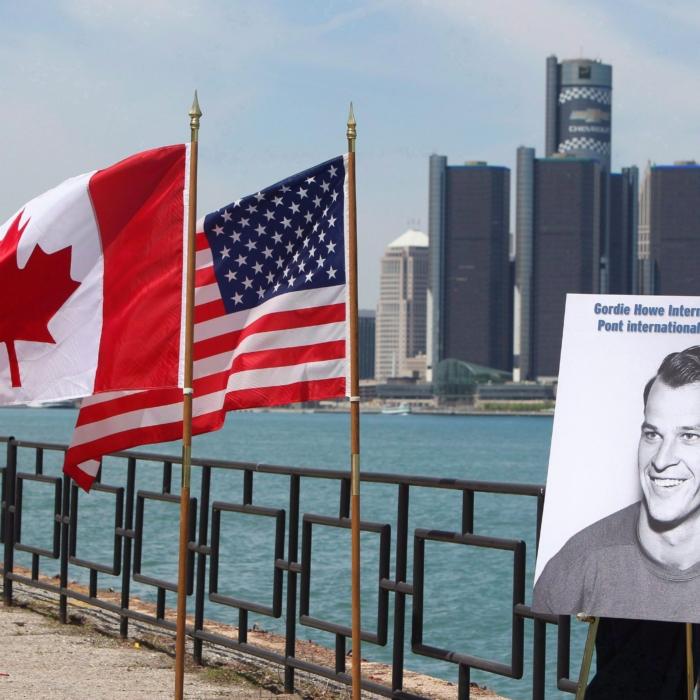
The $6.4-billion Gordie Howe International Bridge was set to open to motorists Monday after months of controversy over financial aspects of the project.
Canada held a ceremony last week to help mark the first new crossing between Ontario and Michigan in more than 60 years, but a joint celebration with the United States was cancelled over Washington’s recent threat of new tariffs on Canadian goods.
With or without fanfare, Millian is grateful for the fresh option now available to the in-house fleets represented by his organization, whose members include Loblaw, Walmart, Home Hardware, Molson and Coca-Cola.
“I didn’t want to sit through 14 traffic lights,” he said, recalling his days as a big-rig driver. “You’ve got to wind your way through city streets on the U.S. side as well.”
Fuel consumption will also be lower without the stop-and-go traffic, he noted, while stops and inspections should be faster at Gordie Howe’s larger customs plazas on both sides of the river.
“It’s going to be an X-ray machine,” Laskowski said of the rapid drive-through system that can scan commercial trucks.
“If it’s good to go, just like you would see at an airport with your luggage, off you go, as opposed to physically taking everything out of your suitcase”—off-loading skids from the truck—he said.
The Gordie Howe’s border complex can host agricultural and meat inspections on site as well, unlike at the Ambassador.
The new bridge also has a commercial office where drivers can go for assistance with any customs documentation mix-ups.
“In the past, that driver might have been sitting there waiting for the documentation to come through, clogging up the lanes,” said Millian.
The span is expected to save commercial carriers about 850,000 hours of travel time each year, according to federal Infrastructure Minister Gregor Robertson.
The Ambassador Bridge handles about US$118 billion in annual trade between Canada and the U.S. each year, or more than a quarter of all truck-borne trade, according to the U.S. Department of Transportation.
It hosted 1.86 million trucks last year—roughly 6,000 per day—data from the binational Bridge and Tunnel Operators Association shows.
However, the tally marked the first time in decades the Ambassador—typically the busiest commercial land crossing along the 9,000-kilometre Canada-U.S. border—notched a lower total than Sarnia’s Blue Water Bridge, an outcome industry observers blame partly on higher tolls.