The outpouring of kindness worldwide toward those impacted by wildfires in northwestern Ontario has been inspirational for one local charity as it fields messages and contributions from places as far-flung as Dubai and Singapore.
“Incredible” and “amazing” are just two of the words Thunder Bay United Way CEO Albert Brulé used to describe the generosity that had led to the charity receiving more than $287,000 for its Northwestern Ontario Wildfire Community Support Fund as of Aug. 3.
The fund is a bid to collect money for communities ravaged by out-of-control wildfires that continue to force evacuations in the far northwestern region of Ontario.
The global scope of the giving was a surprise to Brulé, who told The Epoch Times he expected to receive donations from the region, or even from across the province, but not from around the world. He described the giving as “having no borders.”
“Very early on, we started seeing gifts from Vancouver, Montreal, and then all of a sudden, we started seeing donations from Chicago and New Jersey, California, Florida, and then we started seeing Australia, the UK, Dubai, Singapore, Mexico, the Netherlands and Portugal,” he told The Epoch Times in a July 31 interview.
Brulé was equally surprised by the messages of sympathy and kindness that accompanied the donations.
“It’s about people from around the globe, standing with the people and communities of Northwestern Ontario during this terrible devastation,” he said, adding that a large share of the messages come from south of the border despite the ongoing trade dispute between Canada and the United States and the political rhetoric that has accompanied it.
Messages of Support
Several of the messages from U.S. donors have been shared as part of the “World of Compassion” series on Facebook as well as under the testimonials section of the fundraising website.“I have lived in fire-ravaged areas and Canada has always come to our aid,” reads a message from a donor in Rockport, Maine. “You are family. Borders are invisible. We are all in this together.”
Another message from Milwaukie, Ore., said “what you’re going through is terrible, and you Canadians have always been the best of neighbors to us here in the U.S.”
A donor from Springfield, Ill., offered prayers for those affected, adding that it is a “small thing to send money.”
“I read about entire communities burned to the ground,” the donor said. “My heart goes out to the strong Canadian people in their hour of need as they have so often helped the U.S.”
Brulé said he recently received a call from a woman from Ireland who had visited Thunder Bay and saw the smoke as her plane was landing at the airport.
“She was moved by the stories that she heard about people having to leave their communities,” he said. “She wanted to donate, but she also wanted to reach out to all of her friends and family back in Ireland, and I think some in Scotland, and encouraged them to donate too. So it’s just this amazing experience of people sharing a story, being moved, wanting to support, and that’s how we’ve grown so quickly.”
‘Innate Desire to Help’
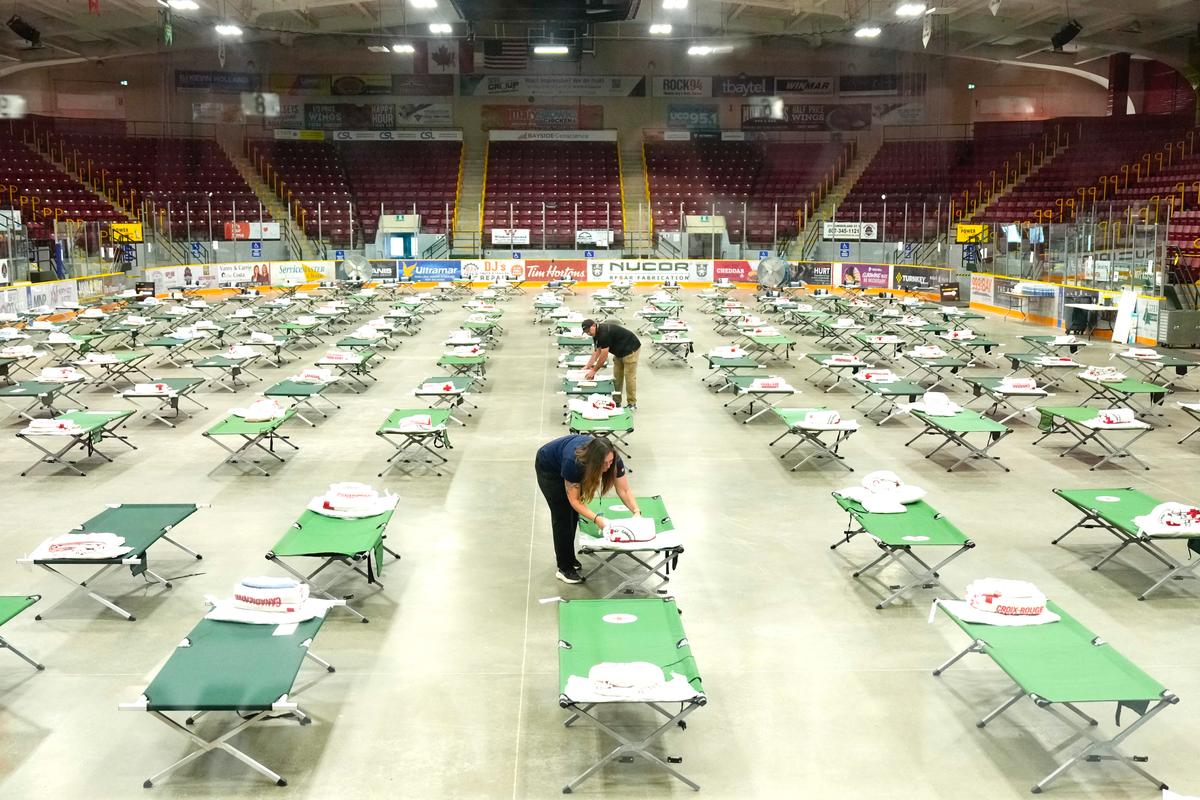
Brulé said the outpouring of support comes at a time when bad news routinely dominates television and social media feeds, but people rarely have an opportunity to make a tangible difference.Individuals are not the only ones responding to the needs of communities such as Namaygoosisagagun First Nation and Whitewater Lake First Nation, where vital infrastructure and homes were destroyed by the wildfires.
Companies, service clubs, unions, and community and church groups from across Canada have also stepped forward, making donations of $5,000 or $10,000, Brulé said.
One of the largest to date came from Toronto and Montreal-based Jewish charity The Azrieli Foundation, which has pledged to match every donation made to the fund as of July 31, dollar for dollar, up to a total of $50,000.Large donations of thousands of dollars are exciting, Brulé said, but noted that smaller amounts are the backbone of the campaign. The fund has received more than 700 donations from individuals so far, and Brulé said these are just as crucial as the large sums given by groups.
“Every gift sends that same message of: ‘we care. You’re not alone’,” he said, adding that no amount is too small and people should give according to their means.
“We have donations of $5, of $10, $25, $50, Every dollar makes a difference.”
Thunder Bay United Way remains in regular contact with First Nations leaders whose communities have been devastated by the wildfires. Brulé said donations of food, clothing, and household goods have been abundant, but what is needed now is financial support to begin rebuilding.
Brulé said he anticipates the United Way fund, and others like it, will be active for several years as several fire-ravaged communities focus on long-term recovery and rebuilding.
“So give early, give often because it just feels good,” he added. “I think it’s actually good for the soul, and it certainly will make a difference for those that benefit.”